
UPSC Mapping
| Prelims | Bankers’ Books Evidence Bill, Digital Evidence, Section 63 Certificate |
|---|---|
| Mains | GS Paper II – Judiciary, Governance, Digital Rights and Data Protection |
What is Bankers’ Books Evidence?
Bankers’ Books Evidence refers to the legal framework governing the use of bank records as evidence before courts. The earlier law, enacted in 1891, allowed certified copies of banking records to be produced instead of requiring bank officials to physically bring original ledgers to court.
This arrangement reduced the burden on banks and courts because financial institutions could certify relevant records rather than repeatedly producing original books. The framework was designed for a period when banking records were largely maintained in physical written form.
The transformation of banking through computers, electronic databases, digital transactions and cloud-based systems has changed the nature of financial records. A modern evidentiary framework therefore needs to recognise how records are actually created, stored, retrieved and transmitted.
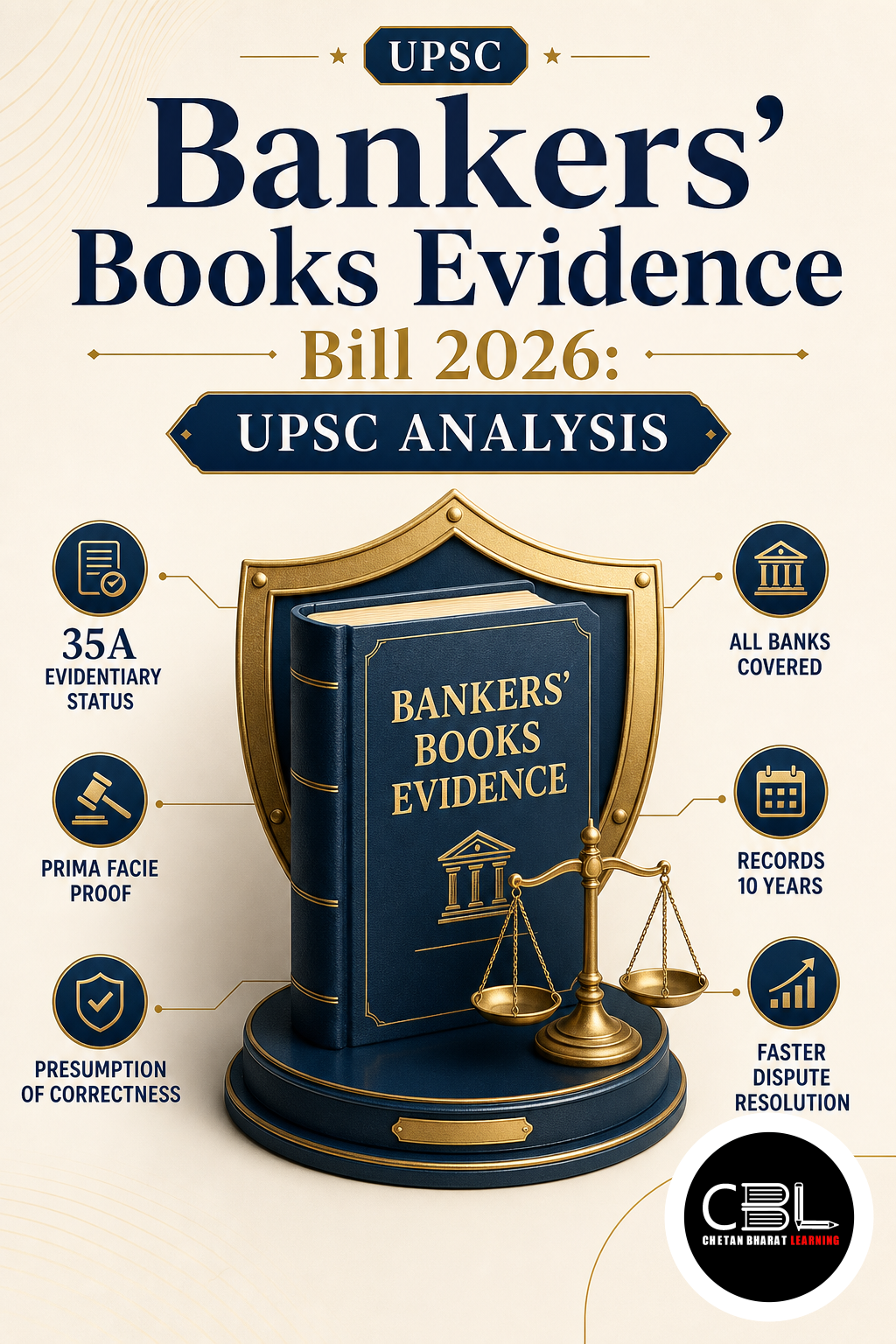
The proposed 2026 framework expands the concept of bankers’ books to include records maintained in electronic or digital form. It also recognises storage arrangements that may be onsite, offsite or located in virtual and cloud environments.
This shift is important because the evidentiary value of a digital record depends not merely on its existence but also on its authenticity, integrity and traceability. Courts need reasonable assurance that a record presented as evidence accurately represents the underlying banking record.
Why is Bankers’ Books Evidence in News?
The Lok Sabha has passed the Bankers’ Books Evidence Bill, 2026, which seeks to overhaul the colonial-era framework. The central objective is to bring evidentiary law into line with the realities of digital banking.
The existing 1891 law was drafted when banks predominantly maintained physical ledgers. The new Bill responds to a financial system where records can be generated and stored through interconnected digital systems, including offsite and cloud infrastructure.
A major reform is the introduction of defined certificate formats and conditions for presenting electronic bank records in court. The supplied material compares this approach with the certificate requirement for electronic evidence under Section 63 of the Bharatiya Sakshya Adhiniyam.
The Bill also clarifies the meaning of special cause, a phrase used in the old legislation without a statutory definition. This can reduce unnecessary demands on bank officials in cases where the bank is not a party to the proceedings.
The reform is particularly relevant to commercial litigation. If authenticated electronic records can be admitted efficiently, disputes such as cheque-related cases may require fewer appearances by bank officials and could potentially move through courts more quickly.
At the same time, the transition from physical records to easily transferable digital files creates new risks. A digital record can potentially be copied, transmitted or leaked much more easily than a physical ledger, making privacy and cybersecurity central concerns.
The issue is therefore important for UPSC because it links judicial reform, digital governance, financial technology and individual privacy. Official parliamentary and legislative information can be checked through the Parliament of India.
Key Features
- Expanded definition: Bankers’ books now cover electronic and digital records stored onsite, offsite or in virtual and cloud locations.
- Digital certification: The Bill provides specified certificate formats and conditions to establish the genuineness of electronic records.
- Special cause clarified: The Bill identifies situations involving doubtful accuracy, interrupted record-keeping or non-compliance with inspection orders.
- Reduced litigation burden: Properly certified digital records can reduce the need for bank officials to repeatedly appear in court.
- Investigation powers retained: The provision concerning production of bank records for investigations continues the power found in the 1891 framework.
Data Privacy and Digital Safeguards
The most important concern raised by experts is that the Bill modernises the form of evidence without providing equally detailed safeguards for the security of digital information.
One suggested safeguard is the use of hash values. A hash acts as a unique digital fingerprint of a file and can help establish whether the contents of an electronic record have changed after the hash was generated.
Such mechanisms can strengthen evidence integrity because courts may need to determine whether a digital document is the same file that existed at an earlier stage. Without reliable technical verification, parties may face difficulties in proving or challenging the authenticity of electronic records.
The absence of a specific data-protection framework within the Bill is another concern. Bank records can contain highly sensitive financial information, including transaction histories and other personal or commercial details.
Greater digital accessibility can increase efficiency, but it can also magnify the consequences of unauthorised access. A physical ledger requires physical handling, whereas an electronic file can potentially be copied and transmitted almost instantaneously.
This creates a need for a balanced framework in which accessibility of evidence and protection of financial data operate together. Judicial efficiency should not come at the cost of inadequate safeguards for sensitive information.
Challenges
- Evidence integrity: The absence of explicit hash-value requirements may make tamper detection more difficult in disputed digital records.
- Privacy risks: Rapid electronic access and sharing can increase the consequences of unauthorised disclosure of sensitive bank information.
- Certification burden: Branch-level certification of complex cybersecurity infrastructure may not match the technical expertise available at branch level.
- Financial-entity expansion: The Union government’s power to extend the framework to other financial entities raises questions about standards for digital lenders and fintech platforms.
- Transition disputes: Replacing the old Act may create interpretative questions about how the new provisions apply to ongoing trials and pending cases.
Way Forward
- Strengthen digital evidence safeguards with hash-based verification and secure audit trails.
- Adopt a modular certification system assigning responsibilities to technical officers and branch officials.
- Ensure clear legal procedures and oversight for investigative access to sensitive financial data.
- Define standards and accountability for fintech platforms and digital lenders included by notification.
- Provide explicit transitional provisions to guide pending and ongoing proceedings under the new law.
Prelims Practice Corner
Q1. The Bankers’ Books Evidence Bill, 2026 seeks to replace which legislation?
- (a) Banking Regulation Act, 1949
- (b) Bankers’ Books Evidence Act, 1891
- (c) Indian Evidence Act, 1872
- (d) Reserve Bank of India Act, 1934
Answer: (b) Bankers’ Books Evidence Act, 1891 — the Bill seeks to replace the colonial-era evidentiary framework for bank records.
Q2. Which of the following storage locations is recognised under the proposed expanded definition of bankers’ books?
- (a) Only physical branches
- (b) Only bank-owned servers
- (c) Onsite, offsite and virtual or cloud locations
- (d) Only microfilm archives
Answer: (c) Onsite, offsite and virtual or cloud locations — the Bill recognises contemporary digital storage arrangements.
Q3. Which of the following is identified as a situation constituting ‘special cause’?
- (a) A change in bank ownership
- (b) Doubt about the accuracy of a record
- (c) A rise in interest rates
- (d) Closure of a bank branch
Answer: (b) Doubt about the accuracy of a record — the Bill defines special cause through specified circumstances.
Q4. A hash value is primarily useful for establishing:
- (a) The market value of a bank
- (b) The identity of a borrower
- (c) The integrity of a digital file
- (d) The interest rate on a loan
Answer: (c) The integrity of a digital file — a hash can act as a digital fingerprint for detecting changes to electronic data.
Q5. The Bill’s provision concerning investigation-related production of bank records is described in the supplied material as:
- (a) A completely new police power
- (b) A power substantially similar to one under the 1891 Act
- (c) A power available only to private investigators
- (d) A power restricted to foreign banks
Answer: (b) A power substantially similar to one under the 1891 Act — the supplied material notes that the earlier law contained an identical provision.
Mains Practice Questions
Q1.
Discuss the significance of replacing the colonial-era Bankers’ Books Evidence Act, 1891 in the context of India’s digital banking transformation. (10 Marks)
Answer Structure:
- Intro: Explain the shift from physical banking records to electronic and cloud-based financial records.
- Body: Discuss the expanded definition, digital certification, clarification of special cause, reduced burden on bank officials and faster commercial litigation.
- Conclusion: Emphasise the need to align evidentiary law with technological change while preserving reliability and due process.
Q2.
The digitisation of evidence improves judicial efficiency but creates new privacy and cybersecurity risks. Examine in the context of the Bankers’ Books Evidence Bill, 2026. (15 Marks)
Answer Structure:
- Intro: Introduce the Bill as a technological update to the law governing bank records as evidence.
- Body: Cover digital accessibility, certificate-based authentication, hash values, data privacy, cybersecurity, certification responsibilities, investigative access and safeguards for fintech entities.
- Conclusion: Recommend a rights-compatible digital evidence framework combining efficiency, authenticity, privacy and institutional accountability.
FAQs on Bankers’ Books Evidence
Why does the Bankers’ Books Evidence Bill, 2026 replace the 1891 law?
The 1891 law was designed when banking records were predominantly physical. The new Bill seeks to recognise electronic, digital and cloud-based records and create procedures suited to contemporary banking.
What is the main concern about digital bank evidence?
The key concern is that digital records can be copied, transmitted or manipulated more easily than physical records. Experts have therefore called for stronger safeguards such as hash-based verification and clearer data-protection measures.
What does ‘special cause’ mean under the Bill?
The Bill defines special cause through specified circumstances, including doubts about record accuracy, interruption of regular record-keeping and disobedience of an inspection order. The clarification aims to reduce uncertainty when courts require bank records or witnesses.
Related Current Affairs
Preparing for UPSC, PCS or HCS?
Talk to a mentor at Chetan Bharat Learning, Chandigarh. Free guidance on choosing the right exam and building a study plan.
Chat on WhatsAppCall 97793 53345UPSC / IAS / PCS coaching in Chandigarh · Trusted by aspirants across Punjab & Haryana
Leave a Reply
You must be logged in to post a comment.