
UPSC Mapping
| Prelims | History & Culture |
|---|---|
| Mains | GS Paper 1 (Modern History & Culture) |
Quick Facts
| Birth | 31 May 1725 |
|---|---|
| Death | 13 August 1795 |
| Capital | Maheshwar |
Who was Ahilyabai Holkar?
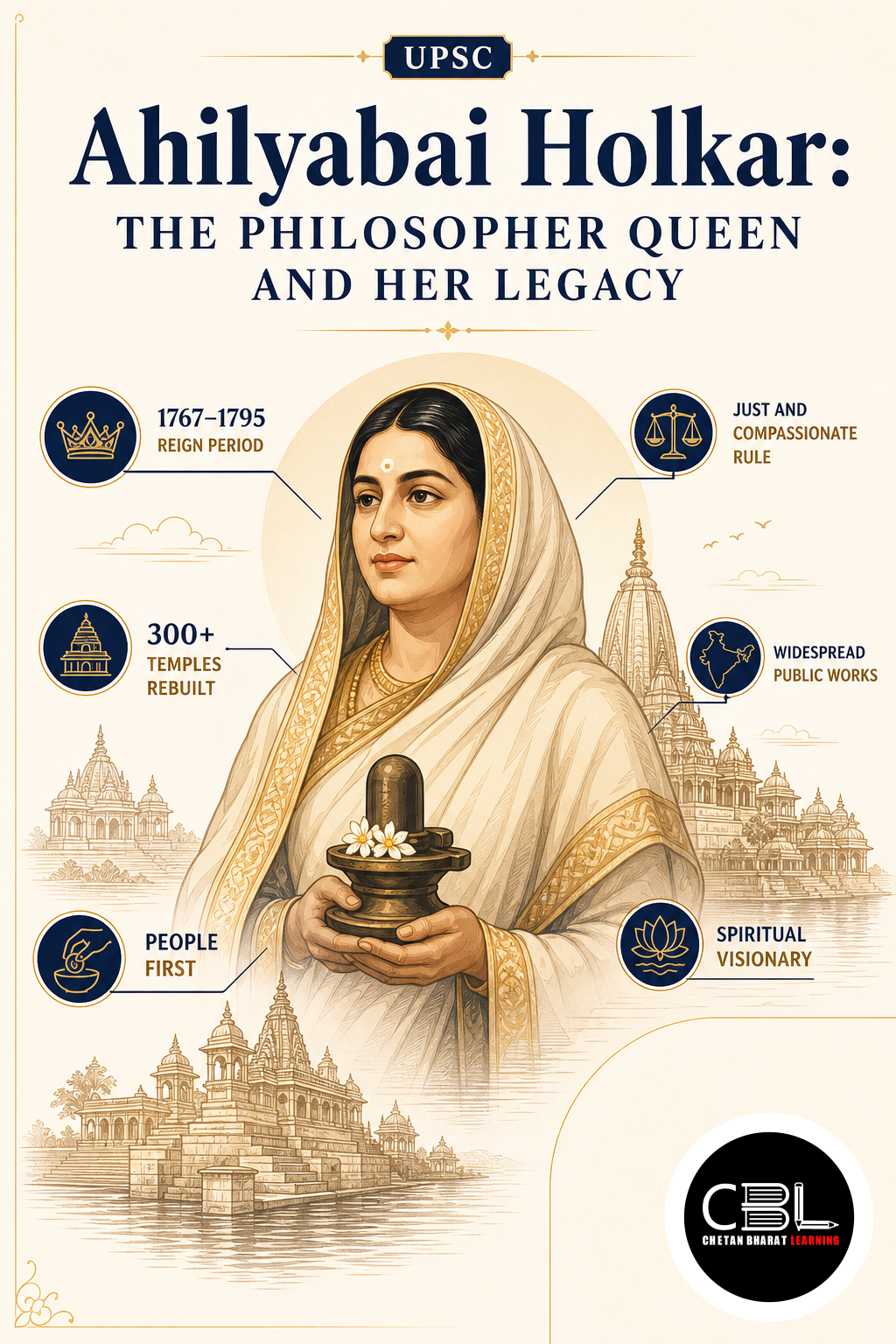
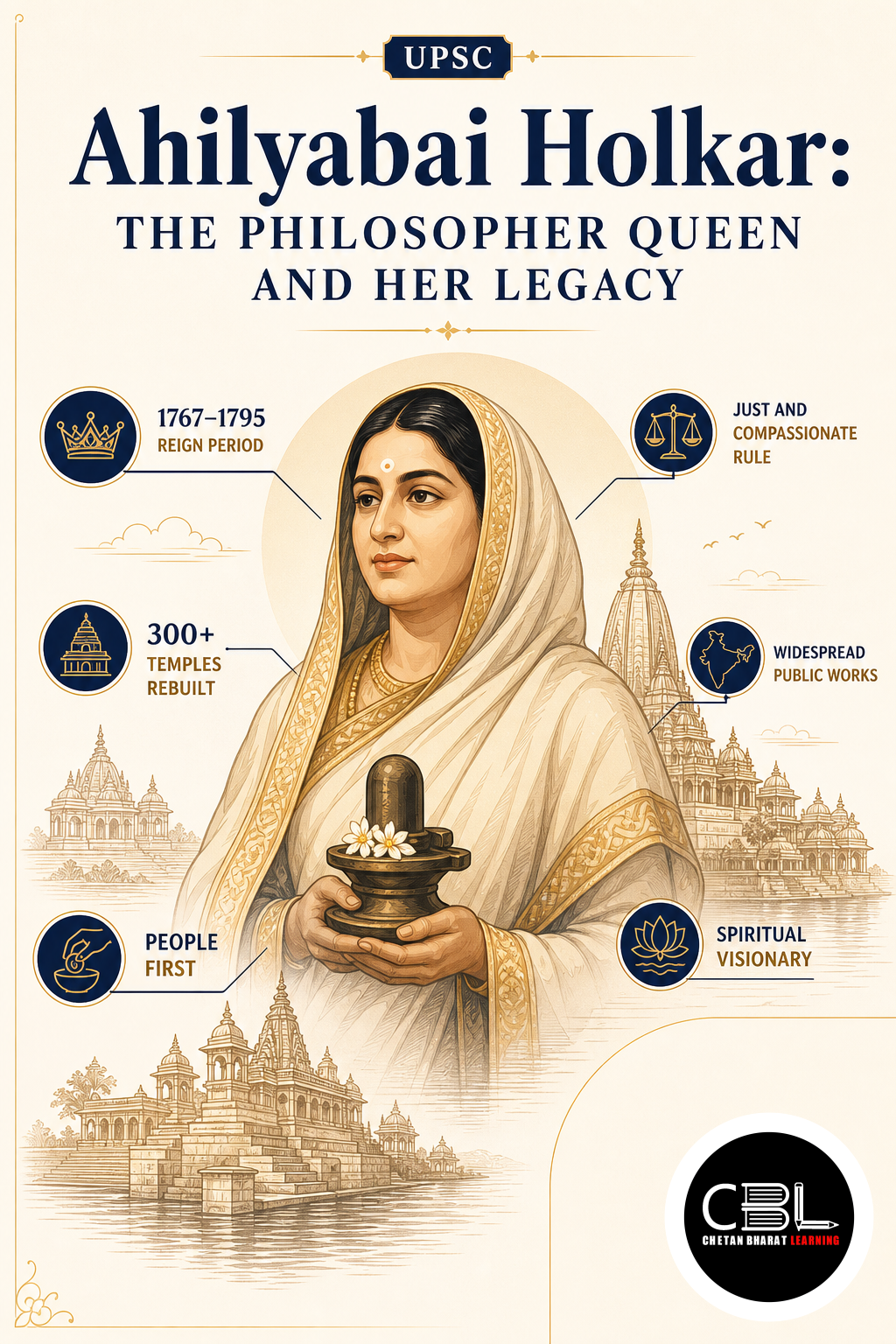
Ahilyabai Holkar (31 May 1725 – 13 August 1795) was an 18th-century Maratha queen who ruled the Malwa kingdom after the death of her husband, Khanderao Holkar, and her father-in-law, Malhar Rao Holkar. She is remembered as a just, capable, and visionary ruler who prioritised the welfare of her subjects.
She personally managed civil administration and state finances, while appointing military commander Tukoji Rao Holkar to command army operations. Her governance model ensured access to judicial sabhas, low taxes, and peaceful diplomacy. She viewed state revenue as a public trust and replaced capital punishment with economic rehabilitation.
Why is Ahilyabai Holkar in News?
Ahilyabai Holkar is in the news because the Union Home Minister paid tributes to her on her death anniversary on August 13. Her legacy is celebrated for her contributions to temple restoration, public works, women’s reforms, and tribal integration.
British historian John Keay called her “The Philosopher Queen,” and Jawaharlal Nehru described her as ‘a very able ruler and organizer’. Her public works programme created a pan-Indian network of ghats, wells, roads, and dharmashalas from Kedarnath to Rameswaram. For more details, refer to this PIB release.
Key Features of Ahilyabai Holkar’s Rule
- Dual Governance: She managed civil administration and finances, while delegating military command to Tukoji Rao.
- Temple Restoration: Rebuilt and restored sacred sites, including Varanasi’s Kashi Vishwanath Temple and Gujarat’s Somnath Temple.
- Public Works: Built a pan-Indian network of ghats, wells, roads, and dharmashalas.
- Economic Development: Established the Maheshwar textile industry, creating the Maheshwari Saree and supporting rural livelihoods.
- Women’s Reforms: Opposed forced Sati, protected childless widows’ inheritance rights, and advocated for raising the age of marriage for girls.
Challenges in Ahilyabai Holkar’s Era
- Maratha Politics: The Maratha Confederacy was factional, and she had to navigate complex power dynamics.
- Military Threats: She faced threats from rival Maratha chiefs, the Mughals, and the British East India Company.
- Succession: After her death, the Holkar dynasty faced succession disputes that weakened the kingdom.
- Economic Sustainability: Maintaining her extensive public works and temple restorations required careful fiscal management.
- Social Conservatism: Her reforms on women’s rights faced resistance from conservative sections of society.
Way Forward for Ahilyabai Holkar’s Legacy
To honour Ahilyabai Holkar’s legacy, her contributions to governance, women’s empowerment, and cultural preservation should be included in school and college curricula. Her Maheshwari saree industry and public works can be revived and promoted as part of heritage tourism.
Her governance model—emphasising public trust, low taxes, and judicial fairness—offers lessons for contemporary administration. Research and documentation of her administration, including her revenue policies and judicial sabhas, can enrich historical scholarship. For international perspectives on women in governance, refer to the UN Women.
Prelims Practice Corner
Q1. When was Ahilyabai Holkar born?
- (a) 31 May 1715
- (b) 31 May 1725
- (c) 31 May 1735
- (d) 31 May 1745
Answer: (b) She was born on 31 May 1725.
Q2. Which temple did Ahilyabai rebuild in Varanasi?
- (a) Somnath Temple
- (b) Kashi Vishwanath Temple
- (c) Kedarnath Temple
- (d) Rameswaram Temple
Answer: (b) She rebuilt Kashi Vishwanath Temple in Varanasi.
Q3. Who called Ahilyabai Holkar “The Philosopher Queen”?
- (a) Jawaharlal Nehru
- (b) John Keay
- (c) R.C. Majumdar
- (d) James Mill
Answer: (b) British historian John Keay called her “The Philosopher Queen.”
Q4. What was her capital?
- (a) Indore
- (b) Maheshwar
- (c) Ujjain
- (d) Pune
Answer: (b) Her capital was Maheshwar on the banks of the Narmada River.
Q5. Which textile industry did she establish?
- (a) Banarasi saree
- (b) Maheshwari saree
- (c) Kanjeevaram saree
- (d) Paithani saree
Answer: (b) She established the Maheshwar textile industry, known for Maheshwari sarees.
Mains Practice Questions
Q1. Discuss the contributions of Ahilyabai Holkar to the social and cultural life of 18th-century India. (250 words, 15 marks)
Answer Structure:
- Intro: Introduce Ahilyabai Holkar and her reign.
- Body: Discuss her temple restoration, public works, economic initiatives, women’s reforms, and tribal integration. Analyse her governance model and legacy.
- Conclusion: Emphasise her enduring relevance as a just and progressive ruler.
Q2. Evaluate the role of women rulers in medieval and early modern India, with reference to Ahilyabai Holkar. (150 words, 10 marks)
Answer Structure:
- Intro: Contextualise women rulers in Indian history.
- Body: Discuss Ahilyabai’s achievements alongside other rulers like Rani Durgavati and Razia Sultan. Highlight their contributions and the challenges they faced.
- Conclusion: Conclude that women rulers often brought progressive governance and cultural patronage.
FAQs on Ahilyabai Holkar
Who was Ahilyabai Holkar?
She was an 18th-century Maratha queen who ruled the Malwa kingdom, known for her just governance, temple restoration, public works, and women’s reforms.
What are her major contributions?
She rebuilt Kashi Vishwanath and Somnath temples, built a pan-India network of dharmashalas and wells, established Maheshwari textile industry, and opposed forced Sati.
What was her governance style?
She personally managed civil administration and finances, delegated military command, ensured low taxes, and viewed state revenue as a public trust.
Related Current Affairs
Preparing for UPSC, PCS or HCS?
Talk to a mentor at Chetan Bharat Learning, Chandigarh. Free guidance on choosing the right exam and building a study plan.
Chat on WhatsAppCall 97793 53345UPSC / IAS / PCS coaching in Chandigarh · Trusted by aspirants across Punjab & Haryana
Leave a Reply
You must be logged in to post a comment.