

UPSC Mapping
| Prelims | Neutrinos, Cherenkov Radiation and IceCube |
|---|---|
| Mains | GS Paper III: Science and Technology |
Quick Facts
| Laureate | Francis Halzen |
|---|---|
| Observatory | IceCube |
| Location | South Pole |
| Sensors | 5,160 Optical Modules |
What is the Nobel Physics Prize?
The Nobel Physics Prize is awarded by the Royal Swedish Academy of Sciences for discoveries or inventions of exceptional importance in physics. In 2026, the Academy selected Belgian-born particle physicist Francis Halzen, a professor at the University of Wisconsin–Madison. The citation recognises his decisive contributions to the IceCube Neutrino Observatory and the discovery of high-energy neutrinos from astrophysical sources.
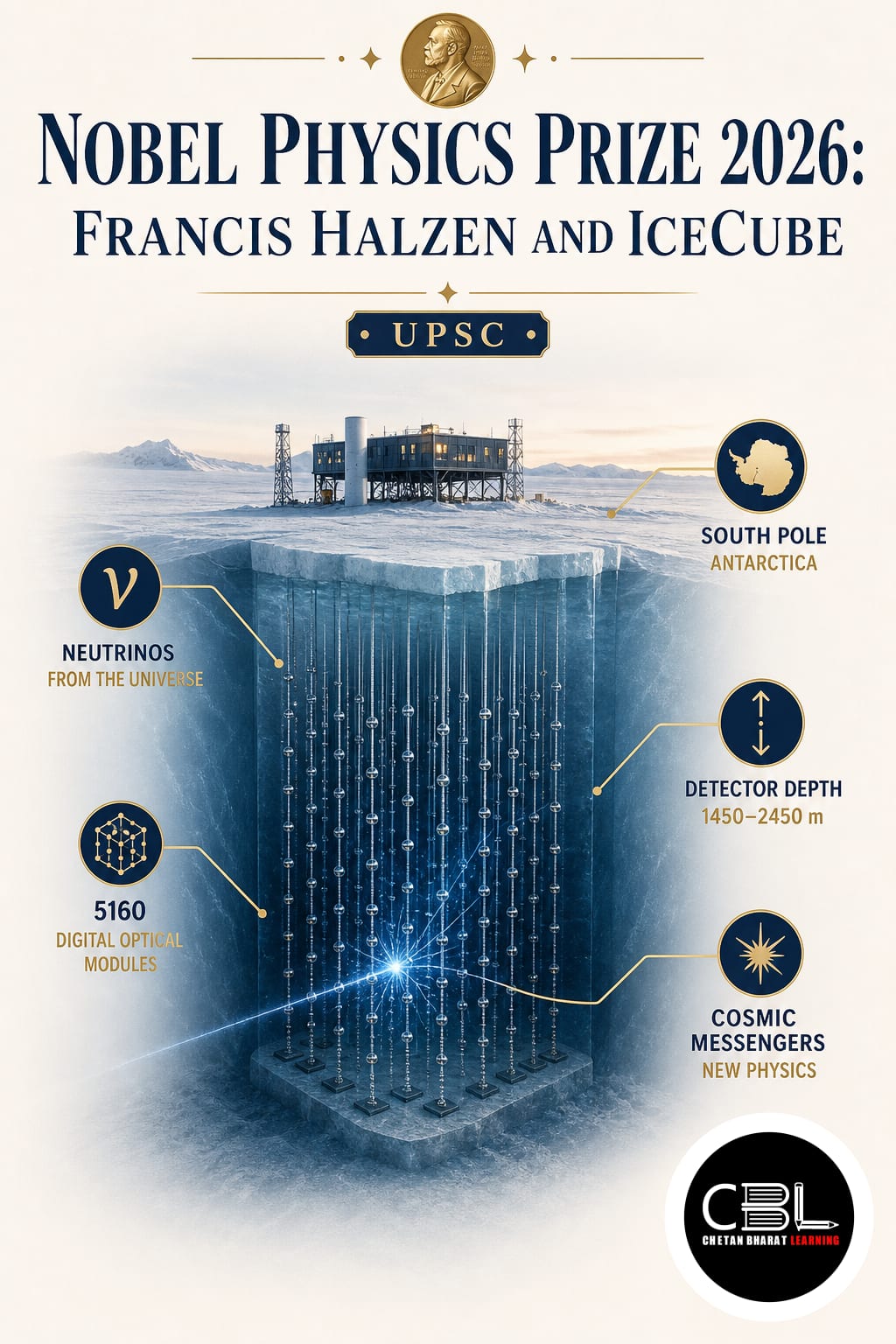
Halzen proposed using exceptionally clear glacial ice deep beneath the South Pole as a vast natural detector. He then helped turn that concept into an international scientific facility capable of observing rare particle interactions across roughly a cubic kilometre of ice. The achievement established neutrino astronomy as an important branch of observational science.
Why is the Nobel Physics Prize in News?
The Nobel Physics Prize entered the news after the Academy announced Francis Halzen as the sole 2026 laureate. The award highlights both his original detector vision and his sustained scientific leadership in developing IceCube. Official news reports note the connection between IceCube and the detection of high-energy neutrinos of astrophysical origin.
The recognition matters because neutrinos can travel through dense matter and vast cosmic distances with little disturbance. Unlike charged cosmic rays, they do not bend significantly in magnetic fields, so their arrival directions can retain information about their sources. Scientists can therefore use them as cosmic messengers from extreme environments such as active galaxies and stellar explosions.
Key Features
The discovery combines particle physics, Antarctic engineering, large-scale computing and observational astronomy.
- Cubic-kilometre detector: IceCube instruments a vast volume of deep Antarctic ice, giving scientists sufficient target material to capture extremely rare neutrino interactions.
- Optical sensor network: The observatory uses 5,160 digital optical modules placed along vertical strings to detect faint flashes produced inside the ice.
- Cherenkov radiation: Charged particles created by neutrino interactions emit blue light when moving faster than light’s phase velocity through ice, though never faster than light in vacuum.
- Directional reconstruction: Differences in the arrival time and intensity of detected light help computers estimate a neutrino’s energy, path and possible celestial origin.
- Multi-messenger role: Neutrino observations can be combined with electromagnetic radiation, cosmic rays and gravitational waves to study the same energetic event from complementary perspectives.
Challenges
Neutrino research must overcome rare interactions, difficult calibration, uncertain source identification and demanding polar operations.
- Weak interaction: Most neutrinos pass through Earth without colliding, requiring enormous detectors and long observation periods to collect meaningful samples.
- Background noise: Atmospheric muons and neutrinos greatly outnumber astrophysical events, making accurate classification and statistical confidence essential.
- Source uncertainty: Angular resolution varies by event type, and many detected neutrinos cannot yet be linked confidently to a specific astronomical object.
- Harsh environment: Installation, repair and data systems must function in remote Antarctic conditions where buried optical modules cannot be physically retrieved easily.
- Model dependence: Researchers rely on simulations of particle showers, light propagation and ice properties, so calibration errors can affect reconstructed energies and directions.
Way Forward
Future observatories should expand instrumented volumes, improve optical sensors and refine machine-learning tools for faster event reconstruction. Planned upgrades can increase sensitivity to fainter sources and improve measurements across a wider energy range, including lower-energy neutrinos relevant to particle properties and ultra-high-energy events linked with the most powerful cosmic accelerators. Coordination with gamma-ray, radio, optical and gravitational-wave facilities will help verify sources through simultaneous observations rather than isolated signals, improving confidence when several independent messengers point towards the same transient or persistent source.
India can strengthen participation through detector research, theoretical modelling, high-performance computing and collaboration in international neutrino projects across diverse scientific institutions worldwide. Training students across physics, astronomy, electronics and data science will build capacity for future facilities. The official Nobel summary shows how sustained investment in fundamental science can create an entirely new way of observing the universe.
Prelims Practice Corner
Q1. Who received the 2026 physics award?
(a) Francis Halzen (b) Peter Higgs (c) Roger Penrose (d) Alain Aspect
Answer
Francis Halzen received the award for contributions to IceCube and astrophysical neutrino discovery.
Q2. IceCube primarily detects neutrinos through:
(a) Radioactive decay heat (b) Cherenkov light (c) Gravitational lensing (d) Nuclear fission
Answer
Optical modules detect Cherenkov light from charged particles produced in neutrino interactions.
Q3. Which statement about neutrinos is correct?
(a) They carry electric charge (b) They are strongly deflected by magnetic fields (c) They interact weakly with matter (d) They have only one flavour
Answer
Their weak interaction allows most neutrinos to cross matter without collision.
Q4. IceCube is located at the:
(a) Equator (b) South Pole (c) Atacama Desert (d) Mediterranean coast
Answer
Its optical sensors are embedded deep in Antarctic ice near the South Pole.
Q5. Which is not one of the three neutrino flavours?
(a) Electron (b) Muon (c) Tau (d) Proton
Answer
Proton is a composite hadron, while electron, muon and tau are neutrino flavours.
Mains Practice Questions
Q1. Explain how the IceCube Observatory has expanded humanity’s ability to study high-energy cosmic events. (250 words, 15 marks)
- Intro: Introduce neutrinos as weakly interacting cosmic messengers.
- Body: Explain the ice detector, Cherenkov light, source tracing and multi-messenger significance.
- Conclusion: Link IceCube with a new observational window on the universe.
Q2. What challenges arise in detecting astrophysical neutrinos, and how can future facilities address them? (150 words, 10 marks)
- Intro: State why weak interaction makes neutrinos valuable but elusive.
- Body: Cover rarity, background noise, calibration, source uncertainty and polar operations.
- Conclusion: Recommend larger detectors, better algorithms and coordinated observations.
FAQs on Nobel Physics Prize
Why did Francis Halzen receive the 2026 award?
He made decisive contributions to the IceCube Neutrino Observatory and the discovery of high-energy neutrinos originating beyond Earth. His work established neutrino astronomy on an unprecedented scale.
Do particles in IceCube travel faster than light?
They can travel faster than light’s phase velocity in ice but not faster than light in vacuum. This produces the detectable Cherenkov radiation.
Why are neutrinos called ghost particles?
Neutrinos carry no electric charge and interact extremely weakly with matter. Vast numbers can pass through Earth without producing a detectable particle interaction.
Related Current Affairs
Preparing for UPSC, PCS or HCS?
Talk to a mentor at Chetan Bharat Learning, Chandigarh. Free guidance on choosing the right exam and building a study plan.
Chat on WhatsAppCall 97793 53345UPSC / IAS / PCS coaching in Chandigarh · Trusted by aspirants across Punjab & Haryana
Leave a Reply
You must be logged in to post a comment.