
UPSC Mapping
- Prelims: OECD, GDP and Economic Indicators
- Mains: GS Paper III: Indian Economy and Inclusive Growth
Quick Facts
| FY 2025–26 | 7.8% |
|---|---|
| FY 2026–27 | 7.1% |
| FY 2027–28 | 6.5% |
| Forecasting Agency | OECD |
What is India Growth Forecast?
India Growth Forecast represents an estimate of the expected change in the country’s real gross domestic product. Real GDP measures the value of final goods and services after adjusting for price changes. Forecasting institutions examine consumption, investment, government expenditure, trade, inflation, financial conditions and global developments. They periodically revise projections when economic data or underlying assumptions change.
India reports most official economic indicators according to an April-to-March financial year. International comparisons require care because several economies and institutions use calendar-year estimates. A growth projection is a baseline assessment, not a guaranteed outcome. Unexpected energy disruptions, weak monsoons, financial instability or policy changes can alter actual performance. Forecasts remain useful because they guide budgets, investment decisions, monetary policy and business planning.
Why is India Growth Forecast in News?
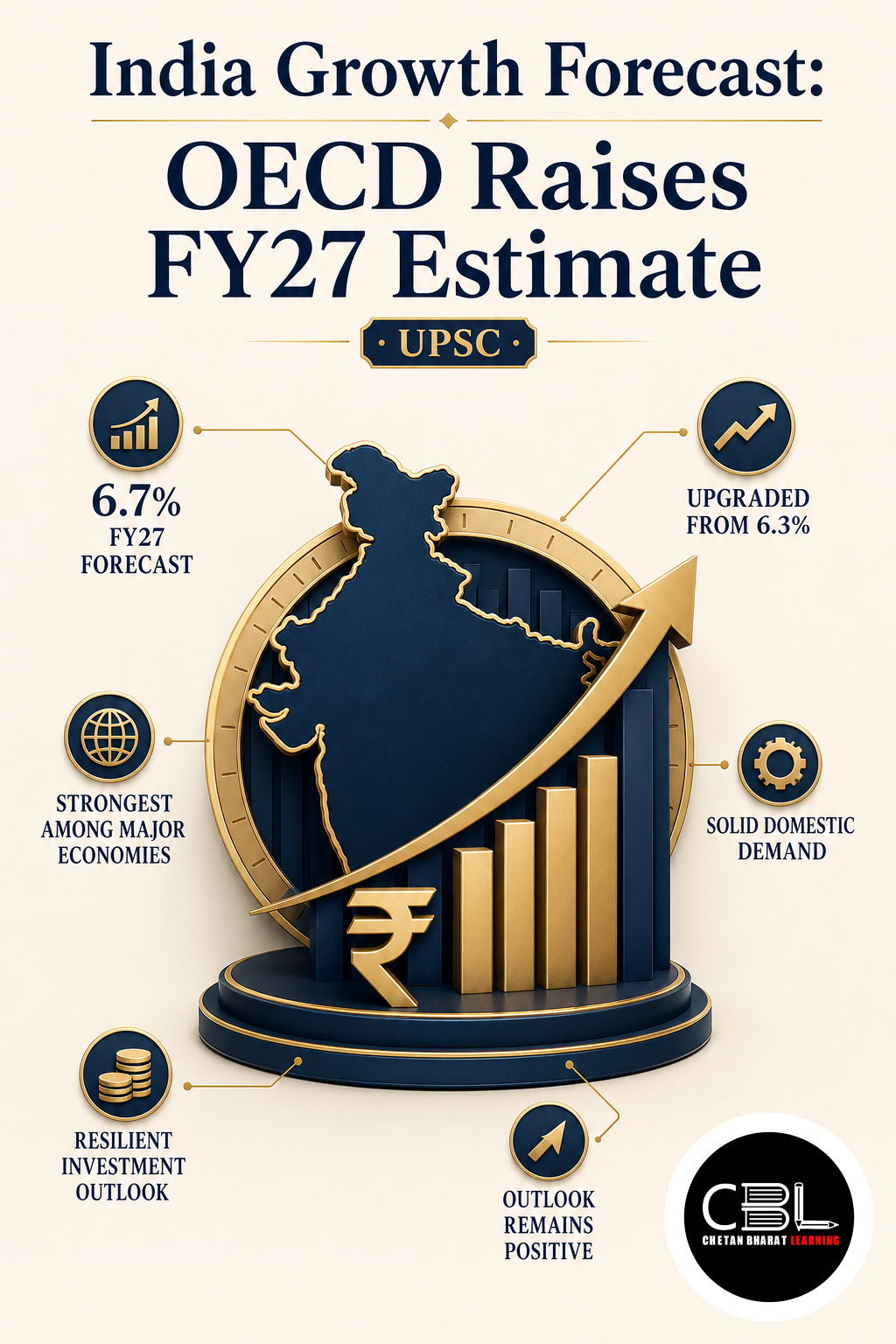
India Growth Forecast entered the news after the OECD released its September 2026 Interim Economic Outlook. The organisation projected real GDP expansion of 7.1% during FY 2026–27. It expects growth to moderate further to 6.5% during FY 2027–28, following an estimated 7.8% expansion in FY 2025–26. The OECD interim outlook provides the underlying international assessment.
The OECD attributed India’s resilience to domestic demand and policies that protected households and businesses from rising global energy costs. Consumption and public support helped contain the immediate impact of external supply disruptions. The organisation nevertheless expects momentum to weaken during the latter part of 2026. Persistent inflation can reduce purchasing power, while weather-related agricultural risks may affect food production and rural incomes.
Key Features
The revised outlook combines strong near-term activity with a gradual moderation in subsequent years.
- Upward revision: India Growth Forecast for FY 2026–27 was raised to 7.1% after stronger-than-expected economic momentum.
- Consumption support: Household spending remains an important driver because India’s large domestic market reduces complete dependence on exports.
- Policy cushioning: Government price-support measures limited the immediate burden of higher energy costs on consumers and businesses.
- Expected moderation: Growth is projected to slow from 7.8% in FY 2025–26 to 6.5% in FY 2027–28.
- External resilience: Domestic activity has partly offset weaker global demand, geopolitical uncertainty and disruptions in international energy markets.
The forecast does not mean that every economic sector will expand at the same rate. Services, construction, manufacturing and agriculture respond differently to interest rates, demand and weather conditions. Headline GDP also does not directly measure income distribution, job quality or environmental sustainability. Policymakers must examine per-capita income, employment, household consumption and sectoral productivity alongside aggregate output.
Challenges
India must manage several domestic and external risks to convert projected growth into durable development.
- Inflation pressure: Expensive food and energy can reduce real household incomes and weaken discretionary consumption.
- Agricultural vulnerability: Irregular rainfall, extreme heat and other weather events can lower output and increase rural distress.
- Energy dependence: Large imports of crude oil and gas expose growth, inflation and the current account to global shocks.
- Employment gap: Rapid GDP expansion may not generate sufficient formal and productive jobs for a growing workforce.
- Global uncertainty: Trade restrictions, geopolitical conflicts and tighter financial conditions can affect exports, investment and capital flows.
Government support can protect vulnerable households during temporary shocks, but broad subsidies create fiscal costs. Poorly targeted measures may benefit higher-income consumers while reducing resources for health, education and infrastructure. Higher inflation can also constrain the Reserve Bank of India’s ability to support demand through lower interest rates. The central challenge involves balancing price stability, fiscal discipline and growth.
Way Forward
Sustaining the India Growth Forecast requires policies that strengthen productive capacity rather than only supporting short-term demand. Public expenditure should prioritise transport, clean energy, irrigation, education and urban infrastructure with measurable economic returns. Stable regulations and faster contract enforcement can encourage private investment. India must also improve manufacturing competitiveness, logistics and participation in diversified global value chains.
Employment-intensive sectors need better credit, technology, skills and market access, particularly for micro and small enterprises. Agricultural reforms should expand irrigation efficiency, climate-resilient crops, storage and transparent markets. Targeted social protection can preserve consumption without creating unsustainable fiscal burdens. The Reserve Bank of India must continue balancing inflation risks with financial stability and growth conditions. Durable progress ultimately requires higher productivity, broader employment and improvements in household welfare.
Prelims Practice Corner
- Q1. What growth rate did the OECD project for India during FY 2026–27?
(a) 5.1% (b) 6.0% (c) 7.1% (d) 8.5%
Answer: (c) The September 2026 interim outlook projected 7.1% real GDP growth. - Q2. India’s financial year ordinarily covers which period?
(a) January–December (b) April–March (c) July–June (d) October–September
Answer: (b) India’s official financial year begins in April and ends in March. - Q3. Real GDP differs from nominal GDP because real GDP adjusts for which factor?
(a) Price changes (b) Political boundaries (c) Population alone (d) Foreign reserves only
Answer: (a) Real GDP adjusts output values for changes in the general price level. - Q4. India holds which status within the OECD?
(a) Founding member (b) Full member (c) Key Partner (d) Suspended member
Answer: (c) India is an OECD Key Partner but not a full member. - Q5. Consider the following statements:
1. A GDP projection guarantees the final growth outcome.
2. Weather shocks can affect growth through agriculture and inflation.
Which is correct?
(a) 1 only (b) 2 only (c) Both 1 and 2 (d) Neither 1 nor 2
Answer: (b) Forecasts remain conditional, while weather can influence output, prices and rural incomes.
Mains Practice Questions
- Q1. Strong GDP growth does not necessarily produce inclusive economic development. Discuss in the Indian context. (250 words, 15 marks)
- Intro: Distinguish aggregate output growth from broader improvements in human welfare.
- Body: Examine employment, inequality, inflation, regional disparities, productivity and access to public services.
- Conclusion: Advocate employment-rich growth supported by skills, social investment and productive infrastructure.
- Q2. Domestic demand has strengthened India’s resilience against recent global economic shocks. Examine. (150 words, 10 marks)
- Intro: Explain the contribution of consumption and investment to India’s GDP.
- Body: Cover market size, policy support, services, investment and continuing energy and trade vulnerabilities.
- Conclusion: Recommend stronger productivity and diversified external linkages alongside domestic demand.
FAQs on India Growth Forecast
- Why did the OECD raise India’s FY27 projection?
- The organisation cited stronger economic momentum, resilient domestic demand and government energy-support measures. These factors cushioned households and firms from external price shocks.
- Why can actual GDP growth differ from a forecast?
- Forecasts rely on assumptions regarding inflation, energy prices, rainfall, trade and policy. Unexpected changes in these conditions can alter the final outcome.
- Is India a member of the OECD?
- India is not a full OECD member. It participates as a Key Partner in selected committees, policy discussions and international initiatives.
Related Current Affairs
Preparing for UPSC, PCS or HCS?
Talk to a mentor at Chetan Bharat Learning, Chandigarh. Free guidance on choosing the right exam and building a study plan.
Chat on WhatsAppCall 97793 53345UPSC / IAS / PCS coaching in Chandigarh · Trusted by aspirants across Punjab & Haryana
Leave a Reply
You must be logged in to post a comment.