
UPSC Mapping
| Mapping | Detail |
|---|---|
| Prelims | Article 324 and Election Commission |
| Mains | GS Paper II – Polity and Governance |
| Constitutional Basis | Article 324 |
| Enacted | 2023 |
| Effective From | 2 January 2024 |
| Appointing Authority | President of India |
Article
What is EC Appointment Law?
The EC Appointment Law refers to the Chief Election Commissioner and Other Election Commissioners (Appointment, Conditions of Service and Term of Office) Act, 2023. Parliament enacted it under Article 324(2), which authorises the President to appoint commissioners subject to any parliamentary law. The statute replaced the earlier framework that primarily governed service conditions without prescribing a detailed appointment process.
The Act creates separate search and selection committees for recommending candidates. It also regulates eligibility, tenure, salary, reappointment and removal while preserving the President’s formal appointment power. The law became operational on 2 January 2024 and now governs appointments to the Election Commission of India.
Why is EC Appointment Law in News?
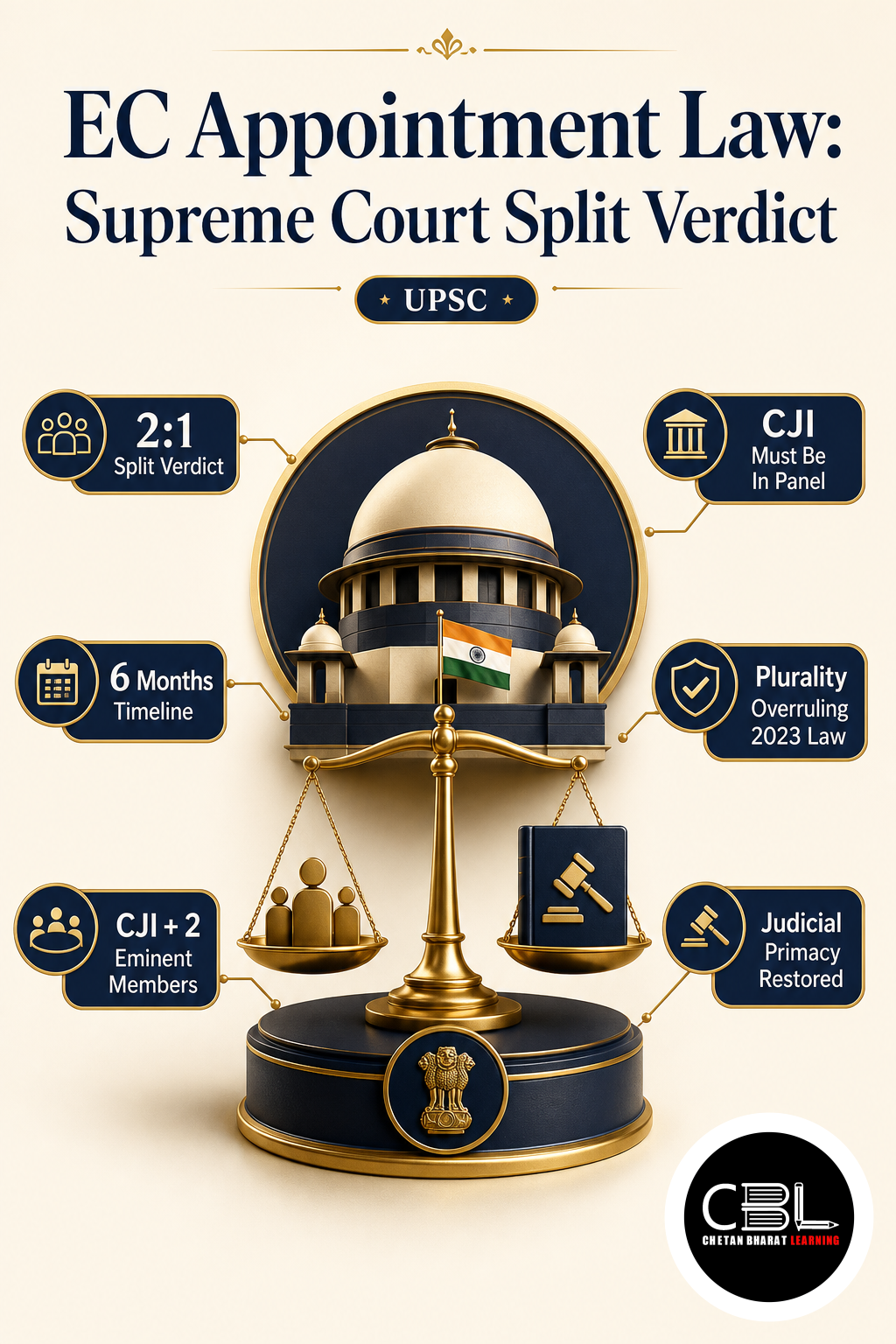
The EC Appointment Law returned to the news after a two-judge Supreme Court Bench delivered a split verdict on 23 September 2026. Justice Dipankar Datta rejected the request to refer the constitutional challenge to a five-judge Bench, while Justice Satish Chandra Sharma favoured referral. The judges directed the Registry to place the papers before the Chief Justice of India for considering an appropriate Constitution Bench.
The petitions challenge Section 7 and connected provisions, particularly the replacement of the Chief Justice with a Union Cabinet Minister on the selection committee. Petitioners argue that the arrangement gives the political executive a structural majority and may weaken institutional independence. The Centre maintains that Article 324 expressly permits Parliament to design the statutory process and does not require judicial membership.
The Supreme Court had earlier refused to stay the law or completed appointments during the 2024 general election period. Its March 2024 order nevertheless stressed procedural fairness, adequate candidate information and meaningful deliberation. The final constitutional validity of the contested provisions remains undecided.
Key Features
The statutory framework combines executive selection, opposition participation and formal presidential appointment.
- Selection committee: The Prime Minister chairs a three-member panel containing a Union Cabinet Minister nominated by the Prime Minister and the Leader of Opposition in the Lok Sabha.
- Opposition representation: When the Lok Sabha lacks a formally recognised Opposition Leader, the leader of the largest opposition party performs that statutory role.
- Search mechanism: A committee headed by the Union Law Minister identifies five eligible candidates for consideration, although the selection committee may consider another qualified person.
- Eligibility standard: Candidates must hold or have held a position equivalent to Union Government Secretary and possess integrity with election-management knowledge and experience.
- Tenure and service: Commissioners serve for six years or until attaining 65 years, whichever occurs earlier, and cannot receive reappointment after completing their term.
The President appoints the recommended candidate after the committee completes its process. A vacancy or defect in the selection committee does not automatically invalidate its recommendation. The official India Code repository provides the enacted legislation and its notified provisions.
Challenges
The dispute raises questions about electoral credibility, separation of powers and the limits of judicial review.
- Executive majority: The Prime Minister and a nominated Cabinet Minister can form a two‐member majority, reducing the practical influence of the Opposition representative during selection.
- Perceived independence: Election administrators regulate political parties and governments, making visible neutrality as important as personal integrity and legally correct decision‐making.
- Judgment‐legislation interface: The Anoop Baranwal arrangement expressly operated until Parliament enacted a law, creating disagreement over how strongly its independence principles constrain that legislation.
- Procedural transparency: Late circulation of candidate profiles, rapid shortlisting and limited public disclosure can prevent committee members from conducting informed and meaningful deliberations.
- Removal asymmetry: The Constitution protects the Chief Election Commissioner through a judge‐like removal process, while another commissioner can be removed on the Chief Election Commissioner’s recommendation.
The controversy also tests the distinction between institutional design and individual conduct. A commissioner may act independently despite executive participation, yet constitutional safeguards must address long‐term structural risks rather than depend entirely on personal virtue. Courts must examine these concerns without replacing Parliament’s policy choice merely because another model appears preferable.
The Election Commission supervises electoral rolls and elections to Parliament, state legislatures, and the offices of President and Vice‐President. Questions about its composition therefore affect public confidence in the wider democratic process. Related constitutional developments are available in CBL’s polity current affairs section.
Way Forward
Any review of the EC Appointment Law should protect both democratic accountability and operational independence. Parliament can strengthen procedural safeguards by prescribing adequate notice, reasoned shortlisting, documented evaluation criteria and timely circulation of candidate records. A published institutional procedure would improve confidence without disclosing confidential personal information.
Policymakers may also examine whether the selection body needs a more balanced composition or stronger consensus requirements. Commissioners require an independent secretariat, stable expenditure arrangements and clear post‐tenure restrictions alongside fair appointments. The Supreme Court should settle the constitutional questions promptly while respecting legislative competence and the basic requirement of free and fair elections.
Prelims Practice Corner
-
Q1. Which constitutional article governs the Election Commission of India?
- (a) Article 280
- (b) Article 315
- (c) Article 324
- (d) Article 356
Answer: (c) Article 324 governs the superintendence, direction and control of elections.
-
Q2. Who formally appoints the Chief Election Commissioner and other Election Commissioners?
- (a) Prime Minister
- (b) Parliament
- (c) Chief Justice of India
- (d) President of India
Answer: (d) Article 324(2) vests the formal appointment power in the President.
-
Q3. Which person is not a member of the selection committee under the 2023 Act?
- (a) Prime Minister
- (b) Chief Justice of India
- (c) Union Cabinet Minister
- (d) Leader of Opposition in Lok Sabha
Answer: (b) The 2023 Act does not include the Chief Justice on the statutory selection committee.
-
Q4. What is the maximum statutory age for holding office as an Election Commissioner?
- (a) 60 years
- (b) 62 years
- (c) 65 years
- (d) 70 years
Answer: (c) The tenure ends after six years or at 65 years, whichever occurs earlier.
-
Q5. The Anoop Baranwal judgment created an interim committee containing which three members?
- (a) President, Prime Minister and CJI
- (b) Prime Minister, Lok Sabha Speaker and CJI
- (c) Prime Minister, Lok Sabha Opposition Leader and CJI
- (d) Prime Minister, Law Minister and Attorney General
Answer: (c) The arrangement included the Prime Minister, Opposition Leader and Chief Justice until Parliament enacted a law.
Mains Practice Questions
-
Q1. Examine whether the appointment framework for Election Commissioners adequately protects institutional independence. (250 words, 15 marks)
Answer Structure:
- Intro: Explain Article 324 and the constitutional role of the Election Commission.
- Body: Assess committee composition, executive majority, opposition participation, procedural safeguards and removal protections.
- Conclusion: Recommend a transparent and balanced process preserving democratic accountability.
-
Q2. Discuss the constitutional relationship between the Anoop Baranwal judgment and Parliament’s 2023 legislation. (250 words, 15 marks)
Answer Structure:
- Intro: Describe the legislative vacuum addressed by the 2023 Constitution Bench judgment.
- Body: Examine Article 324(2), the temporary judicial arrangement, legislative competence and judicial review.
- Conclusion: Balance institutional independence with respect for constitutional separation of powers.
FAQs on EC Appointment Law
Why did the 2023 Act replace the Chief Justice on the committee?
The Anoop Baranwal committee operated only until Parliament enacted a law. Parliament subsequently chose a Cabinet Minister instead of the Chief Justice, and that choice now faces constitutional scrutiny.
Has the Supreme Court invalidated the 2023 Act?
No. The Court previously declined to stay the legislation, and the September 2026 split verdict concerned referral to a larger Bench. Its constitutional validity remains undecided.
How can the Chief Election Commissioner be removed?
The Constitution permits removal through a process and on grounds similar to those applicable to a Supreme Court judge. Other Election Commissioners can be removed only on the Chief Election Commissioner’s recommendation.
Related Current Affairs
Preparing for UPSC, PCS or HCS?
Talk to a mentor at Chetan Bharat Learning, Chandigarh. Free guidance on choosing the right exam and building a study plan.
Chat on WhatsAppCall 97793 53345UPSC / IAS / PCS coaching in Chandigarh · Trusted by aspirants across Punjab & Haryana
Leave a Reply
You must be logged in to post a comment.