
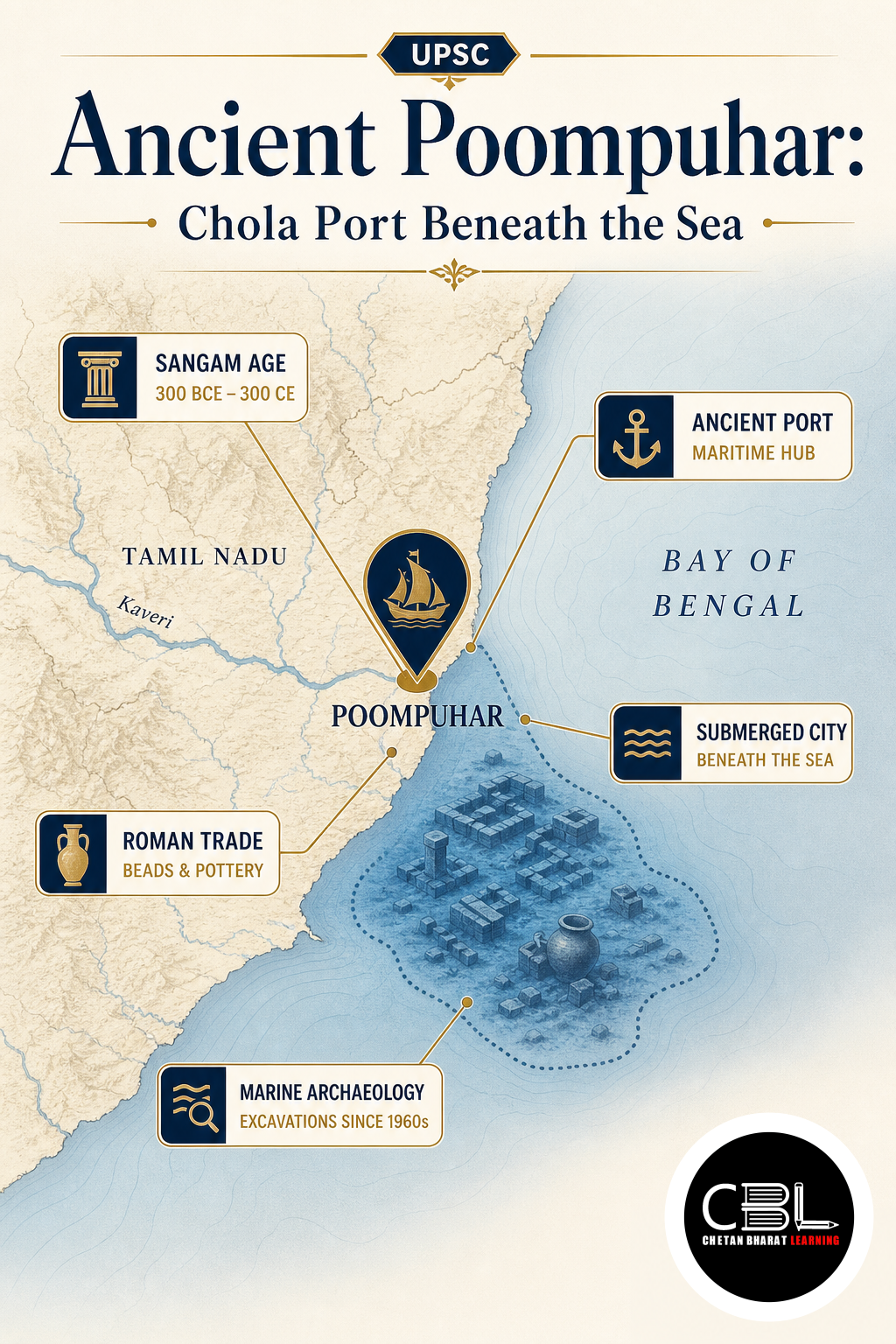
UPSC Mapping
| Prelims | Sangam Age, Cholas, Tamil Literature and Archaeological Sites |
|---|---|
| Mains | GS Paper I – Indian Heritage and Culture |
Quick Facts
| Present Location | Mayiladuthurai, Tamil Nadu |
|---|---|
| Other Names | Kaveripoompattinam and Kaveripattinam |
| Geographical Setting | Mouth of the Kaveri |
| Historical Association | Early Chola Dynasty |
What is Ancient Poompuhar?
Ancient Poompuhar was a prominent coastal settlement and port at the mouth of the Kaveri River in present-day Tamil Nadu. It faced the Bay of Bengal and connected the fertile Kaveri delta with wider maritime networks. Historical accounts identify it as an important port and secondary Chola capital.
The settlement flourished during the Sangam period, broadly placed between the third century BCE and third century CE. Its location allowed agricultural produce, textiles, crafts and imported goods to move between inland markets and overseas destinations. Literary and archaeological evidence together indicate a complex centre of trade and urban life.
Why is Ancient Poompuhar in News?
Ancient Poompuhar returned to attention after underwater archaeological exploration reportedly recovered over 200 artefacts. These finds offer additional material evidence for understanding the extent, chronology and commercial character of the port. Researchers can compare submerged remains with structures, artefacts and settlement traces identified on land.
The discoveries are significant because coastal erosion and marine processes submerged portions of the historical settlement. Scientific investigation can test literary descriptions without treating every narrative detail as established fact. The Tamil Nadu Department of Archaeology provides official information about the site and its marine archaeological heritage.
Key Features
The port’s importance emerges from its strategic location, literary prominence, planned settlement and extensive maritime connections.
- Kaveri estuary location: Ancient Poompuhar stood where the Kaveri entered the Bay of Bengal, allowing river-based transport to connect the productive interior with Indian Ocean trade routes.
- Maruvurpakkam sector: Tamil literary descriptions associate the coastal quarter with merchants, sailors, warehouses, craftspeople and activities linked directly with the harbour and overseas commerce.
- Pattinappakkam sector: The inland quarter reportedly contained royal, administrative and elite establishments, indicating functional differentiation within the wider urban settlement.
- Sangam literary presence: Pattinappalai describes the port’s economic and urban life, while Silappatikaram and Manimekalai connect the city with major narratives of classical Tamil literature.
- International maritime trade: Archaeological evidence and textual references indicate exchanges with Sri Lanka, West Asia and other Indian Ocean regions, demonstrating the outward orientation of early south Indian kingdoms.
Challenges
Research and conservation face coastal erosion, underwater visibility constraints and difficulties in establishing secure archaeological context.
- Changing coastline: Erosion, sediment movement, river processes and possible extreme marine events have repeatedly altered the coast, complicating efforts to reconstruct the settlement’s original extent.
- Underwater investigation: Strong currents, limited visibility and fragile submerged remains require specialised divers, sonar surveys, remotely operated equipment and carefully documented recovery methods.
- Dating and interpretation: Objects recovered from the seabed may have shifted from their original locations, making stratigraphy, scientific dating and comparative analysis essential before drawing historical conclusions.
- Conservation after recovery: Artefacts exposed to saline water can deteriorate quickly unless experts stabilise, desalinate, document and store them under controlled conditions.
- Development and tourism pressures: Coastal construction, unregulated visitor activity and pollution can damage archaeological deposits unless heritage planning informs local development; related topics appear in the history current affairs section.
Way Forward
Ancient Poompuhar requires an integrated research programme combining marine archaeology, coastal geomorphology, remote sensing, literary studies and scientific dating. Authorities should create a detailed geospatial inventory of underwater and terrestrial remains. Repeated surveys can record changes before erosion or human activity destroys additional evidence.
Recovered objects need specialised conservation laboratories, accessible catalogues and interpretation through museums and digital reconstructions. Local fishing communities can contribute knowledge of seabed features while participating in heritage tourism and site protection. The Marine Archaeological Museum can connect new discoveries with public education and responsible heritage management.
Prelims Practice Corner
Q1. Poompuhar is situated near the mouth of which river? (a) Vaigai (b) Kaveri (c) Krishna (d) Pennar
Show answer
Answer: (b) Poompuhar stands near the mouth of the Kaveri River on the Bay of Bengal.
Q2. Poompuhar was closely associated with which dynasty? (a) Early Cholas (b) Kushanas (c) Palas (d) Chalukyas of Badami
Show answer
Answer: (a) It served as an important port and secondary capital of the Early Chola dynasty.
Q3. Which literary works contain references to Poompuhar? (a) Silappatikaram and Manimekalai (b) Arthashastra and Mudrarakshasa (c) Harshacharita and Rajatarangini (d) Prithviraj Raso and Padmavat
Show answer
Answer: (a) Silappatikaram and Manimekalai prominently describe the city and its cultural setting.
Q4. Maruvurpakkam was primarily associated with which activities? (a) Royal administration (b) Maritime commerce and merchants (c) Forest-based hunting (d) Monastic agriculture
Show answer
Answer: (b) Maruvurpakkam was the coastal sector associated with merchants, sailors and maritime activity.
Q5. Consider the following statements: 1. Poompuhar is also known as Kaveripoompattinam. 2. Pattinappakkam represented the inland administrative sector. 3. The site lies on the Arabian Sea coast. Which statements are correct? (a) 1 only (b) 1 and 2 only (c) 2 and 3 only (d) 1, 2 and 3
Show answer
Answer: (b) Statements 1 and 2 are correct; the site faces the Bay of Bengal.
Mains Practice Questions
Q1.
Archaeological and literary evidence together make Poompuhar important for understanding early historic urbanisation and maritime trade in South India. Discuss. (250 words, 15 marks)
Answer Structure
- Intro: Locate the port at the Kaveri mouth and identify its Early Chola association.
- Body: Discuss maritime trade, urban sectors, Sangam literature, underwater remains and Indian Ocean connections.
- Conclusion: Emphasise interdisciplinary research for reconstructing India’s maritime past.
Q2.
Examine the challenges involved in investigating and preserving submerged archaeological heritage. (150 words, 10 marks)
Answer Structure
- Intro: Explain why underwater sites preserve valuable but fragile evidence.
- Body: Cover visibility, currents, dating, disturbed contexts, artefact conservation, documentation and coastal development.
- Conclusion: Recommend scientific surveys, specialised institutions and community-supported protection.
FAQs on Ancient Poompuhar
Where is Poompuhar located?
It is located in Mayiladuthurai district of Tamil Nadu near the Kaveri River’s mouth. The historical port faced the Bay of Bengal.
Why is Poompuhar important in Sangam literature?
Works such as Pattinappalai, Silappatikaram and Manimekalai describe its markets, harbour, social life and urban organisation. These accounts help historians interpret archaeological discoveries.
Why are parts of the historical settlement underwater?
Coastal erosion, marine processes and possible extreme events altered the shoreline over centuries. Underwater archaeology investigates the remains now lying beyond the present coast.
Related Current Affairs
Preparing for UPSC, PCS or HCS?
Talk to a mentor at Chetan Bharat Learning, Chandigarh. Free guidance on choosing the right exam and building a study plan.
Chat on WhatsAppCall 97793 53345UPSC / IAS / PCS coaching in Chandigarh · Trusted by aspirants across Punjab & Haryana
Leave a Reply
You must be logged in to post a comment.