
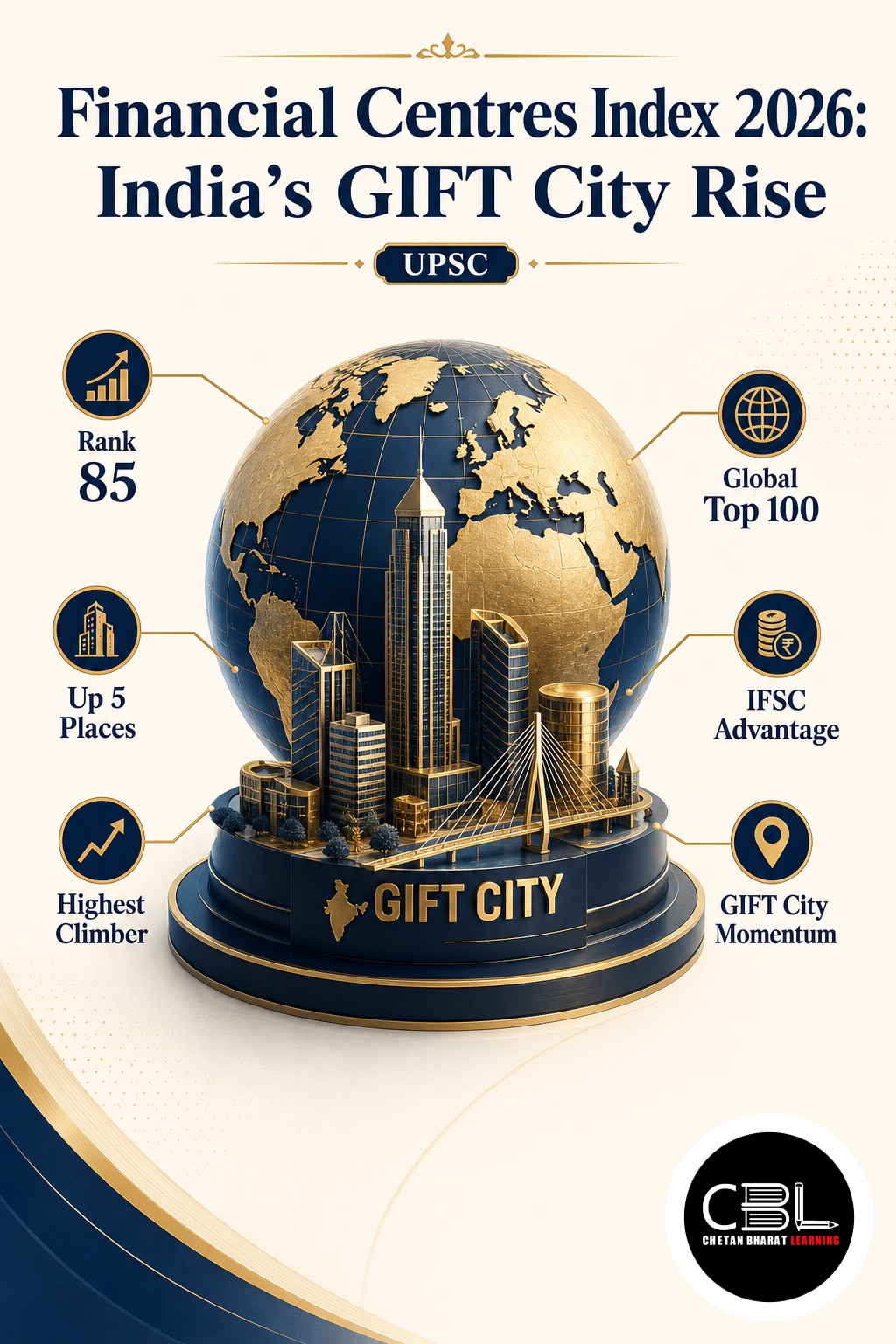
UPSC Mapping
Important for
- Prelims: GFCI 40, GIFT IFSC and IFSCA
- Mains: GS Paper III — Indian Economy and Infrastructure
Quick Facts
| Edition | GFCI 40 |
|---|---|
| Released | 16 September 2026 |
| Publishers | Z/Yen Partners and CDI |
| Centres Ranked | 117 |
| Leading Indian Centre | GIFT City — Rank 37 |
What is Financial Centres Index?
The Financial Centres Index, formally known as the GFCI, compares the competitiveness of major financial hubs. Z/Yen Partners in London produces it with the China Development Institute in Shenzhen, and the partners publish updates every March and September. Since its launch in 2007, the index has become a reference for governments, investors and institutions assessing where financial services can operate efficiently, innovate responsibly and connect with clients across jurisdictions.
The model combines instrumental factors from established external datasets with assessments submitted by financial-services professionals. Its broad competitiveness areas cover business environment, human capital, infrastructure, financial-sector development and reputation, bringing institutional quality and commercial capability into one comparative framework. A high rank therefore signals perceived overall competitiveness, not merely stock-market size, banking assets or one government’s policy performance; the result should always be read with its methodology, survey coverage and margins of uncertainty.
Why is Financial Centres Index in News?
The Financial Centres Index entered the news after GFCI 40 was released on 16 September 2026. The official report ranked 117 centres after researching 139 locations, using 144 instrumental factors and 39,531 assessments from 6,147 respondents. New York retained first place, followed by London, Hong Kong and Singapore, while six Asia-Pacific centres appeared in the global top ten.
India drew attention because GIFT City rose nine places to 37th, becoming the country’s highest-ranked centre and entering the Asia-Pacific top fifteen. Mumbai improved to 49th, Delhi stood at 56th, and GIFT City advanced to 26th in the separate FinTech ranking, strengthening its profile among investors and specialised financial-service providers. The movement indicates improving market perception, but it does not prove that every dimension of competitiveness has strengthened equally or that the centre has already matched the transaction depth of established global hubs.
Key Features
- Hybrid methodology: Combines quantitative indicators with professional assessments, balancing measurable conditions and market perceptions while reducing dependence on any single statistic or temporary market movement.
- Five competitiveness pillars: Business environment, human capital, infrastructure, financial-sector development and reputation capture the regulatory, institutional, technological and talent conditions supporting sophisticated cross-border activity.
- Dynamic survey base: Continuous online questionnaire with progressive weighting of responses, exclusion of home-centre assessments and qualifying thresholds that evolve with professional opinion.
- Sector and FinTech insights: Enables comparisons across banking, insurance, investment management, professional services and government functions, with a separate FinTech assessment for innovation ecosystems and digital infrastructure.
- Regional competition: Asian hubs gained prominence in GFCI 40, while established centres retained leadership through deep markets, predictable regulation and strong reputational networks.
Challenges
- Market depth and liquidity: Global institutions require broad capital markets, reliable price discovery, varied products and sufficient secondary-market liquidity before committing substantial balance sheets.
- Regulatory coordination: Cross-border finance connects banking, securities, insurance, pensions, taxation and foreign-exchange rules, requiring consistent coordination between IFSCA and domestic authorities.
- Specialised talent: India needs professionals in quantitative finance, international taxation, actuarial science, compliance, cybersecurity, fund management and emerging financial technologies.
- Infrastructure and resilience: Secure digital systems, low-latency connectivity, reliable utilities, transport links and tested cyber-resilience are essential to maintain international confidence and continuity.
- Ranking interpretation: Survey perceptions and model choices can change relative positions; policymakers should track real outcomes such as investment, employment, liquidity and innovation.
Way Forward
India should treat Financial Centres Index performance as a diagnostic signal, not an end in itself. GIFT IFSC needs stable rule-making, time-bound approvals, enforceable contracts, credible dispute resolution and proportionate supervision aligned with global standards.
Policymakers should deepen markets for bonds, funds, derivatives, insurance, reinsurance, aircraft and ship leasing while maintaining strong safeguards against money laundering, market abuse, conflicts of interest and systemic risk. The IFSCA institutional framework gives India a unified regulator for financial products, services and institutions within its international financial services centres, supporting transparent evaluation of economic benefits.
Prelims Practice Corner
Q1. The Global Financial Centres Index is produced by:
- (a) IMF and World Bank
- (b) Z/Yen Partners and China Development Institute
- (c) BIS and OECD
- (d) WTO and UNCTAD
Answer: (b) Z/Yen Partners produces the index in collaboration with the China Development Institute.
Q2. GFCI 40 ranked which centre first globally?
- (a) London
- (b) Hong Kong
- (c) New York
- (d) Singapore
Answer: (c) New York retained first position, followed by London, Hong Kong and Singapore.
Q3. Consider the following statements: 1. GFCI combines instrumental factors with professional assessments. 2. It is published once every five years. Which option is correct?
- (a) 1 only
- (b) 2 only
- (c) Both 1 and 2
- (d) Neither 1 nor 2
Answer: (a) The first statement is correct, while GFCI is updated every March and September.
Q4. Which institution regulates and develops financial services in India’s IFSC?
- (a) NITI Aayog
- (b) IFSCA
- (c) Finance Commission
- (d) Competition Commission of India
Answer: (b) IFSCA is the unified authority responsible for financial products, services and institutions in India’s IFSC.
Q5. GIFT City is located in:
- (a) Maharashtra
- (b) Gujarat
- (c) Karnataka
- (d) Telangana
Answer: (b) GIFT City is located at Gandhinagar in Gujarat.
Mains Practice Questions
Q1. Examine the significance of GIFT IFSC for India’s ambition to become a globally competitive financial-services hub. (15 marks)
Answer Structure
- Intro: Define an IFSC and locate GIFT IFSC within India’s financial architecture.
- Body: Discuss capital mobilisation, financial innovation, employment, unified regulation, market depth, talent, infrastructure and risk management.
- Conclusion: Link global competitiveness with stable regulation, institutional trust and measurable economic value.
Q2. Global financial rankings are useful diagnostics but imperfect policy targets. Discuss with reference to GFCI. (10 marks)
Answer Structure
- Intro: Explain how comparative indices inform investors and governments.
- Body: Assess methodology, survey perceptions, data comparability, rankings, reform incentives and the danger of target-driven policy.
- Conclusion: Recommend using rankings alongside market, governance, stability and inclusion indicators.
FAQs on Financial Centres Index
What does the Financial Centres Index measure?
It measures the relative competitiveness of financial centres using quantitative indicators and assessments from financial professionals. The model covers business conditions, talent, infrastructure, market development and reputation.
How did GIFT City perform in GFCI 40?
GIFT City rose nine places to rank 37th globally and became India’s highest-ranked centre. It also reached 26th place in the FinTech ranking.
Is a higher GFCI rank equal to a larger financial market?
No, the index assesses broad competitiveness rather than market size alone. A centre’s position also reflects regulation, skills, infrastructure, connectivity and professional perceptions.
Related Current Affairs
Preparing for UPSC, PCS or HCS?
Talk to a mentor at Chetan Bharat Learning, Chandigarh. Free guidance on choosing the right exam and building a study plan.
Chat on WhatsAppCall 97793 53345UPSC / IAS / PCS coaching in Chandigarh · Trusted by aspirants across Punjab & Haryana
Leave a Reply
You must be logged in to post a comment.