
UPSC Mapping
| Prelims | Chandrayaan-1, Moon Mineralogy Mapper and Lunar Geography |
|---|---|
| Mains | GS Paper III — Space Technology and Scientific Research |
Article
Overview
Australe Basin has revealed important evidence about the Moon’s earliest geological history. Scientists used mineralogical information collected by India’s Chandrayaan-1 mission to study this heavily degraded impact structure. The findings highlight unusual basaltic deposits, ancient volcanic processes and the continuing scientific value of archived space data. Aspirants can follow related developments through the daily current affairs archive.
Quick Facts
| Location | Southeastern Lunar Hemisphere |
|---|---|
| Mission Data | Chandrayaan-1 |
| Instrument | Moon Mineralogy Mapper |
| Research Institution | Physical Research Laboratory |
| Volcanic Features | 248 Small Basalt Ponds |
What is Australe Basin?
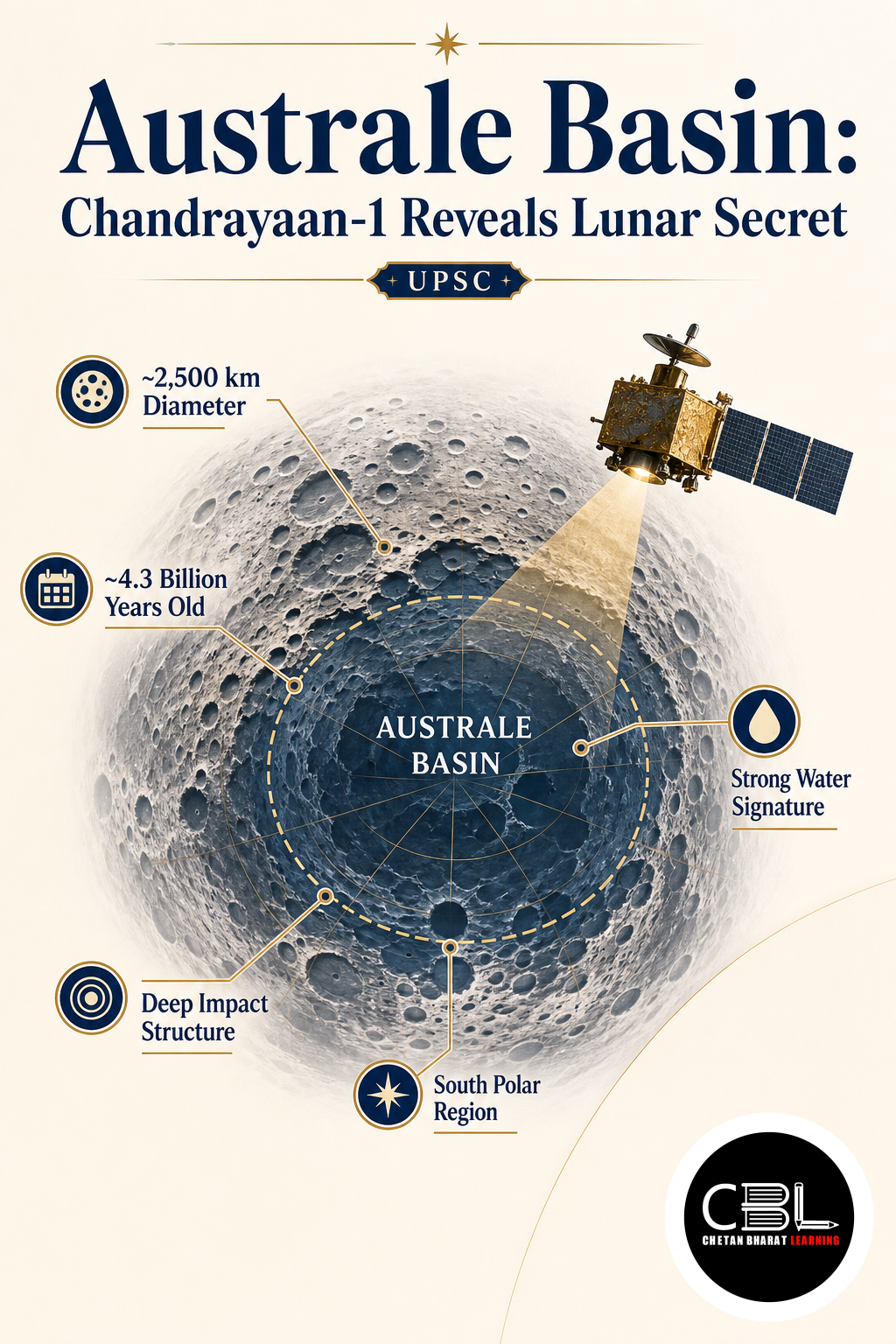
Australe Basin is an ancient lunar impact structure located near the Moon’s southeastern limb. A large asteroid or other space object probably created it during an early stage of lunar evolution. Repeated impacts subsequently damaged its outer rims and covered several original surface features, making the complete structure difficult to recognize through conventional images alone.
An impact basin is much larger and more complex than an ordinary crater. A powerful collision excavates lunar material, fractures the crust and may produce concentric rings. Deep fractures can later provide pathways through which magma reaches the surface. Scientists study these structures because they preserve evidence about planetary bombardment, crustal evolution and volcanic activity.
Why is Australe Basin in News?
Researchers from the Physical Research Laboratory examined its morphology, gravity signatures and mineral composition, supporting the existence of a coherent ancient impact structure that may predate the South Pole–Aitken Basin. They used data from the Moon Mineralogy Mapper aboard Chandrayaan-1, which mapped mineral variations via reflected sunlight. ISRO’s Chandrayaan-1, launched in October 2008, carried eleven scientific instruments from India and international partners.
Key Features
- Ancient impact origin: The basin’s degraded form suggests it formed during a very early period of intense lunar bombardment.
- Distinct circular pattern: Researchers identified 248 small basalt ponds instead of one extensive smooth lava plain.
- Unusual basalt composition: The volcanic deposits contain comparatively less calcium and more magnesium than typical lunar basalts.
- Multiple lines of evidence: Topography, gravity anomalies and mineral signatures collectively support the impact‐basin interpretation.
- Possible great antiquity: Geological conditions indicate a potentially pre‐Nectarian origin, though its exact age remains unresolved.
Challenges
- Severely degraded rims: Later impacts and prolonged surface modification have erased many original boundaries.
- Difficult viewing geometry: Near‐limb location complicates observations and introduces distortions.
- Absence of returned samples: Remote sensing estimates composition but laboratory dating requires physical samples.
- Overlapping geological events: Subsequent craters, lava flows and ejecta can mask or alter primary impact signatures.
- Competing age interpretations: Scientists must verify whether indicators truly make it older than other major lunar basins.
Way Forward
Future high‐resolution imaging, radar and gravity observations can map hidden structures and remaining rings more accurately. Geological maps should identify safe, scientifically valuable sample‐collection sites. A dedicated sample‐return mission would refine the basin’s age and chemical history, improving our understanding of early Solar System impacts. Continued open access to mission archives and collaboration among planetary scientists are essential.
Prelims Practice Corner
- Q1. The Moon Mineralogy Mapper was carried aboard which mission?
(a) Chandrayaan-1 (b) Chandrayaan-2 (c) Mars Orbiter Mission (d) AstroSat - Q2. Which institution led the recent study of the ancient lunar structure?
(a) National Physical Laboratory (b) Physical Research Laboratory (c) National Geophysical Research Institute (d) IIT Mumbai - Q3. Which statement correctly describes an impact basin?
(a) Valley by water flow (b) Large depression from a high‐energy collision (c) Trench by plate tectonics (d) Polar ice deposit - Q4. The volcanic deposits are characterised by:
(a) Higher calcium, lower magnesium (b) Lower calcium, higher magnesium (c) Abundant liquid water (d) Organic minerals - Q5. Consider the following statements: 1. Chandrayaan-1 was India’s first lunar mission. 2. It conducted chemical and mineralogical mapping. Which is correct?
(a) 1 only (b) 2 only (c) Both (d) Neither
Mains Practice Questions
- Q1. Archived space‐mission data can remain valuable long after a mission ends. Discuss with reference to India’s lunar programme. (15 marks)
- Q2. Explain how studying lunar impact basins can improve understanding of the early Solar System. (10 marks)
FAQs on Australe Basin
Where is Australe Basin located?
It lies near the southeastern limb of the Moon; its degraded features made the full basin structure challenging to identify.
Why was the Moon Mineralogy Mapper important?
The imaging spectrometer measured reflected sunlight across multiple wavelengths to identify and compare lunar surface minerals.
Has the basin been proven older than the South Pole–Aitken Basin?
Evidence suggests it may be extremely ancient, but direct sample dating is required to confirm its chronological position.
Related Current Affairs
Preparing for UPSC, PCS or HCS?
Talk to a mentor at Chetan Bharat Learning, Chandigarh. Free guidance on choosing the right exam and building a study plan.
Chat on WhatsAppCall 97793 53345UPSC / IAS / PCS coaching in Chandigarh · Trusted by aspirants across Punjab & Haryana
Leave a Reply
You must be logged in to post a comment.