

UPSC Mapping
| Aspect | Detail |
|---|---|
| Prelims | Official Language Provisions and Government Awards |
| Mains | GS Paper II — Constitution and Governance |
| Administered By | Department of Official Language |
| Ministry | Ministry of Home Affairs |
| Presentation | Annual |
| Occasion | Hindi Diwas, 14 September |
Article
What is Rajbhasha Kirti Puraskar?
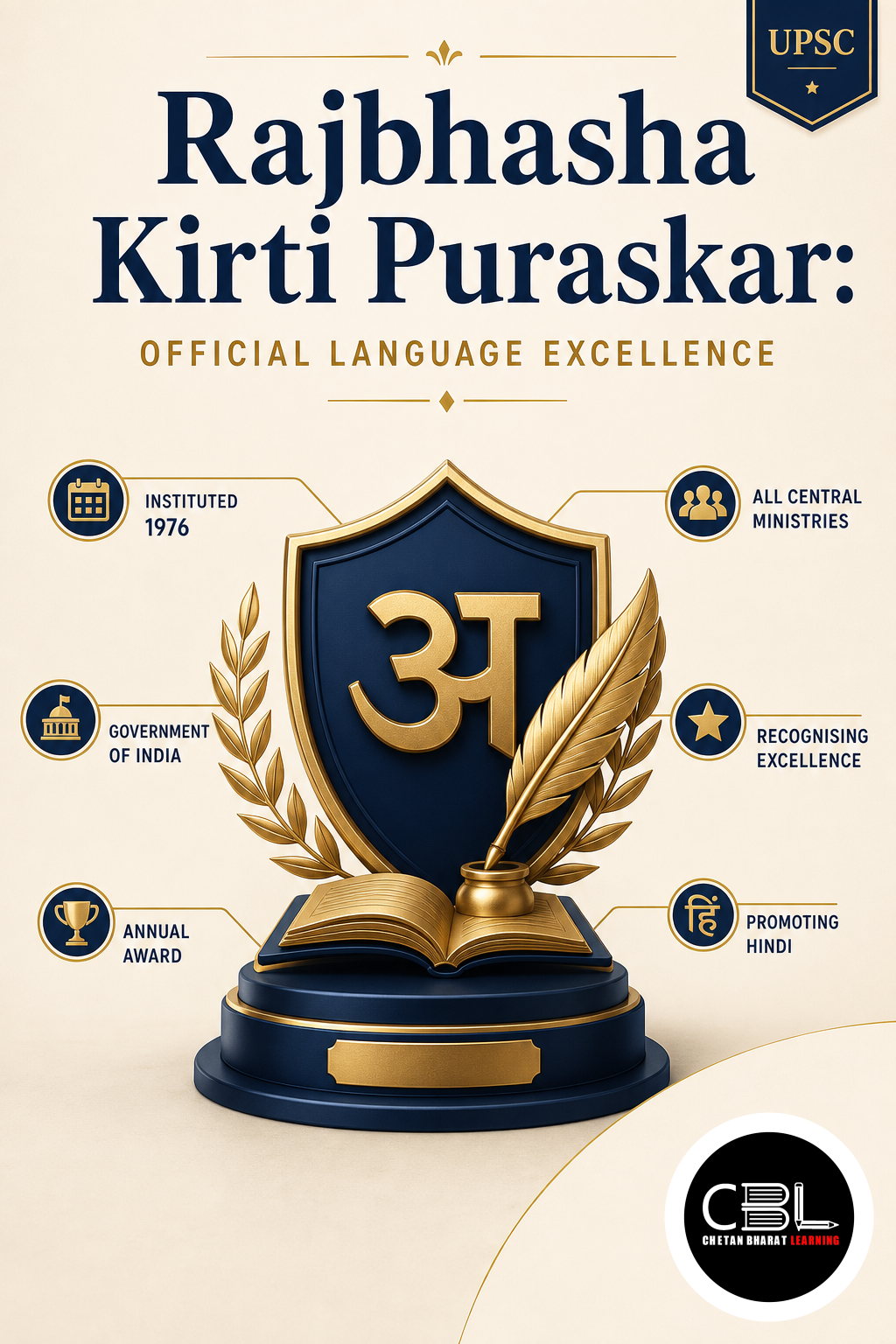
Rajbhasha Kirti Puraskar is an institutional award scheme for recognising effective implementation of Hindi as the Union’s official language. Administered by the Department of Official Language under the Ministry of Home Affairs, it evaluates how public institutions incorporate Hindi into correspondence, administration, publications, training and technology-enabled services.
Eligible recipients include Union ministries, government departments, public-sector undertakings, nationalised banks, autonomous bodies, boards and institutions publishing in-house Hindi magazines. Separate categories allow organisations with different mandates and staff strengths to compete fairly, rewarding sustained administrative performance rather than individual literary contributions.
Why is Rajbhasha Kirti Puraskar in News?
The 2025–26 awards were presented during the sixth All India Official Language Conference on Hindi Diwas. The Ministry of Defence received the first prize among ministries and departments with more than 300 personnel, while the Department of Financial Services led the category for institutions with fewer than 300 personnel. The official PIB announcement provides details on recognised institutions.
Key Features
The award scheme evaluates institutional compliance and efforts to expand accessible official work in Hindi.
- Institutional recognition: Covers ministries, departments, public enterprises, banks, autonomous organisations, boards and eligible official publications.
- Category-based assessment: Institutions compete within defined categories based on type, staffing or region.
- Performance evaluation: Considers official correspondence, reports, training, administrative documents and annual language targets.
- Publication support: Separate recognition for in-house Hindi magazines encourages terminology development and creative communication.
- Annual monitoring: Regular reporting allows comparison and gap identification across institutions.
The constitutional basis lies in Part XVII of the Constitution: Article 343 identifies Hindi in Devanagari script as the Union’s official language, while Article 351 directs the Union to promote Hindi’s development. The Official Languages Act, 1963 and the Official Language Rules, 1976 guide bilingual implementation.
Challenges
Rajbhasha Kirti Puraskar must encourage meaningful language access without reducing implementation to mechanical compliance.
- Quality versus quantity: High volumes of Hindi correspondence do not guarantee clarity or accurate terminology.
- Technical vocabulary: Ensuring consistent terminology in scientific, legal, financial and digital contexts.
- Uneven capacity: Varied training, resources and translation support across departments.
- Digital compatibility: Legacy platforms may lack Unicode support and bilingual processing tools.
- Federal sensitivity: Balancing language promotion with regional autonomy and diverse linguistic backgrounds.
Poor translation can create ambiguity in official documents. Institutions need subject experts and language professionals to ensure accuracy. Reliable data and user feedback are essential for outcome-based evaluation. Hindi promotion should complement the development of all Indian languages.
Way Forward
Evaluation should measure clarity, citizen use, translation accuracy and digital accessibility alongside numerical targets. Departments can establish peer-review panels and share verified bilingual templates. Regular training should focus on practical drafting and communication.
The scheme can recognise innovation in translation technology, accessible websites and multilingual service delivery. Technical support for regional institutions and a balanced approach can sustain constitutional pluralism and efficiency.
Prelims Practice Corner
Q1. Which department administers the award discussed in the article?
(a) Department of Culture (b) Department of Official Language (c) Department of Personnel and Training (d) Department of School Education
Answer: (b) The Department of Official Language under the Ministry of Home Affairs administers the scheme.
Q2. Hindi Diwas is observed annually on which date?
(a) 14 January (b) 26 January (c) 14 September (d) 26 November
Answer: (c) Hindi Diwas commemorates the adoption of the official-language settlement on 14 September 1949.
Q3. Article 343 of the Constitution deals with which subject?
(a) Official language of the Union (b) Formation of new states (c) Election of the President (d) Inter-State Council
Answer: (a) Article 343 identifies Hindi in Devanagari script as the official language of the Union.
Q4. Consider the following statements: 1. The award recognises institutional official-language implementation. 2. It is presented only to individual Hindi authors. 3. Public-sector undertakings and nationalised banks may fall within eligible categories. How many statements are correct?
(a) Only one (b) Only two (c) All three (d) None
Answer: (b) Statements 1 and 3 are correct; the scheme is not confined to individual authors.
Q5. Which legislation provides for the continued use of English alongside Hindi for specified Union purposes?
(a) Official Languages Act, 1963 (b) States Reorganisation Act, 1956 (c) Representation of the People Act, 1951 (d) National Commission for Minorities Act, 1992
Answer: (a) The Official Languages Act, 1963 governs the continued use of English for specified official purposes.
Mains Practice Questions
Q1. Examine how incentive-based schemes can improve official-language implementation in public institutions. (250 words, 15 marks)
Answer Structure:
- Intro: Introduce the institutional award scheme and its administrative objective.
- Body: Discuss incentives, monitoring, staff training, translation quality, digital innovation, measurable outcomes and multilingual sensitivities.
- Conclusion: Recommend citizen-centred evaluation within India’s constitutional language framework.
Q2. Language promotion in administration must balance efficiency with India’s linguistic pluralism. Discuss. (150 words, 10 marks)
Answer Structure:
- Intro: Refer to Part XVII and India’s multilingual administrative environment.
- Body: Cover Hindi promotion, continued English use, regional languages, translation capacity, equality of opportunity and federal consultation.
- Conclusion: Support accessible multilingual governance based on cooperation rather than linguistic uniformity.
FAQs on Rajbhasha Kirti Puraskar
Who received the first prizes for 2025–26?
The Ministry of Defence received the first prize among ministries and departments with more than 300 personnel. The Department of Financial Services led the category for institutions with fewer than 300 personnel.
Is the award meant only for government ministries?
No. Its categories cover departments, public-sector undertakings, nationalised banks, autonomous bodies, boards and eligible in-house Hindi publications.
Does India have a national language?
The Constitution does not declare any national language. Hindi in Devanagari script is the Union’s official language, while English continues for specified official purposes under parliamentary legislation.
Related Current Affairs
Preparing for UPSC, PCS or HCS?
Talk to a mentor at Chetan Bharat Learning, Chandigarh. Free guidance on choosing the right exam and building a study plan.
Chat on WhatsAppCall 97793 53345UPSC / IAS / PCS coaching in Chandigarh · Trusted by aspirants across Punjab & Haryana
Leave a Reply
You must be logged in to post a comment.