

UPSC Mapping
Important for
| Prelims | Science and Technology |
|---|---|
| Mains | GS Paper 3 (Science & Technology) |
Quick Facts
| Target Pathogen | Streptococcus pneumoniae |
|---|---|
| Diseases Caused | Pneumonia, Meningitis, Sepsis |
| New Approach | Reverse Vaccinology |
Article
What is the Pneumococcal Vaccine?
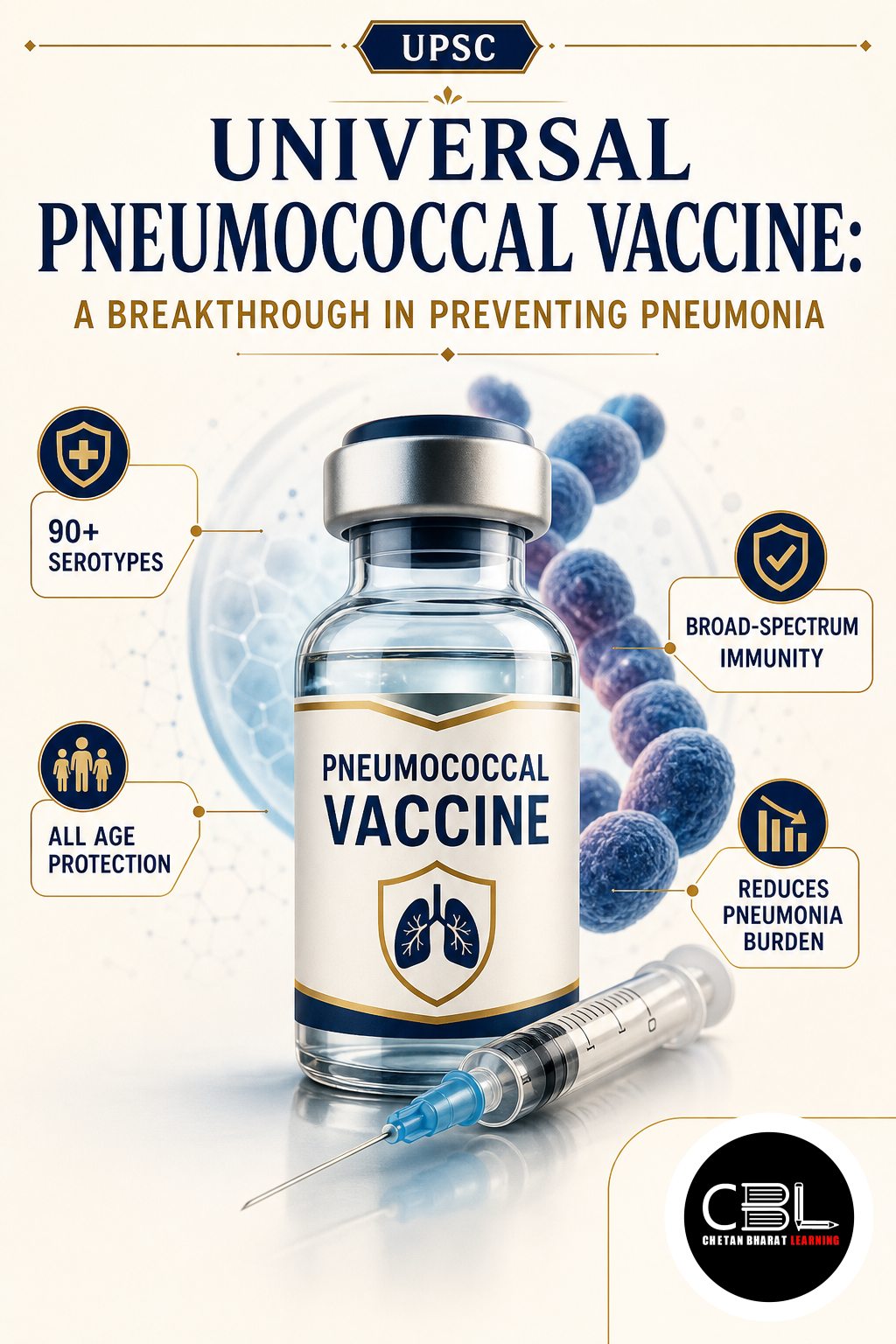
The Pneumococcal Vaccine framework traditionally relies on targeting the sugar capsules of specific bacterial serotypes. Streptococcus pneumoniae is a formidable bacterial pathogen responsible for invasive pneumococcal diseases. These primarily include severe pneumonia, bacterial meningitis, and life-threatening sepsis. The pathogen is particularly dangerous for young children, the elderly, and immunocompromised individuals. Historically, scientists have identified over one hundred distinct serotypes of this bacterium. This immense genetic diversity poses a massive challenge for conventional vaccine development.
Current iterations, such as Pneumococcal Conjugate Vaccines (PCVs) and Polysaccharide Vaccines, only target a limited number of dominant serotypes. While these existing vaccines have significantly reduced disease burden, their overall effectiveness remains inherently limited. The bacteria can easily undergo serotype replacement, where non-vaccine strains become more prevalent. The new experimental candidate overcomes this by utilizing reverse vaccinology. This advanced method scans the entire bacterial genome to identify conserved surface proteins shared across all serotypes. By combining a synthetic DNA stimulant with a natural biopolymer, it enhances immune recognition. This creates a durable, cross-serotype antibody response that traditional methods cannot achieve.
Why is the Pneumococcal Vaccine in News?
Researchers recently developed and successfully tested this experimental universal Pneumococcal Vaccine candidate. The breakthrough addresses a critical gap in modern immunology by offering broad-spectrum protection. Clinical evaluations have demonstrated robust immune responses without the severe adverse effects associated with older formulations. This development marks a significant leap from serotype-specific vaccines to a truly universal preventive tool. You can verify these medical research milestones through the official PIB release on health and biotechnology advancements.
Furthermore, this innovation holds immense promise for developing nations like India. Pneumococcal diseases remain a leading cause of under-five mortality in the country. The existing PCV rollout under the Universal Immunization Programme has been successful but faces coverage and serotype limitation challenges. A universal candidate could drastically simplify national immunization schedules. It would eliminate the need to constantly update vaccine formulations as bacterial strains evolve. This stability is crucial for long-term public health planning and resource allocation.
The global health community views this candidate as a potential game-changer for antimicrobial resistance. By preventing bacterial infections outright, the reliance on broad-spectrum antibiotics decreases significantly. This directly combats the rising threat of drug-resistant pneumococcal strains. International health organizations are closely monitoring the subsequent clinical trial phases of this candidate.
Key Features
- Reverse Vaccinology: Utilizes genomic sequencing to identify conserved surface proteins present across all hundred-plus serotypes of the pathogen.
- Cross-Serotype Protection: Generates a broad-spectrum antibody response, eliminating the vulnerability to serotype replacement seen in older vaccines.
- Synthetic DNA Stimulant: Incorporates advanced molecular adjuvants to significantly enhance the body’s immune recognition and response magnitude.
- Natural Biopolymer Base: Employs safe, naturally derived biopolymers to ensure stability and reduce the risk of adverse inflammatory reactions.
- Simplified Logistics: A universal formulation reduces the complexity of manufacturing and cold chain management compared to multi-valent conjugate vaccines.
Challenges
- Clinical Trial Complexities: Proving efficacy across diverse global populations requires extensive, multi-phase clinical trials that are both time-consuming and expensive.
- Manufacturing Scalability: Transitioning the novel synthetic DNA and biopolymer combination from laboratory scale to mass global production presents significant bioengineering challenges.
- Regulatory Hurdles: Health authorities must establish entirely new evaluation frameworks for universal vaccines, as existing guidelines are tailored for serotype-specific formulations.
- Intellectual Property: Navigating the complex patent landscape surrounding reverse vaccinology and synthetic adjuvants could delay affordable access for developing nations.
- Cold Chain Requirements: Maintaining the stability of the new biopolymer formulation during transport to remote rural areas remains a persistent logistical obstacle.
Way Forward
To maximize the public health impact of the Pneumococcal Vaccine, the global scientific community must prioritize accelerated and collaborative clinical trials. Public-private partnerships should be leveraged to de-risk the massive capital investment required for scaling up novel manufacturing facilities. Governments must also proactively engage with regulatory bodies to streamline the approval pathway for universal vaccine candidates without compromising safety standards.
Moreover, ensuring equitable access for low- and middle-income countries must be a central pillar of the development strategy. The NITI Aayog has consistently emphasized the need for India to strengthen its domestic vaccine manufacturing ecosystem. This comprehensive strategy will ultimately ensure that life-saving immunological breakthroughs reach the most vulnerable populations swiftly and affordably. Strengthening the Universal Immunization Programme will be key to integrating this future candidate seamlessly.
Prelims Practice Corner
Q1. Consider the following statements regarding the new Pneumococcal Vaccine candidate:
1. It uses reverse vaccinology to target surface proteins shared across all serotypes.
2. It is designed to replace the need for all future antibiotic treatments.
Which of the statements given above is/are correct?
(a) 1 only (b) 2 only (c) Both 1 and 2 (d) Neither 1 nor 2
Answer
Answer: (a) While it reduces antibiotic reliance, it does not eliminate the need for all future antibiotic treatments.
Q2. Streptococcus pneumoniae is primarily responsible for which of the following diseases?
(a) Malaria and Dengue (b) Pneumonia, Meningitis, and Sepsis (c) Tuberculosis and Leprosy (d) Cholera and Typhoid
Answer
Answer: (b) It is a bacterial pathogen that causes invasive pneumococcal diseases, mainly pneumonia, meningitis, and sepsis.
Q3. What is the primary limitation of current Pneumococcal Conjugate Vaccines (PCVs)?
(a) They are administered orally (b) They target the sugar capsules of only a few dominant serotypes (c) They cause severe neurological damage (d) They are ineffective in elderly populations
Answer
Answer: (b) Current PCVs target only a limited number of dominant serotypes, leaving populations vulnerable to serotype replacement.
Q4. The new universal vaccine candidate combines a synthetic DNA stimulant with which of the following?
(a) A live attenuated virus (b) A natural biopolymer (c) A broad-spectrum antibiotic (d) A viral vector
Answer
Answer: (b) It combines a synthetic DNA stimulant and a natural biopolymer to enhance immune recognition.
Q5. Approximately how many distinct serotypes of Streptococcus pneumoniae have been identified?
(a) Over 10 (b) Over 50 (c) Over 100 (d) Over 500
Answer
Answer: (c) The pathogen has over 100 distinct serotypes, complicating traditional vaccine development.
Mains Practice Questions
Q1. Discuss the significance of reverse vaccinology in the development of a universal Pneumococcal Vaccine. (150 words, 10 marks)
Answer Structure
- Intro: Define reverse vaccinology and its role in overcoming the limitations of traditional serotype-specific vaccines.
- Body: Mechanism (genomic scanning for conserved surface proteins, synthetic DNA stimulant, natural biopolymer); Significance (cross-serotype protection, mitigating serotype replacement, simplifying immunization schedules, combating antimicrobial resistance).
- Conclusion: Emphasize the potential of this approach to revolutionize preventive healthcare for vulnerable populations globally.
Q2. ‘The development of a universal Pneumococcal Vaccine presents both a scientific triumph and a logistical challenge for developing nations.’ Critically examine. (250 words, 15 marks)
Answer Structure
- Intro: Contextualize the high burden of pneumococcal diseases in developing nations and the promise of a universal vaccine candidate.
- Body: Scientific triumph (broad-spectrum efficacy, reduced need for formulation updates, lower long-term healthcare costs); Logistical challenges (complex clinical trials, manufacturing scalability, intellectual property barriers, cold chain requirements in rural areas); Mitigation (public-private partnerships, technology transfer, strengthening domestic manufacturing).
- Conclusion: Summarize that realizing the vaccine’s potential requires global cooperation to ensure equitable and affordable access for all.
FAQs on Pneumococcal Vaccine
What is the primary limitation of current Pneumococcal Vaccines?
Current vaccines, like PCVs, only target the sugar capsules of a few dominant serotypes, leaving populations vulnerable to infections from the numerous other non-vaccine strains.
How does reverse vaccinology improve vaccine development?
It uses genomic sequencing to scan the entire bacterial genome, identifying conserved surface proteins shared across all serotypes, enabling the creation of a broad-spectrum, universal vaccine.
What diseases does Streptococcus pneumoniae primarily cause?
It is a bacterial pathogen responsible for invasive pneumococcal diseases, primarily severe pneumonia, bacterial meningitis, and life-threatening sepsis.
Related Current Affairs
Preparing for UPSC, PCS or HCS?
Talk to a mentor at Chetan Bharat Learning, Chandigarh. Free guidance on choosing the right exam and building a study plan.
Chat on WhatsAppCall 97793 53345UPSC / IAS / PCS coaching in Chandigarh · Trusted by aspirants across Punjab & Haryana
Leave a Reply
You must be logged in to post a comment.