

UPSC Mapping
| Prelims | Environment |
|---|---|
| Mains | GS Paper 1 & 3 |
Introduction
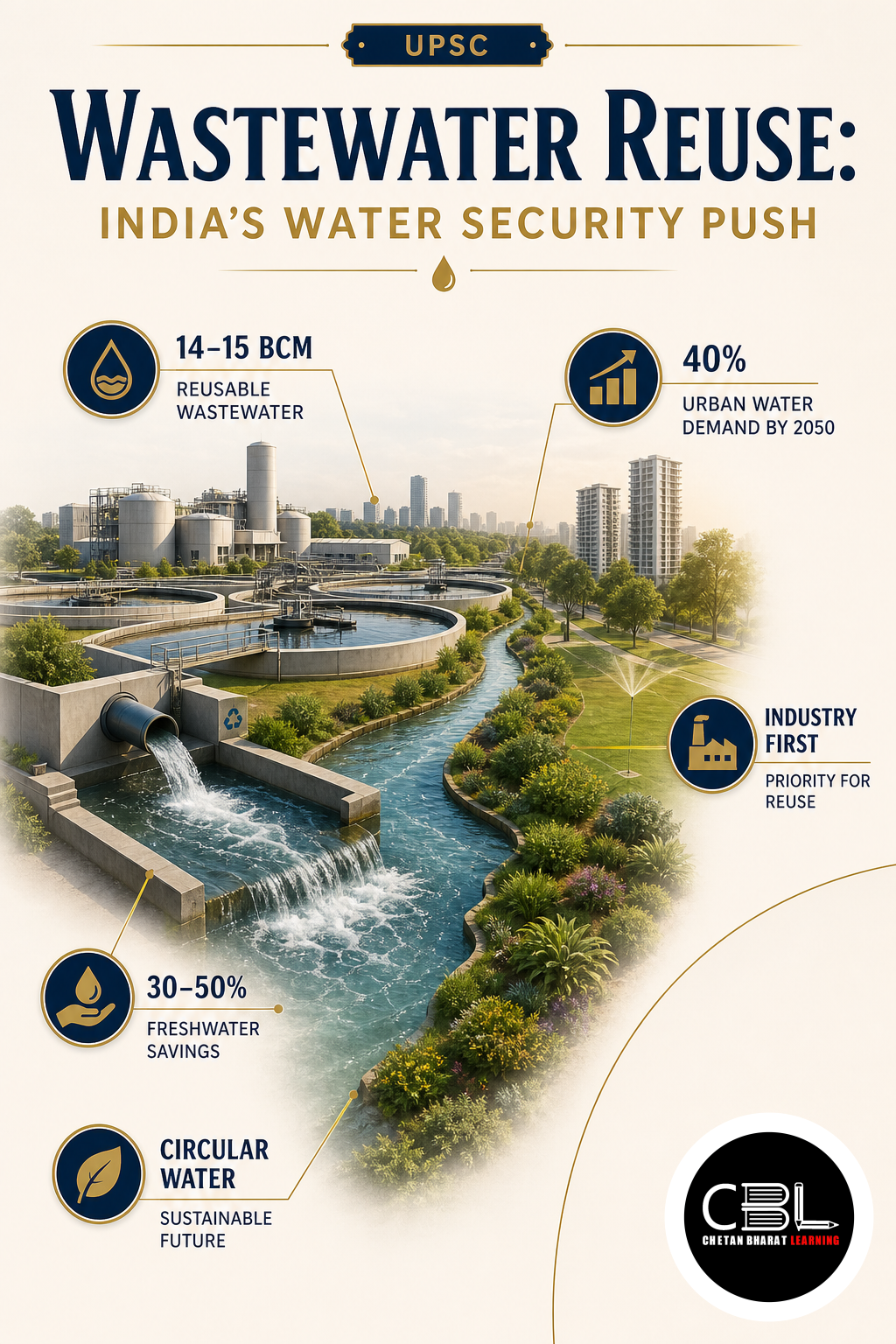
Recent state-level Wastewater Reuse policies aim to transform urban sewage into a valuable resource. This strategic shift addresses severe freshwater deficits and growing industrial demand across major cities, while encouraging extensive private sector participation in building robust treatment capacities.
Quick Facts
| Sewage Generation | 72,368 MLD |
|---|---|
| Treatment Rate | 28% |
| Current Reuse | 8% |
| AMRUT Target | 20% Mandatory |
What is Wastewater Reuse?
Wastewater Reuse involves treating municipal sewage to standards suitable for non-potable applications. Advanced filtration and biological processes remove pathogens and heavy metals, enabling treated water to serve industrial cooling, urban landscaping, and construction purposes. This paradigm shift values sewage as a resource rather than waste. Countries like Israel and Singapore recycle up to 85% and 40% of urban effluent respectively, while India currently recycles only 8%, indicating significant untapped potential.
Why is Wastewater Reuse in News?
Uttar Pradesh and Uttarakhand recently notified comprehensive policies to institutionalize municipal recycling, rebranding treated effluent to counter safety misconceptions. A recent PIB release highlighted the central push for dedicated legal frameworks. With urban sewage projected to reach 120,000 MLD by 2050, wastewater reuse provides the only viable pathway to mitigate freshwater ecosystem stress and regional scarcity.
Key Features
- Mandatory Targets: AMRUT 2.0 enforces a strict 20% urban recycling mandate for all mission cities.
- Industrial Mandates: The National Tariff Policy requires thermal plants within 50 km to use treated effluent.
- Financial Incentives: Schemes like Namami Gange deploy the Hybrid Annuity Model for long-term maintenance.
- Quality Certification: Swachh Bharat Mission enforces Water+ certification to guarantee zero untreated discharge.
- State Frameworks: A National Framework directs states to establish measurable recycling targets.
Challenges
Despite strong policy backing, several hurdles hinder the commercial viability of wastewater reuse projects:
- Network Stranding: Only 33% of urban households are on piped sewerage, leaving treatment assets under-utilized.
- Price Undercut: Recycled water at ₹20/kL is uncompetitive against subsidized freshwater.
- Footprint Barrier: Treatment plants require large land areas, limiting expansion in dense cities.
- Enforcement Paralysis: Overlapping urban local body jurisdictions stall uniform mandate enforcement.
- Offtake Void: Discharging treated effluent into unlined drains negates purification efforts.
Way Forward
The government should forge international partnerships to localize advanced membrane bioreactor manufacturing and prioritize specialized workforce skilling through the Ministry of Jal Shakti. Establishing dedicated dual-piping networks and rationalizing freshwater tariffs will create market certainty. A self-sustaining commercial ecosystem, independent of subsidies, is crucial for long-term success.
Prelims Practice Corner
Q1. What is the current approximate reuse rate of urban wastewater in India?
- (a) 2%
- (b) 8%
- (c) 20%
- (d) 40%
Answer: (b) India currently reuses only about 8% of its urban wastewater, compared to Israel’s 85%.
Q2. Which central scheme mandates a 20% urban wastewater reuse target for mission cities?
- (a) Namami Gange
- (b) AMRUT 2.0
- (c) Swachh Bharat Mission-Gramin
- (d) National River Conservation Plan
Answer: (b) AMRUT 2.0 enforces a mandatory 20% urban wastewater reuse target.
Q3. Under the National Tariff Policy, thermal power plants within what radius must use treated wastewater?
- (a) 10 km
- (b) 25 km
- (c) 50 km
- (d) 100 km
Answer: (c) Thermal power plants within a 50-kilometre radius must use treated wastewater.
Q4. What is the primary purpose of the Water+ certification under SBM-Urban 2.0?
- (a) To certify drinking water quality
- (b) To ensure zero untreated discharge into open environments
- (c) To rate municipal water supply hours
- (d) To certify private water tankers
Answer: (b) Water+ certification ensures no untreated sewage or faecal sludge is discharged into open environments.
Q5. Which model does Namami Gange deploy to fund municipal sewage treatment infrastructure and ensure maintenance?
- (a) Public-Private Partnership
- (b) Hybrid Annuity Model
- (c) Build-Operate-Transfer
- (d) Engineering-Procurement-Construction
Answer: (b) Namami Gange deploys the Hybrid Annuity Model, tying 60% of payouts to 15-year operational maintenance.
Mains Practice Questions
Q1. Discuss the potential of treated wastewater reuse in addressing India’s urban water stress. What are the key infrastructural and regulatory bottlenecks hindering its immediate success? (250 words)
Answer Structure
- Intro: Define wastewater reuse and its objective to transition from a linear to a circular water economy.
- Body: Discuss potential in industrial cooling, urban landscaping, and reducing freshwater extraction. Highlight bottlenecks like network stranding, price undercutting by subsidized freshwater, land footprint barriers, and enforcement paralysis.
- Conclusion: Emphasize the need for dedicated dual-piping networks and rationalizing freshwater tariffs for commercial viability.
Q2. Pricing recycled wastewater competitively against primary freshwater is crucial for the success of circular water economy models. Analyze this statement in the context of industrial demand and municipal governance. (150 words)
Answer Structure
- Intro: Explain the concept of water pricing and its role in driving industrial demand for treated effluent.
- Body: Link freshwater subsidies to the uncompetitiveness of recycled water and discuss how rationalizing primary water tariffs can create a market pull.
- Conclusion: Conclude that economic instruments must align with environmental goals for a self-sustaining water recycling ecosystem.
FAQs on Wastewater Reuse
What is the main difference between wastewater recycling and desalination?
Wastewater recycling treats municipal sewage for non-potable uses with high energy efficiency, while desalination removes salt from seawater for potable use, requiring significantly higher energy inputs and capital costs.
How does the Hybrid Annuity Model improve sewage treatment plant performance?
The HAM ties a significant portion of the developer’s payment to long-term operational performance over 15 years, ensuring plants maintain strict water purity standards beyond initial construction.
Why is network stranding a major concern for wastewater reuse?
With only 33% of urban households connected to piped sewerage, large volumes of sewage bypass treatment plants, leaving existing infrastructure underutilized and reducing the total recyclable water volume.
Related Current Affairs
Preparing for UPSC, PCS or HCS?
Talk to a mentor at Chetan Bharat Learning, Chandigarh. Free guidance on choosing the right exam and building a study plan.
Chat on WhatsAppCall 97793 53345UPSC / IAS / PCS coaching in Chandigarh · Trusted by aspirants across Punjab & Haryana
Leave a Reply
You must be logged in to post a comment.