
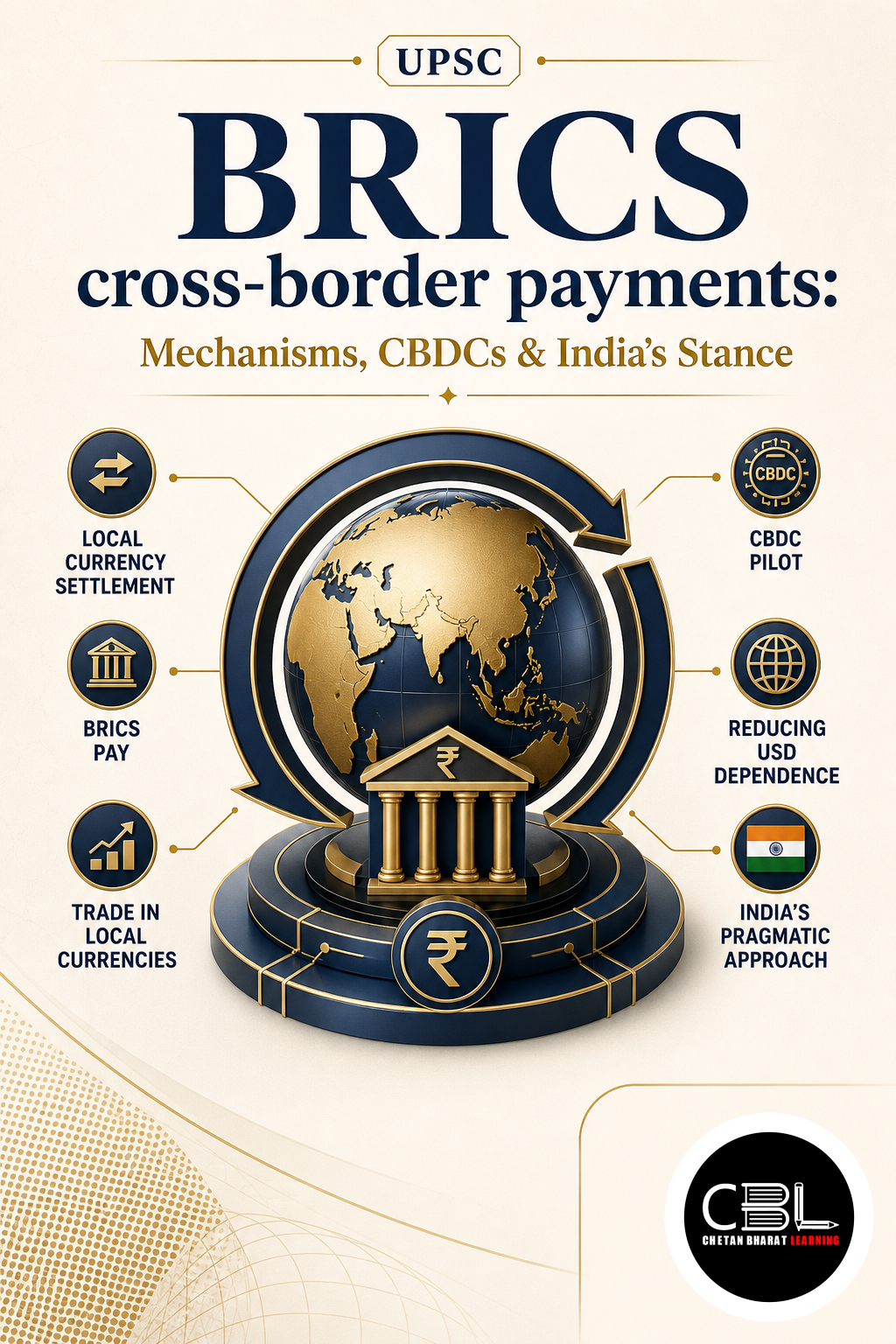
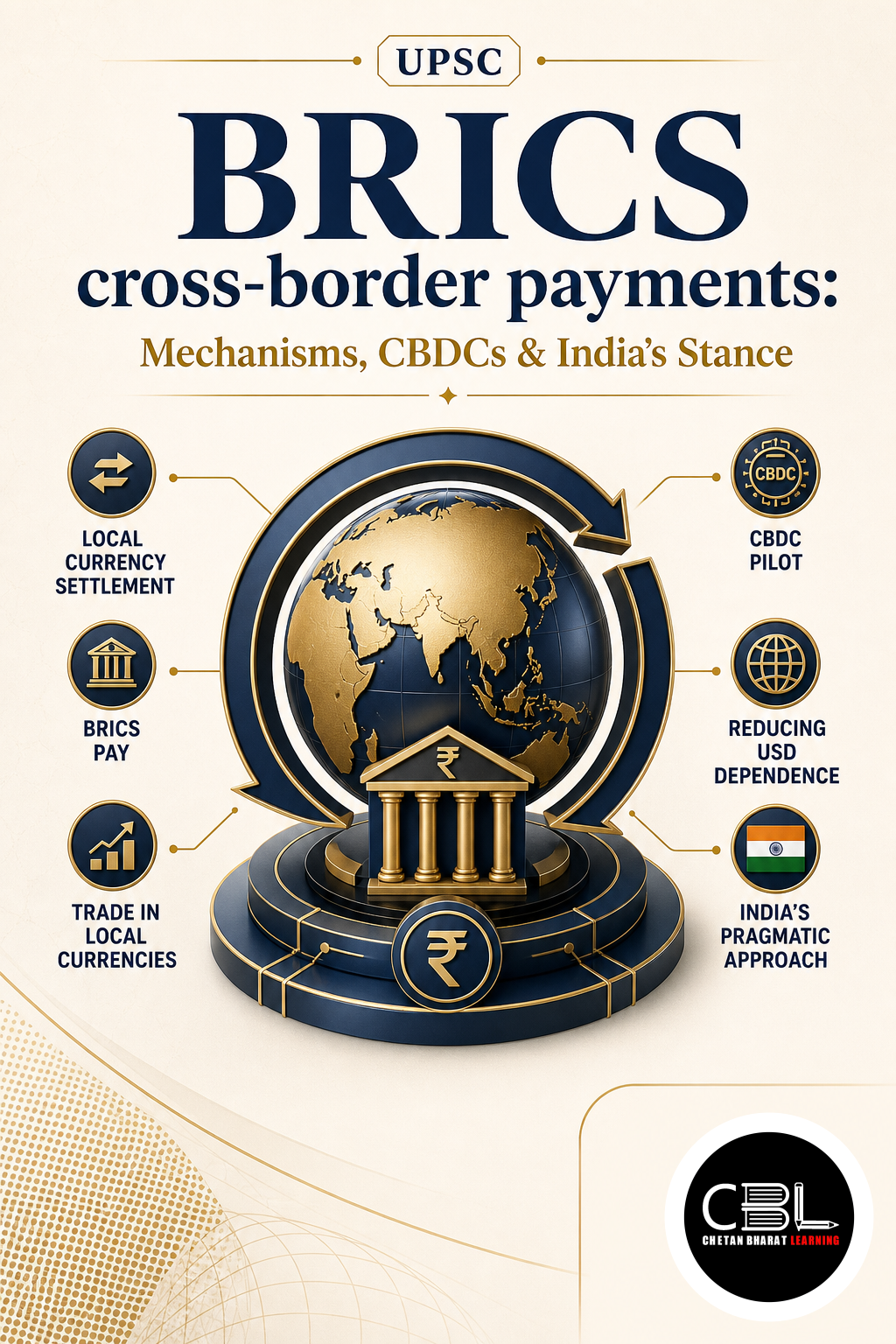
UPSC Mapping
| Prelims | International Relations |
|---|---|
| Mains | GS Paper 2 (International Relations) |
Quick Facts
| Key Forum | 18th BRICS Summit 2026 |
|---|---|
| Proposed Tech | Central Bank Digital Currencies |
| Primary Goal | Reduce transaction costs and delays |
Introduction
The proposed BRICS cross-border payments framework represents a critical shift in global financial architecture. Ahead of the 18th BRICS Summit, member nations are pushing for mechanisms to make international transactions faster and cheaper. Aspirants must thoroughly understand this financial diplomacy for the upcoming civil services examination. You can explore more such vital topics in our daily current affairs archive.
This initiative marks a departure from traditional correspondent banking models. It aims to reduce heavy reliance on dominant vehicle currencies like the US dollar.
What are BRICS cross-border payments?
The current global system relies on a chain of intermediaries called correspondent banks. Payments route through larger international banks, often converting currencies twice. The US dollar frequently acts as a vehicle currency, even when no American party is involved. This process incurs significant forex margins and structural delays. A 2019 survey highlighted forex margins rising up to 8.5 percent for payments involving Africa.
The BRICS cross-border payments initiative seeks to bypass these inefficiencies. Member nations are exploring direct linking of national payment systems. They are also investigating shared hub models and Central Bank Digital Currencies. These alternatives promise simultaneous settlement and reduced transaction costs. The Bank for International Settlements notes that active correspondent banking relationships have fallen significantly.
Building these alternatives requires convincing a large number of banks and regulators to join. There is also a sanctions risk, as several Russian banks were cut off from SWIFT in 2022. This makes other countries cautious about joining any alternative system that a sanctioned nation might use. Consequently, the development of these mechanisms remains a complex geopolitical negotiation.
Why are BRICS cross-border payments in News?
The BRICS cross-border payments agenda recently gained prominence ahead of the 18th BRICS Summit in New Delhi. Finance ministries and central bank representatives met in Jaipur to discuss this financial cooperation. You can verify the latest diplomatic statements on the MEA official portal. India proposed linking CBDCs specifically for trade and tourism payments.
This cautious framing focuses purely on cutting transaction costs. It deliberately avoids framing the initiative as an attempt to displace the US dollar. This contrasts with some Russian and Brazilian proposals that go further toward reducing dollar dependence. India’s stance may be influenced by past threats of tariffs from Western nations against countries moving away from the dollar.
Furthermore, existing platforms like mBridge highlight the current realities of digital settlements. Built by the BIS, mBridge facilitates simultaneous currency swaps. However, over 95 percent of its settlement volume currently occurs in China’s digital yuan. This dominance underscores the need for carefully negotiated multilateral frameworks within the bloc.
Key Features
- Direct System Linking: Countries connect payment systems directly, similar to India’s UPI-PayNow integration with Singapore.
- Shared Hub Architecture: Project Nexus aims to connect multiple national systems through one common hub managed by central banks.
- CBDC Integration: Digital currencies enable simultaneous bank-to-bank settlement, eliminating counterparty risk and speeding up transactions.
- Cost Reduction: Bypassing intermediary banks avoids double currency conversion and high forex margins for developing economies.
- Sanctions Resilience: Alternative messaging networks reduce vulnerability to unilateral financial sanctions like SWIFT cut-offs.
Challenges
- Geopolitical Divergence: Russia favors aggressive de-dollarization, while India prioritizes mere transaction efficiency and cost reduction.
- Sanctions Risk: Nations remain wary of joining alternative systems that sanctioned entities might exploit, fearing secondary sanctions.
- Scalability Issues: Building bilateral payment links one at a time does not scale effectively across the entire bloc.
- Yuan Dominance: Existing platforms like mBridge currently see over 95 percent of settlement volume in China’s digital yuan.
- Regulatory Hurdles: Convincing diverse central banks to adopt a unified technical and legal standard remains a massive challenge.
Way Forward
To maximize the benefits of BRICS cross-border payments, India must continue advocating for a cost-centric, efficiency-driven approach. Strengthening domestic CBDC infrastructure, like the digital rupee, is absolutely vital for seamless integration. The government must actively promote interoperability standards that protect national financial sovereignty. Policymakers should establish clear guidelines to mandate transparent reporting of cross-border digital settlements.
Additionally, international cooperation is vital to manage shared financial resources without triggering geopolitical friction. For detailed parliamentary discussions on financial regulations, refer to the PRS Legislative Research database. A robust, transparent, and inclusive system will ultimately drive India’s strategic financial autonomy forward. Continuous academic research will further refine the operational guidelines for international digital settlements. Future iterations of the policy must remain adaptable to emerging global regulatory standards.
Prelims Practice Questions
Q1. With reference to BRICS cross-border payments, consider the following statements:
1. The current system relies on correspondent banks and often uses the US dollar as a vehicle currency.
2. Project Nexus is a BRICS-specific initiative designed to replace SWIFT entirely.
3. India advocates linking CBDCs primarily to reduce transaction costs and improve efficiency.
Which of the statements given above is/are correct?
(a) 1 only (b) 1 and 3 only (c) 2 and 3 only (d) 1, 2 and 3
Answer: (b) Statement 2 is incorrect because Project Nexus is a BIS-linked initiative, not a BRICS-specific project.
Q2. What is the primary function of SWIFT in international transactions?
(a) It acts as a vehicle currency for trade (b) It serves as a secure messaging network for payment instructions (c) It directly settles central bank digital currencies (d) It regulates forex margins for developing nations
Answer: (b) SWIFT works like a secure messaging network, acting as a post office for payment instructions between banks.
Q3. Which existing platform currently facilitates simultaneous currency swaps using CBDCs, though dominated by the digital yuan?
(a) Project Nexus (b) UPI-PayNow (c) mBridge (d) BRICS Clear
Answer: (c) mBridge is the only such platform running today, built by the BIS with several central banks.
Q4. Why are some BRICS nations cautious about joining alternative payment systems?
(a) The systems are too slow compared to SWIFT (b) Fear of secondary sanctions for using systems accessed by sanctioned entities (c) Lack of internet connectivity in member nations (d) Prohibition by the World Bank
Answer: (b) Nations remain wary of joining alternative systems that sanctioned entities might exploit, fearing secondary sanctions.
Q5. Consider the following challenges in BRICS cross-border payments: 1. Geopolitical divergence 2. Scalability issues 3. Regulatory hurdles. Which of the above are correct?
(a) 1 and 2 only (b) 2 and 3 only (c) 1 and 3 only (d) 1, 2 and 3
Answer: (d) All three are significant structural and operational hurdles facing the initiative.
Mains Practice Questions
Q1. Discuss the significance of developing alternative BRICS cross-border payments mechanisms for developing economies. (150 words, 10 marks)
- Intro: Define the current reliance on correspondent banking and the US dollar as a vehicle currency.
- Body: Discuss significance (reducing forex margins, speeding up settlements, enhancing sanctions resilience, promoting CBDC integration).
- Conclusion: Suggest a way forward focusing on interoperable standards and cautious, efficiency-driven multilateral cooperation.
Q2. The push for alternative cross-border payment systems within BRICS faces significant geopolitical and structural challenges. Critically analyze India’s cautious approach in this context. (250 words, 15 marks)
- Intro: Contextualize the BRICS push for financial cooperation amidst global monetary dominance and sanctions risks.
- Body: Analyze challenges (geopolitical divergence on de-dollarization, sanctions risk, yuan dominance in mBridge, scalability of bilateral links). Discuss India’s cautious, cost-centric approach focusing on efficiency rather than displacing the dollar.
- Conclusion: Conclude that India’s balanced stance protects its strategic autonomy while fostering practical financial integration without inviting unnecessary geopolitical friction.
FAQs on BRICS cross-border payments
What is the primary goal of BRICS cross-border payments initiatives?
The primary goal is to make international transactions faster and cheaper by reducing reliance on intermediary correspondent banks and dominant vehicle currencies like the US dollar.
How do Central Bank Digital Currencies (CBDCs) help in this process?
CBDCs enable simultaneous bank-to-bank settlement on a common platform. This eliminates counterparty risk, speeds up settlement, and reduces the capital banks need to set aside for international payments.
What is India’s specific stance on these alternative payment systems?
India supports linking CBDCs specifically for trade and tourism payments. It frames this purely as a way to cut transaction costs and improve efficiency, avoiding aggressive de-dollarization rhetoric to prevent geopolitical friction.
Related Current Affairs
Preparing for UPSC, PCS or HCS?
Talk to a mentor at Chetan Bharat Learning, Chandigarh. Free guidance on choosing the right exam and building a study plan.
Chat on WhatsAppCall 97793 53345UPSC / IAS / PCS coaching in Chandigarh · Trusted by aspirants across Punjab & Haryana
Leave a Reply
You must be logged in to post a comment.