
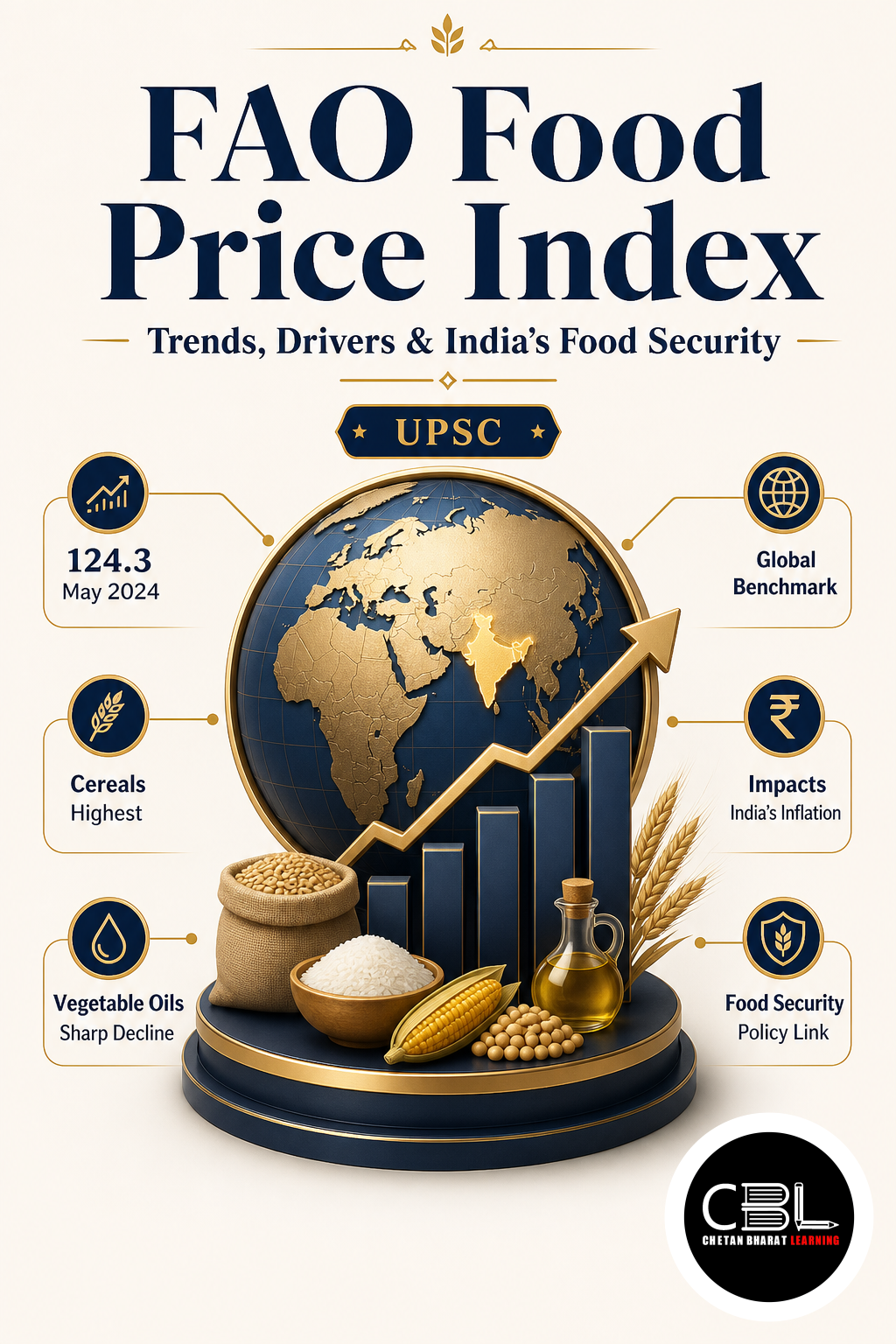

UPSC Mapping
- Prelims: Economy and Agriculture
- Mains: GS Paper 3 (Economy)
| Latest Value | 133.3 points (August 2026) |
|---|---|
| Publishing Agency | Food and Agriculture Organization |
| Tracked Commodities | Cereals, meat, dairy, oils, sugar |
Article
What is the FAO Food Price Index?
The FAO Food Price Index is a comprehensive measure of the monthly change in international prices of a basket of food commodities. It consists of the average of five commodity group price indices, weighted with the average export shares of each group over a specific base period. The Food and Agriculture Organization developed this tool to monitor global market conditions and provide early warnings for potential food crises. It serves as a vital diagnostic instrument for policymakers and international trade organizations.
Crucially, this index does not measure physical food shortages but rather reflects price dynamics driven by supply and demand interactions. A rising index indicates tightening market conditions or increased production costs, while a falling index suggests ample supply or weakened demand. The weighting mechanism ensures that commodities with larger shares in global trade exert a proportionate influence on the final index value. This methodological rigor makes it the most reliable benchmark for international food trade contracts.
Why is the FAO Food Price Index in News?
The FAO Food Price Index recently gained prominence as it reached a four-year high, signaling mounting global supply risks. Extreme weather events, including prolonged droughts and severe heatwaves, have increasingly disrupted agricultural production and logistics globally. You can verify the latest commodity market reports and detailed assessments on the FAO official portal. Furthermore, geopolitical tensions surrounding the Black Sea region continue to create significant uncertainty in global grain markets, affecting wheat and sunflower oil supplies.
Energy prices also heavily influence food costs due to the deeply interconnected nature of natural gas, fertilizers, cultivation, and global shipping. When energy prices spike, the cost of producing and transporting food rises correspondingly. Trade restrictions and logistical disruptions can rapidly transmit local supply problems into amplified global price increases. For India, this global food-price volatility creates direct risks through edible-oil imports, fertilizer dependence, and climate-sensitive domestic agriculture.
Key Features
- Commodity Basket Tracking: Monitors five major groups—cereals, meat, dairy products, vegetable oils, and sugar—for a holistic market view.
- Weighted Average Calculation: Uses average export shares of each group to ensure trade volume dictates index influence.
- High-Frequency Publication: Monthly releases provide timely data to help policymakers anticipate market volatility and implement preemptive measures.
- Global Benchmark Status: Serves as the primary reference for international food trade contracts, futures markets, and policy interventions.
- AMIS Integration: Feeds directly into the Agricultural Market Information System to enhance global food market transparency.
Challenges
- Climate Vulnerability: Extreme weather events disrupt crop yields, creating sudden supply shocks that the index captures only retrospectively.
- Geopolitical Friction: Conflicts in major exporting regions restrict trade flows, inflating prices independent of production levels.
- Input Cost Spikes: Rising energy prices increase the cost of fertilizers, cultivation, and global shipping, compounding food inflation.
- Trade Restrictions: Export bans and logistical bottlenecks amplify global price increases, distorting market signals.
- Access Inequality: High global prices disproportionately impact low-income nations, exacerbating access and utilization dimensions of food security.
Way Forward
To maximize resilience against FAO Food Price Index volatility, India must prioritize climate-resilient farming practices and diversified crop patterns. Securing alternative international suppliers will reduce dependency on single-source imports for critical commodities like edible oils and pulses. Strengthening domestic buffer stocks is essential to insulate the local market from global price shocks and ensure availability. The government must actively promote sustainable agricultural practices to maintain long-term yield stability.
Additionally, international cooperation is vital to prevent cascading effects of export restrictions. Policymakers should mandate transparent reporting of agricultural output and stock levels. For detailed policy frameworks, refer to the PRS Legislative Research database. A robust, transparent, and predictable international trade environment will ultimately drive global food security forward, while continuous academic research refines early-warning operational guidelines.
Prelims Practice
Q1. With reference to the FAO Food Price Index, consider the following statements:
- It measures the monthly change in international prices of a basket of food commodities.
- It includes only cereals and vegetable oils in its calculation.
- A rising index necessarily implies a physical shortage of food globally.
Options: (a) 1 only (b) 1 and 2 only (c) 2 and 3 only (d) 1, 2 and 3
Answer: (a) Statements 2 and 3 are incorrect. It tracks five groups, and rising prices reflect market dynamics, not physical shortages.
Q2. Which of the following commodity groups is NOT explicitly tracked by the FAO Food Price Index?
(a) Dairy products (b) Meat (c) Processed snacks (d) Sugar
Answer: (c) The index tracks cereals, meat, dairy, oils, and sugar, but not processed snacks.
Q3. How do rising energy prices impact the FAO Food Price Index?
(a) They decrease the index by lowering transportation demand (b) They have no impact as food and energy markets are decoupled (c) They increase the index by raising fertilizer, cultivation, and shipping costs (d) They only affect the meat and dairy components
Answer: (c) Energy prices heavily influence food costs due to the interconnected nature of natural gas, fertilizers, and transportation.
Q4. For India, global food-price volatility creates specific risks primarily through:
(a) Edible-oil imports and fertilizer dependence (b) Surplus wheat exports (c) Decreased domestic agricultural productivity (d) Reduced demand for organic farming
Answer: (a) India faces direct risks through its reliance on edible-oil imports, fertilizer dependence, and climate-sensitive agriculture.
Q5. Food security is understood through four dimensions. Which of the following is NOT one of them?
(a) Availability (b) Accessibility (c) Profitability (d) Stability
Answer: (c) The four dimensions are availability, access, utilization, and stability. Profitability is an economic metric, not a food security dimension.
Mains Practice
Q1. Discuss the significance of the FAO Food Price Index in monitoring global food security. What are the primary drivers of recent price surges? (150 words, 10 marks)
Answer Structure:
- Intro: Define the FAO Food Price Index and its role as a global market barometer.
- Body: Discuss significance (early warning, trade benchmark) and drivers (extreme weather, geopolitical tensions, energy costs, trade restrictions).
- Conclusion: Emphasize the need for climate-resilient farming and predictable international trade to ensure stability.
Q2. Global food-price volatility poses significant risks to India’s food security. Critically analyze the challenges and suggest a comprehensive way forward. (250 words, 15 marks)
Answer Structure:
- Intro: Contextualize India’s vulnerability to global price shocks due to specific import dependencies.
- Body: Analyze challenges (edible oil imports, fertilizer dependence, climate-sensitive agriculture, access inequality) and the four dimensions of food security. Suggest way forward (climate-resilient farming, diversified suppliers, buffer stocks, WTO reforms).
- Conclusion: Conclude that long-term resilience requires a multi-pronged approach combining domestic agricultural reforms with proactive global diplomatic engagement.
FAQs on FAO Food Price Index
What commodities are tracked by the FAO Food Price Index?
The index tracks five major commodity groups: cereals, meat, dairy products, vegetable oils, and sugar. These are weighted based on their average global export shares.
Does a high FAO Food Price Index mean there is a global food shortage?
Not necessarily. A high index reflects price dynamics driven by supply and demand, energy costs, or trade restrictions, rather than an absolute physical shortage of food globally.
How does global food-price volatility specifically impact India?
India faces direct risks through its heavy reliance on edible-oil imports, dependence on imported fertilizers, and the vulnerability of its domestic agriculture to climate-sensitive disruptions.
Related Current Affairs
Preparing for UPSC, PCS or HCS?
Talk to a mentor at Chetan Bharat Learning, Chandigarh. Free guidance on choosing the right exam and building a study plan.
Chat on WhatsAppCall 97793 53345UPSC / IAS / PCS coaching in Chandigarh · Trusted by aspirants across Punjab & Haryana
Leave a Reply
You must be logged in to post a comment.