
UPSC Mapping
| Exam | Topic |
|---|---|
| Prelims | Geography and Environment |
| Mains | GS Paper 1 (Geography) |
| Proposed Links | Nodal Agency | Primary Goal |
|---|---|---|
| 30 (14 Himalayan, 16 Peninsular) | National Water Development Agency | Address regional water scarcity |
Article
What is River Interlinking?
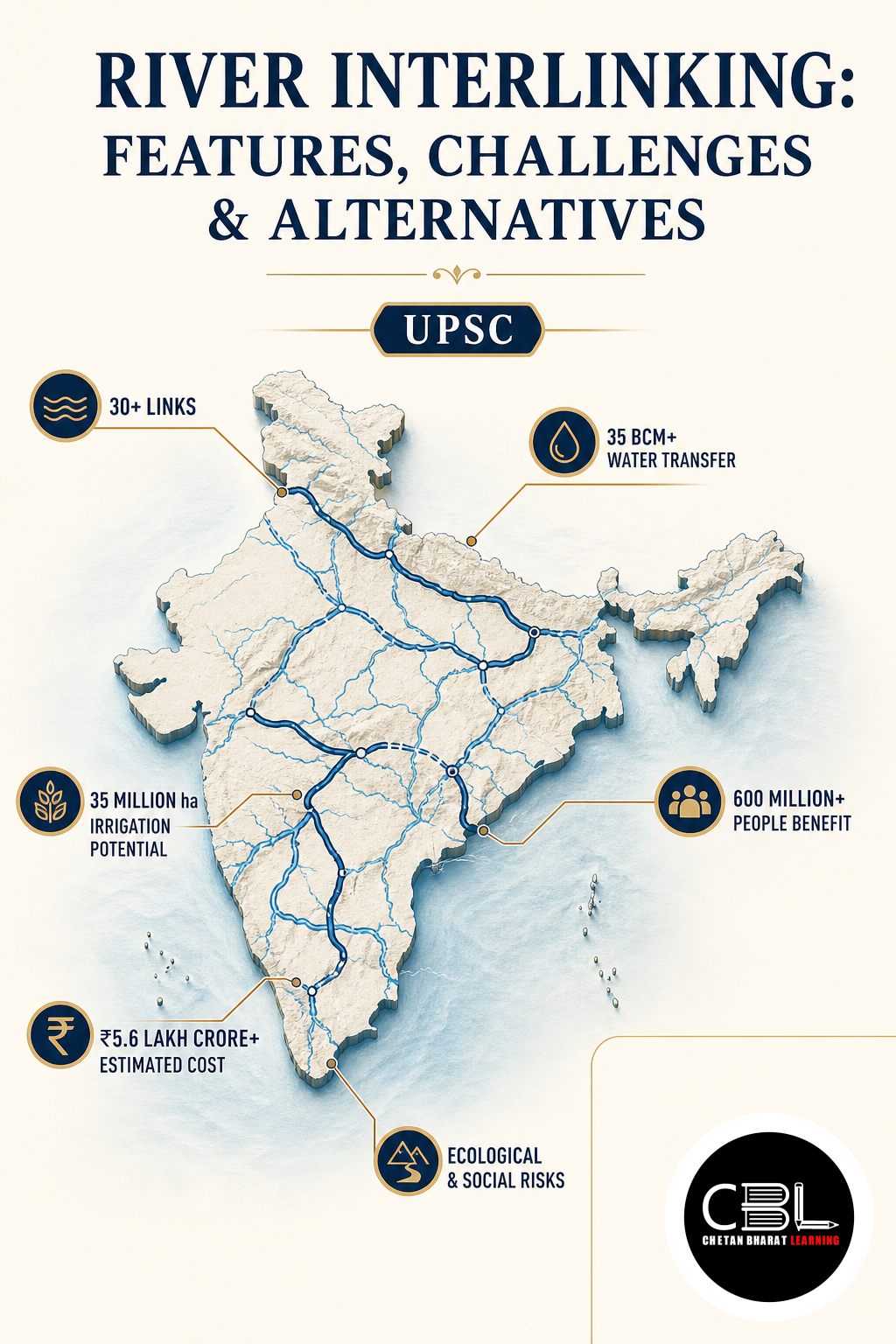
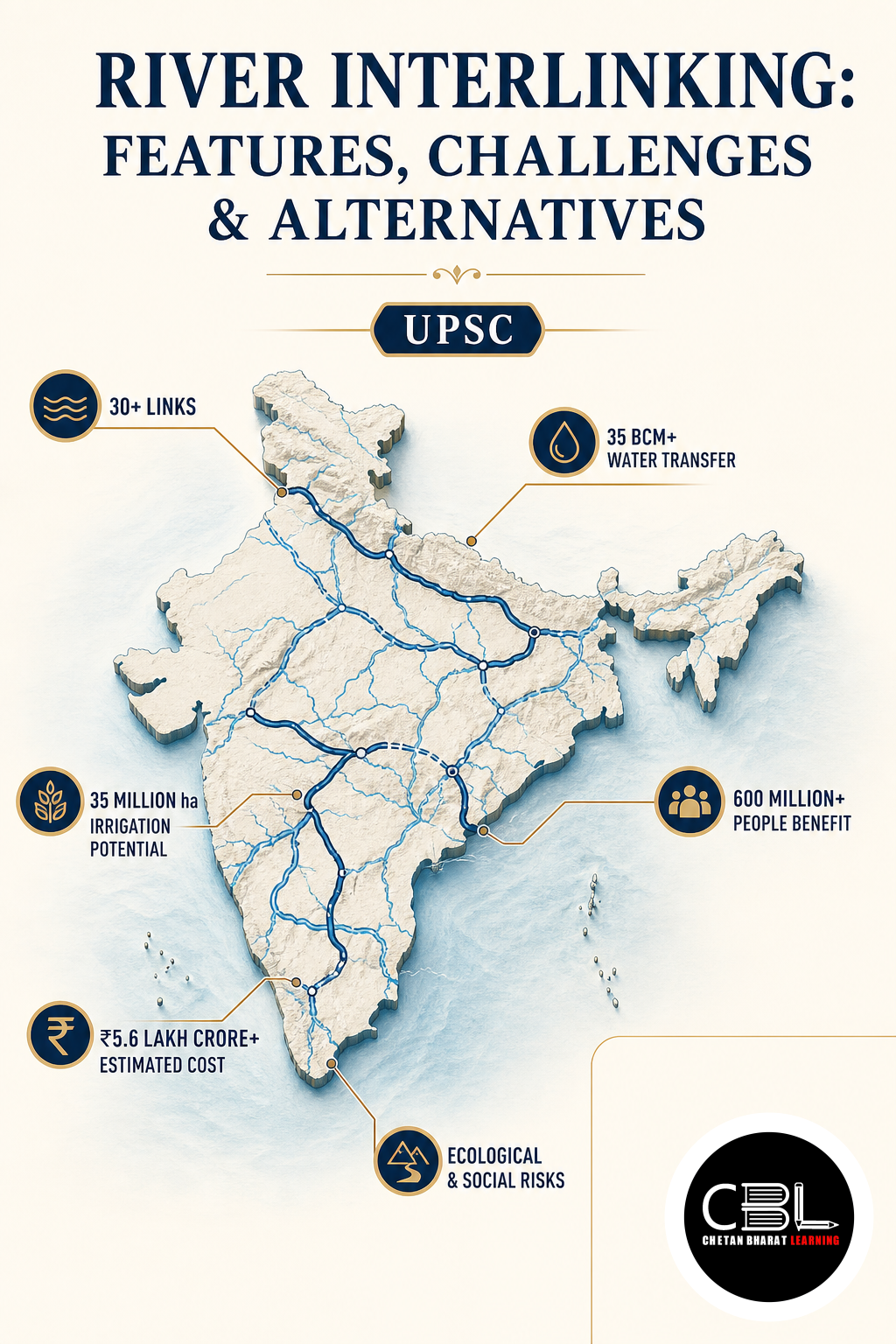
The River Interlinking framework operates as a comprehensive strategy to address regional water scarcity. Sir Arthur Cotton originally proposed this concept in the nineteenth century. The Ministry of Jal Shakti and the National Water Development Agency currently institutionalize this vision. The National Water Development Agency conducts extensive feasibility studies for each proposed link. These studies evaluate the topographical, hydrological, and environmental viability of the projects. The agency also coordinates with respective state governments to secure necessary land acquisitions.
The National Perspective Plan proposes thirty inter-basin water transfer links across the country. These links divide into fourteen Himalayan and sixteen Peninsular components. The framework relies heavily on mutual state consensus and complex canal networks. The historical context of this vision dates back to the nineteenth century. Modern engineers have since adapted this vision to address contemporary water scarcity challenges. The National Perspective Plan serves as the foundational document for this entire initiative.
Why is River Interlinking in News?
The River Interlinking initiative recently gained prominence following the commencement of the Ken-Betwa Link Project. This flagship endeavor marks the first major operational milestone for the entire national program. Policymakers view this development as a critical step toward achieving national water security. The Ken-Betwa Link Project specifically aims to transfer surplus water from the Ken basin. This transfer will irrigate the drought-prone Bundelkhand region in Madhya Pradesh and Uttar Pradesh. The project also includes a significant component for wildlife conservation and habitat restoration.
Furthermore, recent environmental assessments highlighted significant ecological fragmentation risks associated with mega-canal construction. The project threatens over ten percent of the Panna Tiger Reserve habitat. Environmentalists and policy analysts frequently criticize this paradigm as fundamentally flawed. They argue that climate change renders traditional surplus basins highly unpredictable. This scientific uncertainty challenges the foundational idea of permanent water surpluses.
Key Features
- Multi-basin Transfer: Connects thirty distinct river basins to redistribute freshwater resources nationally.
- Hydropower Integration: Includes constructing new hydropower stations alongside the water transfer canal networks.
- Constitutional Alignment: Operates under Entry 17 of the State List and Entry 56 of the Union List.
- Decentralized Execution: State governments handle land acquisition and local rehabilitation processes.
Challenges
- Flawed Scientific Premise: Erratic monsoons and climate change cause traditional surplus basins to face seasonal deficits.
- Ecological Fragmentation: Mega-canals and dams alter river morphology and submerge critical wildlife corridors permanently.
- Social Displacement: Mega-infrastructure projects displace vulnerable rural households and cause severe cultural alienation.
- Fiscal Burden: The estimated program cost diverts public capital from decentralized, sustainable water management solutions.
Way Forward
To maximize the impact of River Interlinking, the government must prioritize localized watershed management. Providing simplified digital tools will empower local communities to participate actively in rainwater harvesting. Strengthening the technical capabilities of Panchayati Raj Institutions will also ensure sustainable aquifer management. Additionally, integrating agricultural reforms with micro-irrigation incentives will drastically reduce freshwater consumption. Policymakers should establish clear guidelines to mandate decentralized sewage treatment plants for urban wastewater recycling.
Continuous academic research and independent audits will further refine operational guidelines over time. The success of this initiative depends entirely on maintaining strict ecological integrity. India has the opportunity to set a global benchmark for sustainable water management. The government must also prioritize the rejuvenation of traditional water bodies across the nation. Initiatives like the Amrit Sarovar mission offer excellent templates for localized water conservation. These decentralized approaches capture precipitation and recharge groundwater tables effectively.
Prelims Practice Corner
Q1. With reference to the National Perspective Plan for River Interlinking, consider the following statements:
- It proposes 30 inter-basin water transfer links.
- It is divided into 14 Peninsular and 16 Himalayan components.
- The National Water Development Agency is the nodal body.
Options:
- (a) 1 only
- (b) 1 and 3 only
- (c) 2 and 3 only
- (d) 1, 2 and 3
Answer: (b) Statement 2 is incorrect because it comprises 14 Himalayan and 16 Peninsular components.
Q2. The Ken-Betwa Link Project, a flagship River Interlinking initiative, is located in which region?
- (a) Western Ghats
- (b) Bundelkhand
- (c) Vidarbha
- (d) Rayalaseema
Answer: (b) The project aims to transfer surplus water to the drought-prone Bundelkhand region.
Q3. Under the Indian Constitution, water is primarily a State subject under which entry?
- (a) Entry 17 of the State List
- (b) Entry 56 of the Union List
- (c) Entry 13 of the State List
- (d) Concurrent List
Answer: (a) Water is a state subject under Entry 17, while the Union regulates inter-state rivers under Entry 56.
Q4. Which of the following is a major ecological concern associated with River Interlinking?
- (a) Increased soil organic carbon
- (b) Submergence of critical wildlife corridors
- (c) Reduction in saline intrusion
- (d) Expansion of deltaic silt deposition
Answer: (b) Mega-canals and dams alter river morphology and submerge critical wildlife corridors like Panna Tiger Reserve.
Q5. Consider the following sustainable alternatives to mega River Interlinking projects:
1. Watershed management
2. Micro-irrigation incentives
3. Decentralized sewage treatment
Which of the above are recommended?
- (a) 1 and 2 only
- (b) 2 and 3 only
- (c) 1 and 3 only
- (d) 1, 2 and 3
Answer: (d) All three are recommended sustainable alternatives to conserve water and manage resources locally.
Mains Practice Questions
Q1. Discuss the significance of River Interlinking in addressing India’s water scarcity. What are the potential ecological and social challenges? (150 words, 10 marks)
Answer Structure:
- Intro: Define River Interlinking and its core objective of transferring water from surplus to deficit basins.
- Body: Discuss significance (national water grid, irrigation, hydropower) and challenges (ecological fragmentation, social displacement, fiscal burden, flawed scientific premise).
- Conclusion: Suggest a balanced way forward focusing on decentralized watershed management alongside selective interlinking.
Q2. Critically analyze the statement: ‘River Interlinking is a flawed paradigm that prioritizes engineering solutions over sustainable water management.’ (250 words, 15 marks)
Answer Structure:
- Intro: Contextualize the debate between mega-infrastructure water projects and localized ecological conservation.
- Body: Analyze the engineering perspective (addressing regional scarcity, flood control) versus the sustainability critique (climate unpredictability, downstream degradation, high fiscal cost, displacement).
- Conclusion: Conclude that while selective links may be necessary, they must be secondary to robust decentralized water budgeting and agricultural reforms.
FAQs on River Interlinking
What is the main objective of River Interlinking?
The main objective is to address regional water scarcity by transferring surplus water from flood-prone basins to drought-prone regions. It aims to optimize national water resource distribution for irrigation, drinking, and hydropower generation.
How many river links are proposed under the National Perspective Plan?
The National Perspective Plan proposes a total of 30 inter-basin water transfer links. These are divided into 14 Himalayan components and 16 Peninsular components to address diverse geographical water imbalances.
What are the major ecological concerns associated with River Interlinking?
Major concerns include ecological fragmentation, submergence of critical wildlife habitats, and downstream degradation. Diverting freshwater flows can starve deltas of essential silt, increasing coastal erosion and saline intrusion in estuarine fisheries.
Related Current Affairs
Preparing for UPSC, PCS or HCS?
Talk to a mentor at Chetan Bharat Learning, Chandigarh. Free guidance on choosing the right exam and building a study plan.
Chat on WhatsAppCall 97793 53345UPSC / IAS / PCS coaching in Chandigarh · Trusted by aspirants across Punjab & Haryana
Leave a Reply
You must be logged in to post a comment.