

UPSC Mapping
| Prelims | Environment & Geography |
|---|---|
| Mains | GS Paper 3 |
Quick Facts
| Historical Impact | 5 of 6 Deficit Years |
|---|---|
| Rainfall Deficit | 14% Below LPA |
| Net Irrigated Area | 59 Per Cent |
| Buffer Stocks | Twice the Norm |
What is El Niño impact and IOD?
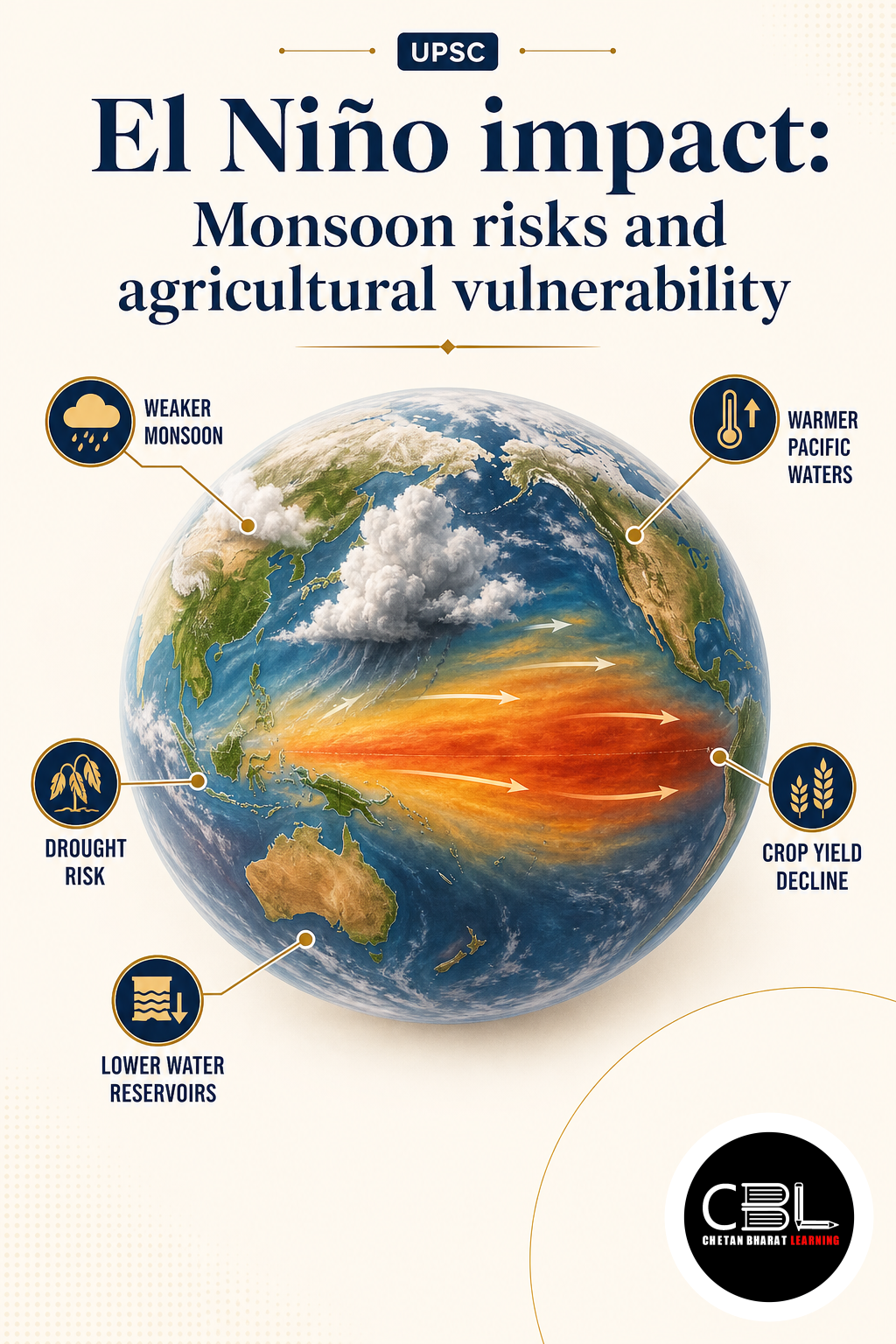
El Niño refers to the abnormal warming of surface waters in the equatorial Pacific Ocean. This warming alters global atmospheric circulation (the Walker Circulation), creating subsiding air masses over the Indian subcontinent that suppress the formation of monsoon clouds and reduce rainfall.
The Indian Ocean Dipole (IOD) is a similar ocean-atmosphere interaction occurring in the Indian Ocean. A ‘positive’ IOD—characterized by warmer waters in the western Indian Ocean near Africa and cooler waters near Indonesia—typically drives moisture-laden winds toward India. A strong positive IOD can sometimes neutralize or offset the drought-inducing effects of an El Niño event, acting as a crucial climate modulator.
Why is El Niño impact in News?
The WMO recently issued an advisory warning that the current El Niño conditions in the equatorial Pacific are intensifying and could persist well into 2027. Economists and rating agencies like Crisil have flagged these weather-related risks as a primary variable that could derail India’s growth-inflation balance. You can review climate and agricultural data via this IMD portal for precise meteorological forecasts.
Historical data underscores this vulnerability: over the past 25 years, five of the six El Niño years have resulted in below-normal rainfall in India. This year, cumulative rainfall stood at 14 per cent below the long-period average (LPA) by the end of August, with August alone recording a severe 16 per cent deficit, directly threatening kharif yields and rabi soil moisture.
Key Features
The interaction between global climate phenomena and domestic agriculture relies on several structural and geographical mechanisms.
- Atmospheric Subsidence: El Niño shifts the tropical rain belt eastward, causing high-pressure zones and sinking air over India, which prevents the upward convective movement necessary for monsoon rains.
- Teleconnections: Global climate systems are deeply interconnected. Warming in the Pacific triggers a chain reaction that affects jet streams, trade winds, and regional ocean temperatures thousands of miles away.
- The IOD Shield: A positive IOD enhances cyclogenesis in the Arabian Sea and Bay of Bengal, frequently triggering active monsoon spells that can partially compensate for Pacific-driven deficits.
- Rabi Vulnerability: Weak monsoons deplete reservoir levels and reduce soil moisture, severely impacting the sowing and yield of crucial winter crops like wheat and mustard.
Challenges
Managing the macroeconomic fallout of an intensifying El Niño presents several severe structural and policy hurdles today.
- Food Inflation Spikes: While foodgrain stocks currently sit at more than twice the buffer norms, perishable vegetables, pulses, and oilseeds lack strategic reserves and are highly vulnerable to immediate price shocks.
- Rural Demand Contraction: Crop failures and lower farm incomes directly depress rural consumption, which accounts for a massive share of India’s GDP, particularly in the automobile and FMCG sectors.
- Uneven Spatial Distribution: Even if the national rainfall average appears normal, severe localized deficits in critical agricultural zones like Maharashtra, Karnataka, and Rajasthan can trigger acute regional distress.
- Monetary Policy Dilemma: The Reserve Bank of India faces a difficult trade-off; raising interest rates to combat food inflation could choke industrial credit and slow down the ongoing capital expenditure cycle.
Way Forward
The administration must continue to aggressively expand micro-irrigation and protective farming techniques to insulate agriculture from rainfall shocks. Over the past decade, India’s net irrigated area has risen by 10 percentage points to 59 per cent, significantly improving baseline resilience. Promoting crop diversification toward less water-intensive millets and pulses is essential for long-term sustainability.
Check the latest NITI Aayog reports for strategic climate-resilient agriculture frameworks. State governments must actively utilize localized weather advisories to guide farmers on sowing windows and contingency crop plans. This unified approach will significantly accelerate the national transition toward a self-reliant and climate-proof agrarian economy.
Prelims Practice Corner
Q1. Which oceanic phenomenon is primarily responsible for suppressing the Indian summer monsoon during its warm phase?
(a) Indian Ocean Dipole (b) El Niño-Southern Oscillation (c) Madden-Julian Oscillation (d) North Atlantic Oscillation
Show answer
Answer: (b) El Niño (the warm phase of ENSO) causes atmospheric subsidence over India, suppressing monsoon rainfall.
Q2. How does a ‘Positive’ Indian Ocean Dipole (IOD) generally affect India’s monsoon?
(a) It completely halts the monsoon (b) It has no impact (c) It brings more moisture and enhances rainfall (d) It causes severe winter droughts
Show answer
Answer: (c) A positive IOD drives moisture-laden winds toward the subcontinent, often offsetting El Niño’s negative effects.
Q3. According to historical data over the past 25 years, how many El Niño years resulted in below-normal rainfall in India?
(a) 2 out of 6 (b) 3 out of 6 (c) 5 out of 6 (d) All 6
Show answer
Answer: (c) Five of the six El Niño years over the past 25 years have resulted in below-normal rainfall.
Q4. What percentage of India’s agricultural area is currently covered under net irrigation?
(a) 35 per cent (b) 45 per cent (c) 59 per cent (d) 75 per cent
Show answer
Answer: (c) India’s net irrigated area has risen to 59 per cent over the past decade, improving resilience.
Q5. Which of the following crops is most vulnerable to immediate price shocks due to a lack of strategic buffer stocks during a drought?
(a) Wheat (b) Rice (c) Perishable vegetables (d) Maize
Show answer
Answer: (c) Unlike wheat and rice, perishable vegetables and certain pulses lack strategic buffer reserves.
Mains Practice Questions
Q1. Discuss the atmospheric mechanisms of El Niño and the Indian Ocean Dipole (IOD), and their combined impact on the Indian summer monsoon. (10 marks)
Answer Structure
Intro: Define ENSO and the Walker Circulation, highlighting how Pacific warming creates high-pressure zones over India.
Body: Explain the mechanics of a Positive IOD and how it acts as a climate modulator by enhancing cyclogenesis and driving moisture toward the subcontinent, often neutralizing El Niño deficits.
Conclusion: Conclude that understanding these teleconnections is vital for accurate agricultural planning and disaster preparedness.
Q2. “While India’s macroeconomic buffers have improved, the agrarian economy remains highly vulnerable to the cascading impacts of El Niño.” Analyze this statement in the context of food inflation and rural demand. (15 marks)
Answer Structure
Intro: Highlight the WMO warnings and historical data showing 5 out of 6 recent El Niño years caused below-normal rainfall.
Body: Analyze the structural vulnerabilities (perishable crops lacking buffer stocks, depleted rabi soil moisture) versus the new resilience factors (59% net irrigated area, massive foodgrain reserves). Discuss the RBI’s monetary policy dilemma regarding food inflation.
Conclusion: Suggest that accelerating micro-irrigation, crop diversification toward millets, and localized weather advisories are critical to insulating rural demand from climate shocks.
FAQs on El Niño impact
Why does El Niño cause droughts in India?
During an El Niño event, the warming of the central and eastern Pacific Ocean shifts the global atmospheric circulation. This creates a zone of sinking air (subsidence) over the Indian subcontinent, which prevents the upward movement of moist air required to form monsoon clouds and trigger rainfall.
Can a positive IOD completely save the monsoon from El Niño?
Not always completely, but it significantly helps. A strong positive IOD generates favorable winds and increased cyclogenesis over the Indian Ocean, which can push moisture into the subcontinent. Historically, strong positive IOD years have sometimes resulted in normal or even surplus rainfall in India despite a concurrent El Niño.
How does a weak monsoon affect the subsequent Rabi season?
A weak southwest monsoon fails to adequately replenish major reservoirs and leaves the soil deficient in moisture. Since Rabi crops like wheat, mustard, and chickpeas rely heavily on stored reservoir water and residual soil moisture for winter irrigation, a monsoon deficit directly threatens the yield and sowing area of the subsequent Rabi season.
Related Current Affairs
Preparing for UPSC, PCS or HCS?
Talk to a mentor at Chetan Bharat Learning, Chandigarh. Free guidance on choosing the right exam and building a study plan.
Chat on WhatsAppCall 97793 53345UPSC / IAS / PCS coaching in Chandigarh · Trusted by aspirants across Punjab & Haryana
Leave a Reply
You must be logged in to post a comment.