

UPSC Mapping
- Prelims: Governance
- Mains: GS Paper 2
Article
What is dearness allowance?
The dearness allowance functions as a crucial cost-of-living adjustment for government employees. It protects the real purchasing power of salaries against rising retail inflation. The administration periodically revises these payouts to ensure that nominal incomes match actual market prices.
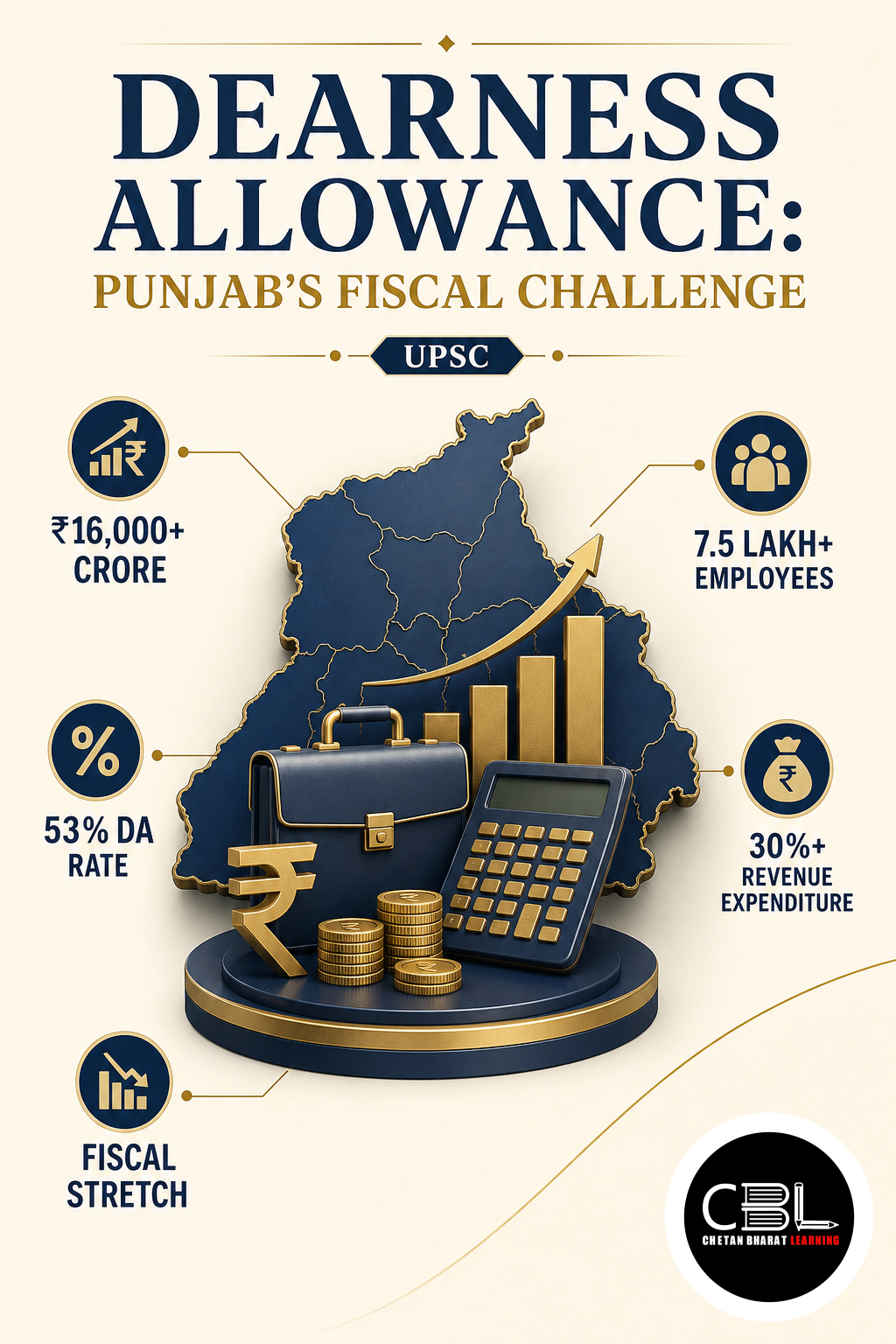
Similarly, the government provides dearness relief to pensioners and family pensioners. This mechanism ensures that retired individuals do not suffer from a declining standard of living. Both components form a massive part of the state’s recurring revenue expenditure.
Historically, the concept emerged to protect government workers during periods of severe wartime inflation. The central administration eventually formalized this mechanism to ensure uniform compensation adjustments across all departments. Reliable projections ultimately ensure that critical welfare schemes receive adequate funding during volatile economic cycles.
The strategic pivot recognizes that controlling the underlying economic fundamentals guarantees long-term national prosperity. The government provides substantial financial incentives to domestic startups developing indigenous manufacturing technologies. Local engineers can now access expensive industrial automation tools through dedicated state-backed support mechanisms.
Why is dearness allowance in News?
The Punjab and Haryana High Court recently directed the state government to release all pending dues within a fortnight. The massive financial obligation prompted the state to file a Special Leave Petition in the Supreme Court. You can review similar legal mandates via the Supreme Court portal for precise judicial orders.
State officials argue that complying with this strict timeline is practically impossible without crippling other essential services. The administration warned that such massive immediate payouts would severely derail critical capital investments. Economists view this standoff as a vital test of modern fiscal federalism.
The government recently established specialized task forces to align state financial databases directly with central accounting requirements. This administrative intervention will drastically reduce the historical gap between treasury departments and district offices. Financial experts anticipate a massive surge in digital audit implementations over the coming quarters.
Quick Facts
| Arrears Amount | Rs 14,191 Crore |
|---|---|
| Beneficiaries | Employees & Pensioners |
| Core Issue | Revenue vs Capital |
| Legal Forum | Supreme Court |
Key Features
- Inflation Shield: The primary objective remains protecting the real income of workers from sudden spikes in retail consumer prices.
- Revenue Burden: These mandatory payouts fall strictly under recurring revenue expenditure, leaving fewer resources for long-term asset creation.
- Judicial Intervention: Courts frequently step in to enforce statutory employee rights when administrative delays cause massive arrears to accumulate.
- Pension Linkage: The parallel dearness relief mechanism ensures that retired personnel maintain their historical purchasing power effectively.
Challenges
- Fiscal Squeeze: High committed expenditure severely restricts the available fiscal space for building new hospitals, schools, and physical infrastructure.
- Contempt Threats: Administrators face severe legal risks and potential contempt proceedings when they fail to meet strict judicial deadlines.
- Debt Traps: States frequently resort to expensive market borrowings to fund these recurring obligations, thereby increasing future interest burdens.
- Intergenerational Inequity: Diverting massive funds toward past arrears unfairly deprives future generations of essential developmental investments.
Way Forward
The administration must implement strict medium-term fiscal planning to phase out legacy arrears without triggering economic shocks. Establishing dedicated sinking funds will help states gradually meet future pension and compensation liabilities. Providing transparent communication to employee unions will drastically reduce the frequency of aggressive judicial litigations.
Check the latest RBI state finances report for strategic macroeconomic management frameworks. The government must periodically review the baseline methodologies to ensure they reflect current demographic realities. Continuous refinement of compensation structures will guarantee that the initiative delivers genuine welfare without bankrupting the exchequer.
State governments must actively align their local recruitment policies with central guidelines to maximize regional synergies. Coordinated efforts between different administrative tiers will eliminate redundant bureaucratic hurdles for aspiring civil servants. This unified approach will significantly accelerate the national transition towards a self-reliant economic powerhouse.
Policymakers must also focus heavily on creating a robust domestic framework for alternative pension architectures. Mandating the use of defined contribution models in government recruitment projects will guarantee initial relief for state budgets. This assured structural shift will provide the necessary confidence for private investors to fund ambitious infrastructure ventures.
Prelims Practice Corner
Q1. What primary economic variable does this specific allowance protect against?
- a) Currency depreciation
- b) Retail inflation
- c) Unemployment
- d) Interest rate hikes
Answer: (b) It protects the real purchasing power of salaries against rising retail consumer prices.
Q2. Under which category of state expenditure do these mandatory payouts fall?
- a) Capital expenditure
- b) Revenue expenditure
- c) Plan expenditure
- d) External grants
Answer: (b) These mandatory payouts fall strictly under recurring revenue expenditure.
Q3. What is the approximate financial obligation the state recently contested in the apex court?
- a) Rs 5,000 crore
- b) Rs 14,191 crore
- c) Rs 25,000 crore
- d) Rs 50,000 crore
Answer: (b) The massive Rs 14,191 crore obligation prompted the state to file a Special Leave Petition.
Q4. What parallel mechanism ensures retired personnel maintain their historical purchasing power?
- a) Dearness relief
- b) Gratuity bonus
- c) Provident fund
- d) Commutation
Answer: (a) The parallel dearness relief mechanism ensures that retired personnel maintain their purchasing power.
Q5. Which constitutional body frequently intervenes to enforce these statutory employee rights?
- a) Finance Commission
- b) Judiciary
- c) Election Commission
- d) CAG
Answer: (b) Courts frequently step in to enforce statutory employee rights when administrative delays occur.
Mains Practice Questions
Q1. Discuss the structural challenges states face in balancing employee rights with long-term capital investments. (10 marks)
Answer Structure:
- Intro: Define the core tension between recurring revenue commitments and the necessity of building public infrastructure.
- Body: Explain the impact of high committed expenditure, the accumulation of legacy arrears, and how judicial interventions force states into debt traps.
- Conclusion: Conclude that medium-term fiscal planning and dedicated sinking funds are essential for sustainable governance.
Q2. Fiscal sustainability requires harmonizing legal obligations with the state capacity to generate future economic growth. Analyze. (15 marks)
Answer Structure:
- Intro: Introduce the concept of fiscal space and the recent Supreme Court battles over massive state-level compensation arrears.
- Body: Analyze the risks of intergenerational inequity, the crowding out of capital expenditure, and the necessity of structural pension reforms.
- Conclusion: Suggest that transparent communication with employee unions and phased payout mechanisms will ensure both equity and macroeconomic stability.
FAQs on dearness allowance
Why do states accumulate such massive arrears over time?
States often delay implementing central pay commission recommendations due to immediate fiscal constraints. This administrative delay causes massive compound interest and back-wage liabilities to accumulate over several years.
How does this impact the broader economy of the state?
High revenue expenditure leaves very little fiscal space for capital investments like roads and hospitals. This lack of infrastructure development ultimately stifles long-term economic growth and private investment.
What role does the judiciary play in these disputes?
Employees frequently approach high courts and the Supreme Court to enforce their statutory rights. The judiciary issues strict timelines for payout, forcing states to reallocate budgets or seek legal stays to avoid contempt.
Related Current Affairs
Preparing for UPSC, PCS or HCS?
Talk to a mentor at Chetan Bharat Learning, Chandigarh. Free guidance on choosing the right exam and building a study plan.
Chat on WhatsAppCall 97793 53345UPSC / IAS / PCS coaching in Chandigarh · Trusted by aspirants across Punjab & Haryana
Leave a Reply
You must be logged in to post a comment.