UPSC Mapping
| Prelims | Mains |
|---|---|
| International Relations | GS Paper 2 |
Quick Facts
| Brokered By | Enactment Year | Eastern Rivers | Western Rivers |
|---|---|---|---|
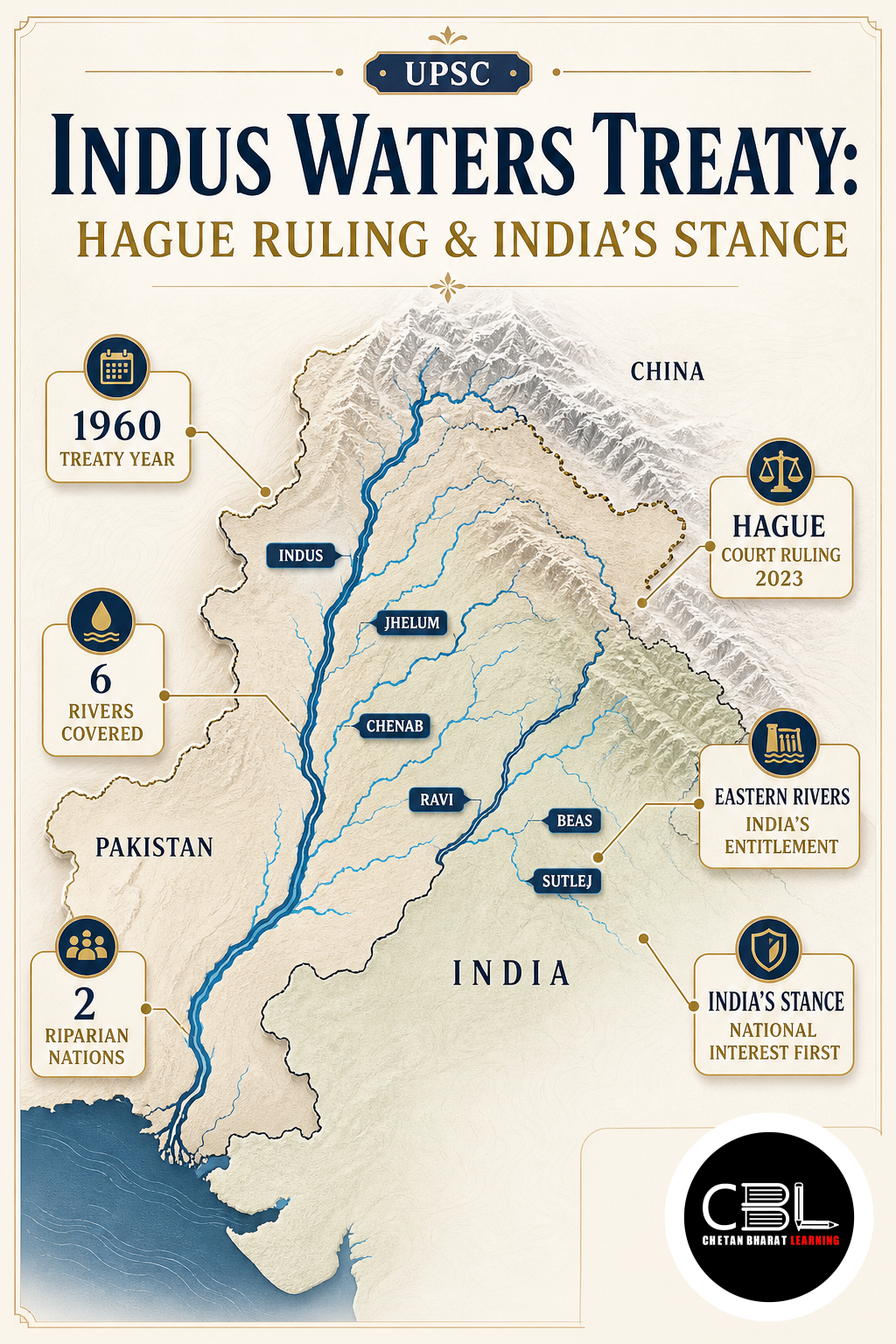
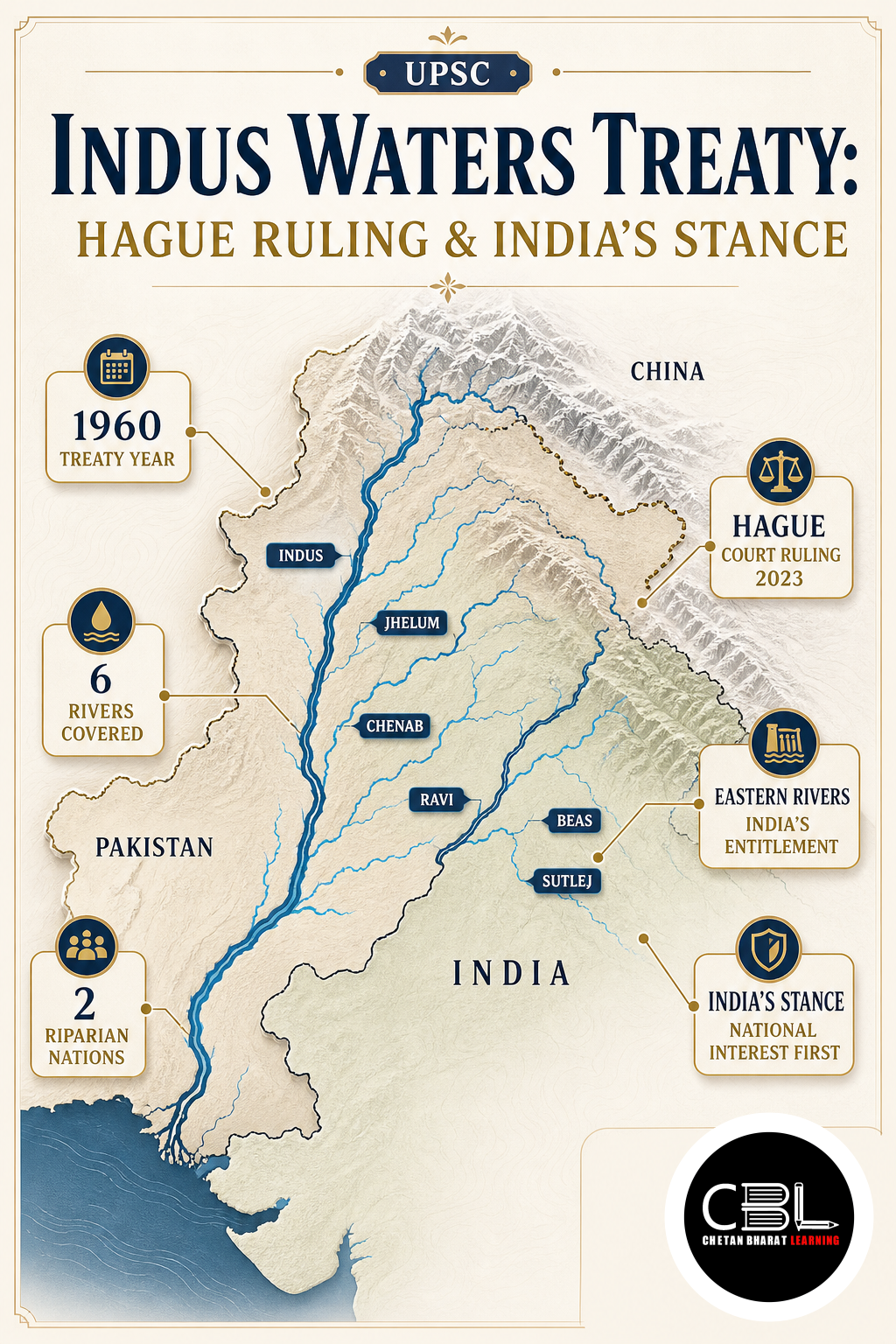
| World Bank | 1960 | Ravi, Beas, Sutlej | Indus, Jhelum, Chenab |
What is Indus Waters Treaty?
The Indus Waters Treaty functions as the primary bilateral framework governing transboundary river sharing. The World Bank originally brokered this historic agreement to allocate six critical rivers. The eastern rivers primarily serve Indian agricultural needs while Pakistan utilizes the western rivers.
The treaty establishes robust mechanisms for resolving technical differences and legal disputes. A Permanent Indus Commission regularly monitors the cross-border flow of these vital water resources. Both nations historically relied on neutral experts to resolve complex hydroelectric disagreements.
Why is Indus Waters Treaty in News?
The Hague-based arbitration court recently ruled that the agreement remains fully binding. The tribunal explicitly rejected the attempt to place the pact in temporary abeyance. You can review the official diplomatic stance via the MEA portal for precise foreign policy details.
The tribunal also imposed strict interim restrictions on the Ratle Hydroelectric Project construction. Indian officials argue this parallel proceeding violates the core dispute-resolution architecture. The government maintains that cross-border terrorism fundamentally alters the underlying bilateral obligations.
Key Features
- River Allocation: The agreement clearly divides the six river systems between the two riparian states.
- Run-of-the-River Rights: India retains specific rights to generate electricity on western rivers without storing massive volumes.
- Dispute Mechanisms: The treaty outlines a graded approach involving neutral experts and formal arbitration courts.
- Permanent Commission: A dedicated bilateral body conducts regular inspections and shares crucial hydrological data annually.
Challenges
- Parallel Proceedings: Simultaneous hearings by neutral experts and arbitration courts create massive legal confusion.
- Terrorism Linkage: New Delhi firmly links water sharing to the complete cessation of cross-border militant activities.
- Climate Change: Rapid glacial melt and erratic monsoons fundamentally alter the historical flow patterns assumed earlier.
- Infrastructure Delays: Continuous legal objections severely delay the construction of critical hydroelectric projects in Jammu.
Way Forward
The administration must leverage multilateral forums to highlight the severe security threats emanating from state-sponsored terrorism. Simplifying the internal clearance processes will help domestic engineers launch critical hydroelectric projects easily. Providing dedicated technical assistance will drastically reduce the legal vulnerabilities of future dam designs.
Check the latest World Bank reports for strategic transboundary water recommendations. The government must periodically review the baseline methodologies to ensure they reflect current geopolitical realities. Continuous refinement of the Indus Waters Treaty strategy will guarantee that the initiative delivers genuine national security.
Prelims Practice Corner
Q1. Which international organization originally brokered this historic water-sharing agreement?
- (a) United Nations
- (b) World Bank
- (c) International Court of Justice
- (d) Asian Development Bank
Answer: (b) The World Bank brokered the agreement in 1960 to allocate the six critical rivers.
Q2. Which rivers are primarily allocated to India under the treaty framework?
- (a) Indus, Jhelum, Chenab
- (b) Ravi, Beas, Sutlej
- (c) Ganga, Yamuna, Brahmaputra
- (d) Narmada, Tapi, Mahi
Answer: (b) The eastern rivers comprising Ravi, Beas, and Sutlej are primarily allocated to India.
Q3. Which specific hydroelectric project faced interim restrictions from the recent arbitration ruling?
- (a) Kishenganga
- (b) Baglihar
- (c) Ratle
- (d) Uri
Answer: (c) The tribunal imposed strict interim restrictions on the Ratle Hydroelectric Project construction.
Q4. What primary reason did New Delhi cite for rejecting the arbitration court’s jurisdiction?
- (a) Financial constraints
- (b) Parallel proceedings and illegal constitution
- (c) Lack of translators
- (d) Environmental concerns
Answer: (b) India argued the court was illegally constituted and created parallel proceedings violating the treaty.
Q5. Which body regularly monitors the cross-border flow of these vital water resources?
- (a) UNEP
- (b) Permanent Indus Commission
- (c) WTO
- (d) SAARC Secretariat
Answer: (b) A dedicated bilateral body called the Permanent Indus Commission conducts regular inspections.
Mains Practice Questions
Q1. Discuss the structural challenges of parallel dispute-resolution mechanisms under the Indus Waters Treaty. (10 marks)
- Intro: Define the treaty framework and highlight the recent Hague arbitration ruling regarding hydroelectric projects.
- Body: Explain how simultaneous hearings by neutral experts and arbitration courts create legal confusion, violating the graded dispute mechanism.
- Conclusion: Clarify the need to prevent diplomatic standoffs and infrastructure delays by refining dispute-resolution architecture.
Q2. Transboundary water diplomacy must adapt to emerging climate realities and security concerns. Analyze this statement. (15 marks)
- Intro: Introduce the historical context of the 1960 agreement and India’s recent stance linking water sharing to cross-border terrorism.
- Body: Analyze the impact of rapid glacial melt, erratic monsoons, and the strategic necessity of securing national interests against state-sponsored militancy.
- Conclusion: Suggest leveraging multilateral forums and modernizing hydrological data sharing to ensure long-term regional stability.
FAQs on Indus Waters Treaty
Why did India place the agreement in temporary abeyance?
New Delhi placed the pact in abeyance following severe cross-border militant attacks. The government maintains that state-sponsored terrorism fundamentally alters the underlying bilateral obligations and security parameters.
What are run-of-the-river rights under this framework?
These rights allow India to generate electricity on the western rivers without storing massive water volumes. This specific mechanism ensures continuous downstream flows while supporting critical domestic energy requirements.
How does climate change impact this historic water-sharing pact?
Rapid glacial melt and erratic monsoons fundamentally alter the historical flow patterns assumed during 1960. These emerging environmental realities necessitate a modernized approach to transboundary water management and disaster preparedness.
Related Current Affairs
Preparing for UPSC, PCS or HCS?
Talk to a mentor at Chetan Bharat Learning, Chandigarh. Free guidance on choosing the right exam and building a study plan.
Chat on WhatsAppCall 97793 53345UPSC / IAS / PCS coaching in Chandigarh · Trusted by aspirants across Punjab & Haryana
Leave a Reply
You must be logged in to post a comment.