

UPSC Mapping
- Prelims: Economy & IR
- Mains: GS Paper 3 & 2
Article
Recent data shows that Russian oil imports experienced a significant decline in August amid tightening global supply chains. The shift highlights the complex interplay between energy security and shifting geopolitical alliances. Policymakers continuously monitor these fluctuations to protect the national import bill.
Students can track similar macroeconomic updates in our daily current affairs archive regularly. The administration actively balances cost advantages against the rising risks of maritime navigation.
Quick Facts
| August Volume | 2.08 mbpd |
|---|---|
| Market Share | 45 Per Cent |
| Top Competitor | China |
| Alternative Source | Venezuela |
What is the Russian oil imports trend?
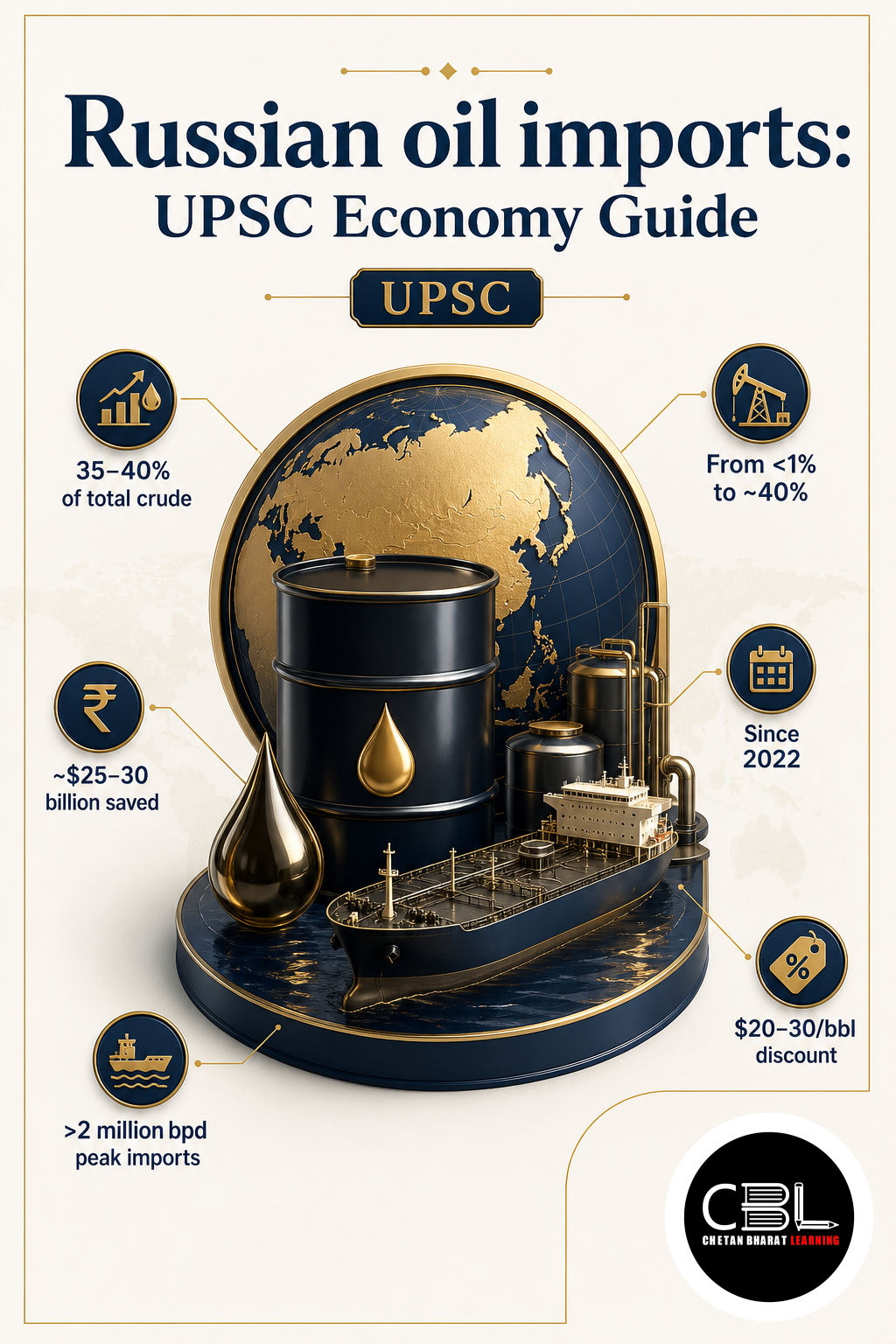
The volume of Russian oil imports into the country recently dropped to 2.08 million barrels per day. This represents a substantial 26 per cent decline from the historic highs recorded in the previous month. Market analysts describe this shift as a normalisation rather than a structural retreat from discounted crude.
The national crude diet previously relied heavily on Moscow to offset expensive West Asian barrels. Evolving global freight economics and infrastructure attacks have altered these established supply routes. Refiners now actively balance cost advantages against the rising risks of maritime navigation.
The strategic pivot recognizes that controlling the underlying energy sources guarantees long-term national security. The government provides substantial financial incentives to domestic refiners to process diverse grades of crude. Local engineers can now access advanced desalting tools through dedicated state-backed support mechanisms.
Why is Russian oil imports in News?
Global commodity tracking firms recently reported that Chinese refiners are competing much more aggressively for available cargo volumes. Simultaneously, Ukrainian drone attacks on export infrastructure in the Black Sea have severely disrupted traditional shipping lanes. You can review global energy trends via this PIB release for precise macroeconomic data.
The ongoing crisis around the Strait of Hormuz has effectively taken a large portion of traditional Gulf supplies offline. This disruption forces national refiners to diversify aggressively towards African and South American barrels. Shipments from Venezuela recently jumped by over 60 per cent to secure energy needs.
The central administration recently launched dedicated initiatives to connect academic energy research directly with commercial refining requirements. This technological intervention will drastically reduce the historical gap between university laboratories and factory floors. Industry experts anticipate a massive surge in registered energy patents over the coming financial quarters.
Key Features
- Freight Economics: Avoiding the dangerous Black Sea routes forces exporters to use the Northern Sea Route or Baltic ports, significantly altering transportation costs.
- Source Diversification: Refiners actively purchase crude from Latin America and Africa to offset the shortfall from traditional Gulf suppliers.
- Strategic Autonomy: The government continues to base its purchasing decisions strictly on national interest rather than yielding to external geopolitical pressure.
- Discounted Crude: Securing cheaper barrels remains essential to control domestic inflation and protect the purchasing power of local consumers.
- Refinery Configuration: Domestic processing facilities possess the complex technical capacity to handle heavy, high-sulphur Urals grade crude efficiently.
Challenges
- Chinese Competition: Aggressive buying by Beijing reduces the available volume of discounted barrels for other Asian buyers.
- Sanctions Pressure: Western restrictions on banking, shipping, and insurance frequently complicate the financial settlement of energy trades.
- Chokepoint Vulnerability: Ongoing conflicts near critical maritime routes like the Strait of Hormuz drastically increase freight insurance premiums.
- Infrastructure Attacks: Drone strikes on foreign export terminals create unpredictable bottlenecks and delay crucial cargo deliveries.
- Currency Fluctuations: A depreciating domestic currency automatically inflates the final landed cost of all foreign commodities.
You can explore similar economic strategies in our economy section for deeper insights.
Way Forward
The administration must accelerate the expansion of strategic petroleum reserves to cushion against sudden supply shocks. Securing long-term contracts with diverse global producers will drastically reduce exposure to volatile spot markets. Providing dedicated financial assistance will help state-owned refiners upgrade their processing infrastructure.
Check the latest NITI Aayog reports for strategic energy transition recommendations. The government must periodically review the baseline methodologies to ensure they reflect current global maritime realities. Continuous refinement of the Russian oil imports strategy will guarantee that the initiative delivers genuine energy security.
State governments must actively align their local biofuel blending targets with central guidelines to maximize regional synergies. Coordinated efforts between different administrative tiers will reduce the overall fossil fuel dependence of the transport sector. This unified approach will significantly accelerate the national transition towards a resilient green economy.
Policymakers must also focus heavily on creating a robust domestic market for alternative energy technologies. Mandating the use of local components in government solar projects will guarantee initial demand for startups. This assured market access will provide the necessary confidence for private investors to fund ambitious renewable ventures.
Prelims Practice Corner
Q1. Which region’s crisis recently forced Indian refiners to diversify towards South American barrels?
(a) Strait of Malacca (b) Strait of Hormuz (c) Suez Canal (d) Bab-el-Mandeb
Answer
Answer: (b) The ongoing crisis around the Strait of Hormuz effectively took a large portion of traditional Gulf supplies offline.
Q2. What primary factor recently caused a 26 per cent drop in the specific import volume?
(a) Domestic refinery strikes (b) Tighter export availability and Chinese competition (c) UN Sanctions (d) Monsoon delays
Answer
Answer: (b) Tighter Russian export availability and aggressive buying by Chinese refiners reduced the available cargo volumes.
Q3. Which alternative maritime route is increasingly used to avoid Black Sea drone threats?
(a) Cape of Good Hope (b) Northern Sea Route (c) Panama Canal (d) Northwest Passage
Answer
Answer: (b) Exporters use the Northern Sea Route or Baltic ports to avoid dangerous Black Sea navigation.
Q4. Which South American country recently saw a 60 per cent jump in oil shipments to India?
(a) Brazil (b) Argentina (c) Venezuela (d) Ecuador
Answer
Answer: (c) Shipments from Venezuela jumped by over 60 per cent to secure national energy needs.
Q5. What does the term strategic autonomy imply in the context of national energy purchases?
(a) Buying only from allies (b) Purchasing based on national interest despite external pressure (c) Boycotting all sanctions (d) Relying solely on domestic production
Answer
Answer: (b) The government bases its purchasing decisions strictly on national interest rather than yielding to geopolitical pressure.
Mains Practice Questions
Q1. Discuss the significance of source diversification in ensuring India’s energy security amidst ongoing West Asian conflicts. (10 marks)
Intro: Define energy security and highlight the recent disruptions in traditional Gulf supply routes.
Body: Discuss the shift towards African and South American barrels, the role of strategic petroleum reserves, and the balancing act of strategic autonomy.
Conclusion: Conclude that diversified and resilient energy supplies are strategically indispensable for an import-dependent nation.
Q2. “Energy imports are no longer just an economic commodity but a strategic resource shaping foreign policy.” Analyze this statement in the context of shifting global crude markets. (15 marks)
Intro: Introduce the concept of resource geopolitics and how energy purchases are guided by national interest.
Body: Analyze the impact of Western sanctions, the competition with China for discounted crude, and the vulnerability of strategic chokepoints like the Strait of Hormuz.
Conclusion: Suggest that accelerating the green transition and boosting domestic biofuel production are essential for long-term energy independence.
FAQs on Russian oil imports
Why did the import volume drop in August?
The volume dropped primarily due to tighter export availability from Moscow and aggressive competition from Chinese refiners. Additionally, maintenance shutdowns at a few domestic refineries likely contributed to the lower crude intake.
How do Western sanctions affect these energy trades?
Sanctions create secondary effects by restricting banking, shipping, and insurance services. This forces traders to innovate payment mechanisms and accept higher transportation costs to secure the cargo.
What is the role of the Northern Sea Route?
Freight economics and drone threats in the Black Sea are incentivizing exporters to avoid traditional southern routes. The Northern Sea Route provides a safer, albeit geographically distinct, alternative for moving crude to Asian markets.
Related Current Affairs
Preparing for UPSC, PCS or HCS?
Talk to a mentor at Chetan Bharat Learning, Chandigarh. Free guidance on choosing the right exam and building a study plan.
Chat on WhatsAppCall 97793 53345UPSC / IAS / PCS coaching in Chandigarh · Trusted by aspirants across Punjab & Haryana
Leave a Reply
You must be logged in to post a comment.