

| Exam | Details |
|---|---|
| Prelims | Economy / Rural Development |
| Mains | GS Paper III – Economy, Employment |
| Key Scheme | MGNREGA |
|---|---|
| Debate | Jobs vs wage guarantees |
| Focus | Productive employment |
What is Rural Jobs?
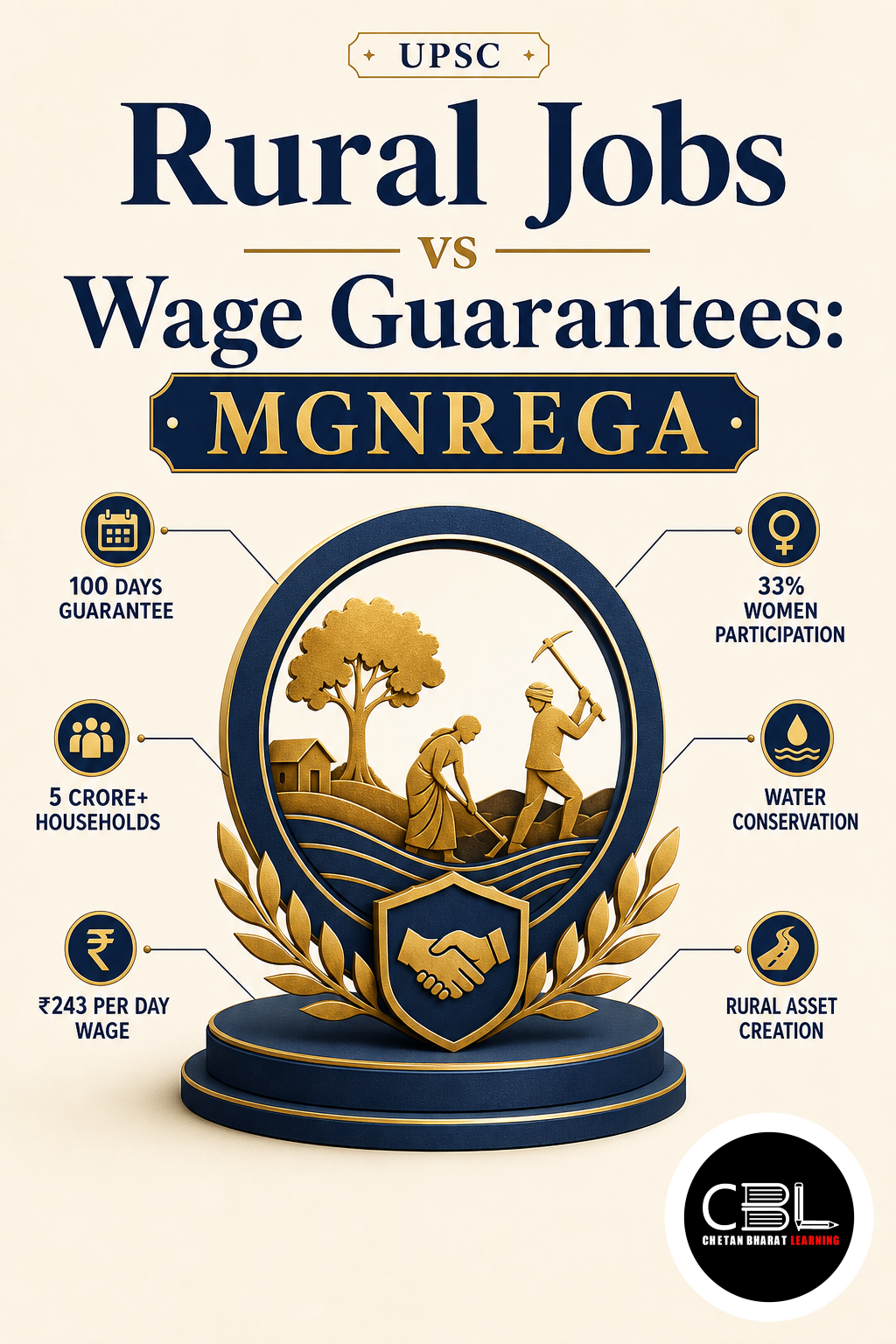
Rural jobs refer to employment opportunities in agriculture, manufacturing, services and public works that provide income and livelihoods to rural populations. In India, the Mahatma Gandhi National Rural Employment Guarantee Act provides a legal wage guarantee for 100 days of unskilled work per rural household. However, wage guarantee alone may not create sustainable, productive employment.
Many rural jobs under MGNREGA involve low-productivity earthworks that create disguised unemployment—workers appear employed but contribute little to output. The larger goal should be structural transformation: shifting workers from agriculture to higher-productivity non-farm activities. This requires investment in rural infrastructure, agro-processing, rural industries and skill development.
Why are Rural Jobs in the News?
Commentators and economists argue that India needs real job creation rather than expanding wage guarantee schemes. While MGNREGA provides a safety net, it cannot substitute for productive employment in manufacturing and services. The debate reframes policy priorities toward rural non-farm economy and private investment.
The PIB release shows that government has been focusing on infrastructure and rural livelihoods, but challenges remain in generating durable jobs. The discussion links to broader issues of disguised unemployment and low agricultural productivity.
Key Features
- MGNREGA wage guarantee: Provides 100 days of unskilled wage work, acting as a safety net during distress.
- Productive employment: Sustainable jobs in manufacturing, services and agro-based industries offer higher income and skill accumulation.
- Disguised unemployment: Agriculture employs many workers beyond what is needed, reducing overall productivity.
- Structural transformation: The economy must shift labour from low-productivity farm work to non-farm sectors.
- Rural non-farm economy: Expansion of rural enterprises, logistics and digital services can absorb workers locally.
Challenges
- Low agricultural productivity: Dependence on rain-fed farming limits income growth and encourages over-employment in agriculture.
- Inadequate rural infrastructure: Poor roads, power and connectivity discourage private investment in rural industries.
- Skill deficit: Rural workers often lack the skills needed for emerging non-farm jobs.
- Policy inertia: Political reliance on wage schemes can delay reforms needed for long-term job creation.
- Migration pressure: Without local jobs, rural youth migrate to cities, straining urban infrastructure.
Way Forward
India should integrate MGNREGA with asset creation that raises farm productivity and supports rural industries. Public investment in rural infrastructure, irrigation and cold chains can crowd in private sector jobs. Skill programmes must align with local economic opportunities in food processing, logistics and digital services.
The NITI Aayog has recommended district-level employment strategies that balance safety nets with growth-oriented interventions. A phased approach that gradually shifts workers to productive jobs is essential for long-term rural prosperity.
Prelims Practice Corner
Q1. MGNREGA guarantees how many days of wage employment per rural household?
- a. 50
- b. 100
- c. 150
- d. 200
Answer: (b) 100 days.
Q2. What does disguised unemployment mean?
- a. Open unemployment
- b. Workers appear employed but contribute little to output
- c. Seasonal unemployment
- d. Cyclical unemployment
Answer: (b) Workers appear employed but contribute little to output.
Q3. Which sector has the highest share of disguised unemployment?
- a. Manufacturing
- b. Services
- c. Agriculture
- d. Construction
Answer: (c) Agriculture.
Q4. Which type of employment is considered more sustainable than wage guarantee?
- a. Temporary public works
- b. Productive employment in non-farm sectors
- c. Seasonal agriculture
- d. Unskilled labour
Answer: (b) Productive employment in non-farm sectors.
Q5. The rural non-farm economy includes which activities?
- a. Only agriculture
- b. Agro-processing, rural industries and services
- c. Only government jobs
- d. Only mining
Answer: (b) Agro-processing, rural industries and services.
Mains Practice Questions
Q1. Critically examine the argument that India needs productive jobs rather than wage guarantees like MGNREGA. (15 marks)
Answer Structure:
- Intro: Mention MGNREGA and the jobs debate.
- Body: Cover wage guarantee benefits, disguised unemployment, need for structural transformation, non-farm economy.
- Conclusion: Suggest integrated approach.
Q2. Discuss the challenges in transforming India’s rural labour market from low-productivity agriculture to sustainable non-farm employment. (10 marks)
Answer Structure:
- Intro: State rural employment context.
- Body: Cover infrastructure, skills, credit, land and policy reforms, migration.
- Conclusion: Recommend investment and institutional support.
FAQs on Rural Jobs
What is MGNREGA?
MGNREGA is a law that guarantees 100 days of unskilled wage employment per rural household to provide a safety net.
Why is productive employment better than wage guarantee?
Productive employment offers higher income, skill development and sustainable livelihoods, while wage guarantees are temporary and low-productivity.
What is disguised unemployment?
Disguised unemployment occurs when more workers are engaged in an activity than needed, so their contribution to output is marginal.
Related Current Affairs
Preparing for UPSC, PCS or HCS?
Talk to a mentor at Chetan Bharat Learning, Chandigarh. Free guidance on choosing the right exam and building a study plan.
Chat on WhatsAppCall 97793 53345UPSC / IAS / PCS coaching in Chandigarh · Trusted by aspirants across Punjab & Haryana
Leave a Reply
You must be logged in to post a comment.