
UPSC Mapping
| Prelims | Indian Economy: External Sector and Balance of Payments |
|---|---|
| Mains | GS Paper III — Indian Economy |
Quick Facts
| Record Level | $729.33 billion |
|---|---|
| Week Ended | 21 August 2026 |
| Weekly Rise | $12.42 billion |
| Custodian | Reserve Bank of India |
What is Forex Reserves?
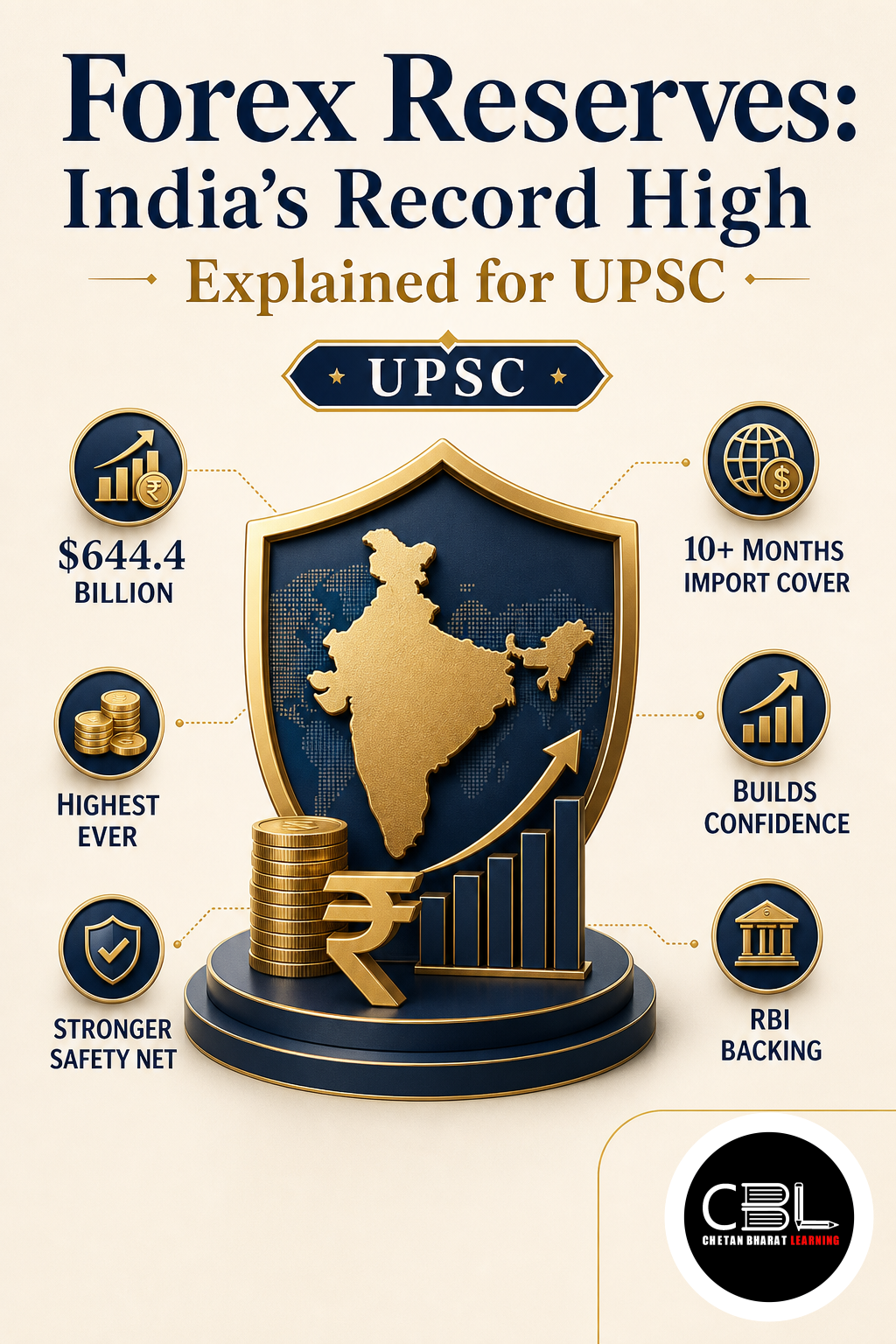
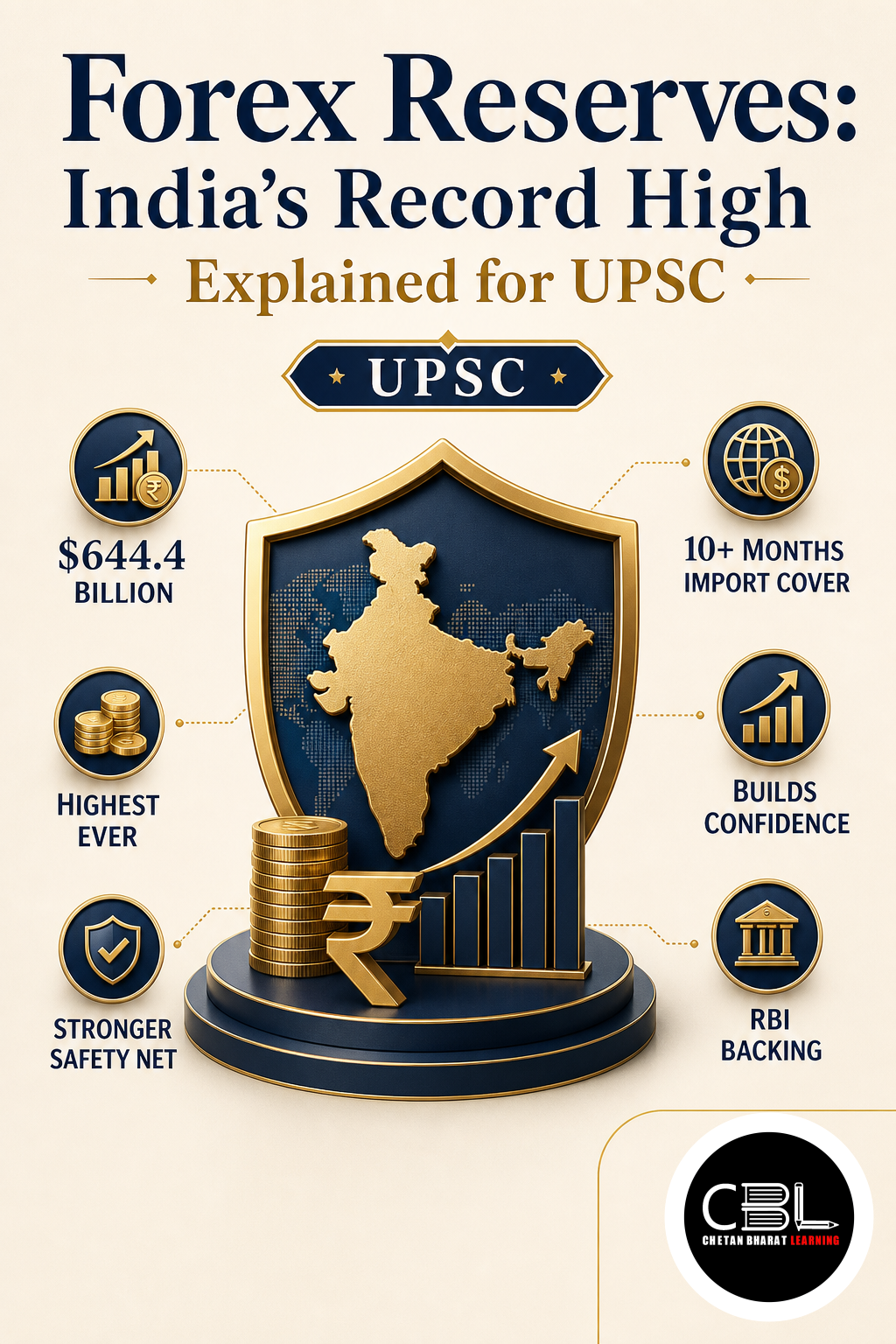
Forex Reserves have climbed to a record level, strengthening India’s external financial buffer during a period of global uncertainty. The source article cites Reserve Bank of India data showing reserves at $729.33 billion for the week ended 21 August 2026, after a weekly rise of $12.42 billion. This matters for the rupee, import financing and confidence during external shocks; see the daily current affairs archive for related UPSC coverage.
Forex Reserves are external assets held by a country’s monetary authority and available for meeting foreign-currency needs or supporting financial stability. In India, the RBI manages a reserve pool comprising foreign currency assets, gold, Special Drawing Rights and the reserve tranche position with the International Monetary Fund. These assets provide liquidity when normal foreign-exchange inflows weaken or market conditions become disorderly, allowing essential external payments to continue without forcing abrupt adjustment in trade or financing.
Why is Forex Reserves in News?
The rise in Forex Reserves is in focus because the source reports an all-time high of $729.33 billion for the week ended 21 August 2026. It also records a $12.42 billion weekly increase, signalling a substantial addition to India’s external buffer. The article places this movement in the wider context of reserve adequacy, rupee management and India’s position among major reserve-holding economies, while cautioning that a large stock does not eliminate exposure to external shocks.
The immediate increase should not be read as a simple measure of economic strength because reserve levels can change through several channels. Foreign investment, remittances, export receipts and foreign-currency deposits can expand market supply, while RBI transactions and valuation changes influence the official stock, so weekly reserve movements can reflect both fresh flows and changes in asset values. Aspirants can track the central bank’s official releases through the Reserve Bank of India for authoritative reserve and monetary data.
Key Features
- Four-part reserve composition: Combines foreign currency assets, gold, SDRs and the IMF reserve tranche position, giving the RBI access to different forms of internationally accepted liquidity during stress while reducing dependence on a single reserve instrument.
- Shock-absorption capacity: A large liquid reserve stock can help finance essential imports, meet external payment needs and reassure markets during global funding tightness, reducing the risk of broader financial disruption.
- Managed-float support: The RBI can buy or sell foreign currency to curb excessive volatility and preserve orderly market functioning when demand–supply imbalances become disruptive.
- Multiple inflow channels: Export earnings, remittances, foreign investment and foreign-currency deposits increase supply, while actual accumulation depends on central-bank transactions and valuation effects.
- FCNR(B) relevance: Foreign-currency non-resident deposits boost availability without converting principal into rupees, illustrating the importance of deposit stability and maturity profile.
Challenges
- Opportunity cost: Prioritising safety and liquidity means reserve assets may earn lower returns compared with riskier alternatives, creating a trade-off between insurance and income.
- Valuation volatility: Exchange-rate changes among major currencies and movements in gold or security prices can alter the reported total even without fresh inflows.
- Imported energy dependence: A sustained rise in crude-oil prices can expand dollar demand, widen the import bill and pressure the rupee, inflation and current account.
- Sudden capital outflows: Global risk aversion can trigger portfolio withdrawals, requiring the financial system to absorb sharper currency movements.
- Durability of inflows: Exports, remittances, portfolio flows and deposits differ in persistence and sensitivity to global rates, so not all additions are equally stable.
Way Forward
India should assess reserve strength through adequacy, liquidity and safety rather than ranking alone. Metrics such as import cover, short-term external debt, potential capital outflows and commodity-price exposure provide a fuller picture of preparedness. A diversified portfolio reduces dependence on any single asset while preserving payment capacity during market stress.
The stronger long-term strategy is to reinforce sustainable reserve-generating flows—competitive exports, resilient services earnings, stable remittances and prudent external borrowing. The RBI must balance exchange-rate flexibility with judicious intervention, complementing sound domestic macroeconomic policy. Official indicators can be followed via the RBI Database on Indian Economy.
Prelims Practice Corner
- Q1. Which of the following forms part of India’s official foreign-exchange reserve assets?
(a) Gold reserves (b) SDR holdings (c) Reserve tranche position with the IMF (d) All of the above
Answer: (d) India’s official reserves include foreign currency assets, gold, SDRs and the IMF reserve tranche position. - Q2. Special Drawing Rights are created by which institution?
(a) World Bank (b) International Monetary Fund (c) Bank for International Settlements (d) Asian Development Bank
Answer: (b) SDRs are international reserve assets created by the IMF. - Q3. Which statement best describes India’s exchange-rate arrangement?
(a) Permanently fixed to the US dollar (b) Currency-board system (c) Managed floating arrangement (d) Gold-standard parity
Answer: (c) Market forces determine the rupee broadly, while the RBI may intervene to manage excessive volatility. - Q4. A sharp rise in global crude-oil prices is most likely to affect India through which channel?
(a) Lower dollar demand (b) Higher import bill and currency pressure (c) Automatic fall in inflation (d) Guaranteed rise in exports
Answer: (b) Higher oil prices can raise dollar demand, widen the import bill and pressure the rupee. - Q5. Why is a higher reserve stock not always unambiguously better?
(a) Reserves cannot be liquid (b) They create no external buffer (c) Maintaining safe liquid assets can involve opportunity costs (d) They always weaken the domestic currency
Answer: (c) Reserve assets prioritise safety and liquidity, which may involve lower returns than alternative uses of capital.
Mains Practice Questions
Q1. Explain how a strong foreign-exchange reserve position strengthens India’s ability to manage external-sector shocks. (10 marks)
Answer Structure:
- Intro: Define official reserve assets and identify the RBI as the managing authority.
- Body: Cover import financing, exchange-market intervention, confidence effects, capital outflows, oil shocks and reserve-adequacy indicators.
- Conclusion: Emphasise that adequate, liquid and safe reserves complement sound macroeconomic fundamentals.
Q2. More foreign-exchange reserves do not automatically mean greater economic security. Discuss in the context of reserve adequacy and opportunity cost. (15 marks)
Answer Structure:
- Intro: Distinguish a record reserve level from the broader concept of external resilience.
- Body: Examine liquidity needs, import cover, short-term debt, capital-flow risks, valuation effects, opportunity cost and the durability of reserve-generating inflows.
- Conclusion: Link reserve policy with diversified exports, prudent external liabilities and flexible exchange-rate management.
FAQs on Forex Reserves
What are the main components of India’s foreign-exchange reserve assets?
India’s official reserve assets comprise foreign currency assets, gold, SDRs and the reserve tranche position with the IMF. The RBI manages these assets to preserve liquidity, safety and external-payment capacity.
Does a record reserve level mean the rupee cannot depreciate?
No. The rupee remains market-determined within a managed-float framework, so it can move with demand, supply and global conditions. The RBI may intervene to curb disorderly volatility rather than guarantee a fixed rate.
How should UPSC aspirants judge reserve adequacy?
Aspirants should look beyond the absolute dollar total and examine import cover, short-term external debt, potential capital outflows and financing needs. The quality, liquidity and durability of the reserve buffer matter alongside its size.
Related Current Affairs
Preparing for UPSC, PCS or HCS?
Talk to a mentor at Chetan Bharat Learning, Chandigarh. Free guidance on choosing the right exam and building a study plan.
Chat on WhatsAppCall 97793 53345UPSC / IAS / PCS coaching in Chandigarh · Trusted by aspirants across Punjab & Haryana
Leave a Reply
You must be logged in to post a comment.