
UPSC Mapping
| Prelims | International Relations, Energy |
|---|---|
| Mains | GS Paper 2 – International Relations |
Quick Facts
| Trade Target | USD 5 Billion by 2030 |
|---|---|
| Bilateral Trade 2025-26 | Close to USD 1 Billion |
| Partnership Anniversary | 15th Year |
| Aral Sea Grant | USD 1 Million for Afforestation |
What is India Uzbekistan Relations Upgrade?
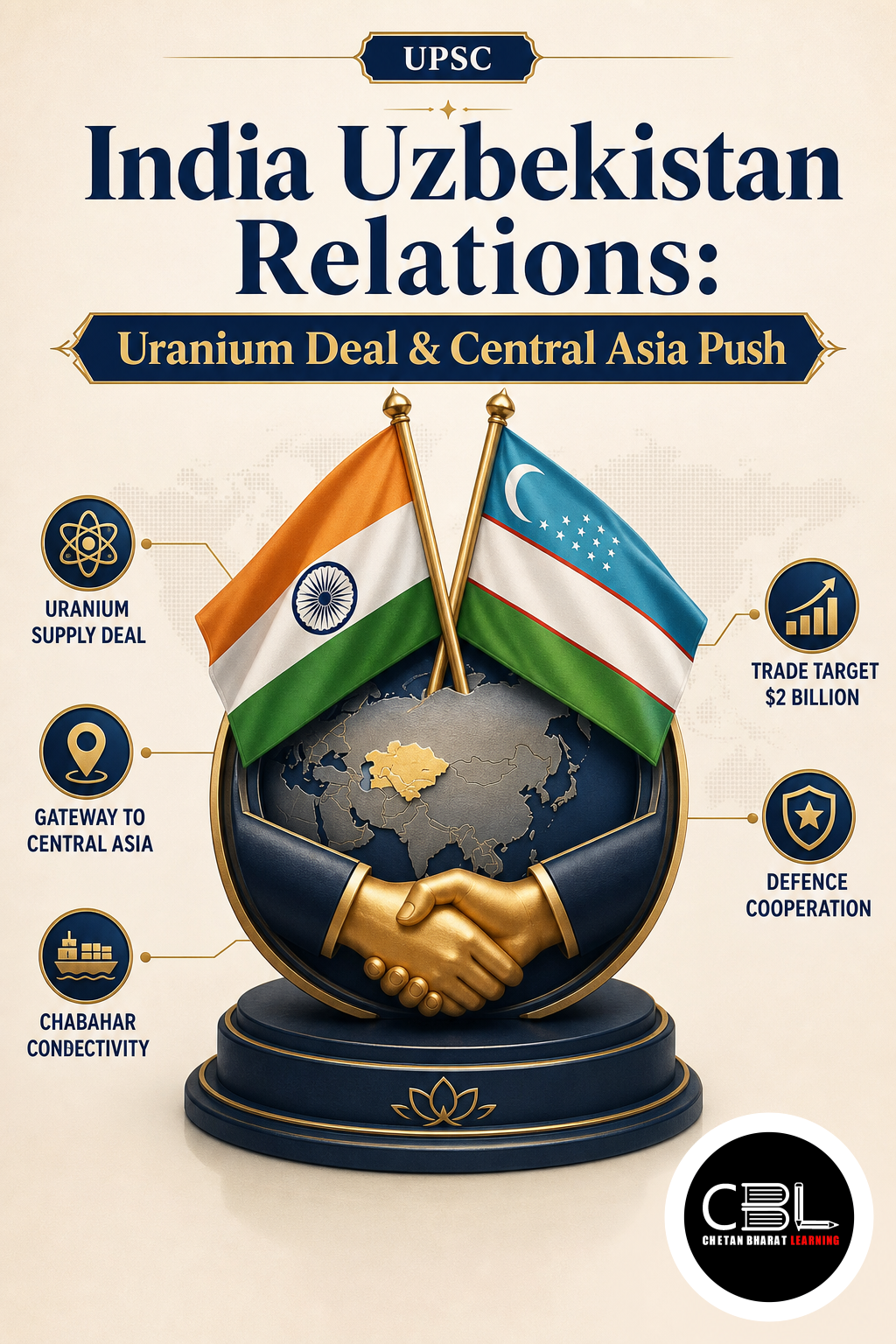
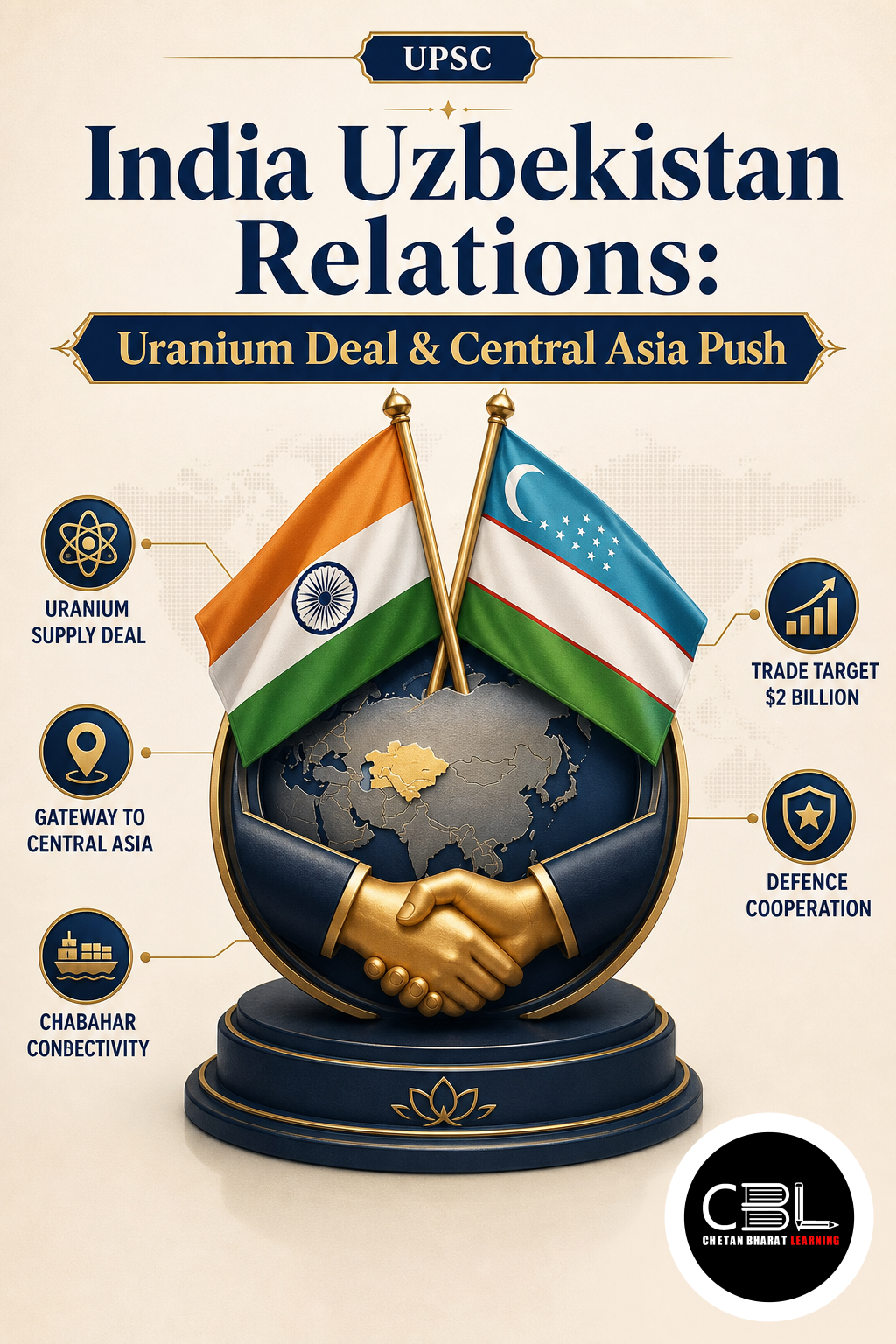
India Uzbekistan Relations were elevated to a Comprehensive Strategic Partnership during PM Modi’s Tashkent visit, covering energy, critical minerals, defence, agriculture and pharmaceuticals. Uzbekistan is the most populous country in Central Asia and sits at the heart of the region’s connectivity and resource landscape.
Uzbekistan is rich in gold, minerals and uranium, and serves as an important hub for reaching Afghanistan and the wider region. India’s engagement here is guided by the shared vision of “Yangi Uzbekistan” and “Viksit Bharat 2047”, tying youth, innovation and modern technology into the partnership’s core.
Why is India Uzbekistan Relations in News?
The two sides discussed a long-term arrangement for uranium supply to India, with an agreement expected soon to feed India’s growing civilian nuclear power programme. Security cooperation has also deepened since the Taliban takeover in Afghanistan, with both nations working through a Joint Working Group on Military Cooperation and joint military exercise Dustlik.
Officials signed 11 pacts covering trade, investment, infrastructure, critical minerals, mining, health, education and digital public infrastructure including UPI. Further details are available via the MEA statement on the visit.
Key Features
- Energy security: Uranium, oil, natural gas and hydropower access reduce India’s import dependence.
- Critical minerals access: Central Asian reserves support India’s renewables, EV and electronics manufacturing goals.
- Security cooperation: Joint efforts address terrorism, extremism and drug trafficking linked to Afghanistan.
- Geopolitical balancing: India seeks a meaningful Eurasian presence amid competition from China, Russia, the US and Turkiye.
- Nuclear energy expansion: Secure uranium imports support India’s low-carbon baseload power strategy.
Challenges
- No direct land connectivity: Pakistan’s location blocks a traditional overland route to Central Asia.
- Reliance on alternate corridors: Chabahar Port and the INSTC remain underdeveloped compared to China’s Belt and Road routes.
- China’s infrastructure lead: Beijing has invested heavily in Central Asian roads, railways and pipelines.
- Diplomacy without delivery risk: Goodwill visits must translate into real projects, a gap tracked in the daily current affairs archive.
- Limited domestic uranium reserves: India must diversify suppliers to avoid overdependence on any single country.
Way Forward
India’s Central Asia strategy is expected to rest on three pillars: connectivity, energy and resources, and security partnerships. Rather than replicating China’s infrastructure-heavy model, India can build on its comparative strengths in development partnership, education, healthcare and digital public infrastructure.
Converting diplomatic goodwill into real connectivity and economic presence, supported by clear roadmaps in energy, minerals and defence sectors, remains the central challenge. Updates on related uranium and nuclear cooperation are tracked through Department of Atomic Energy releases.
Prelims Practice Corner
Q1. India and Uzbekistan set a bilateral trade target of USD 5 billion by which year?
(a) 2026 (b) 2028 (c) 2030 (d) 2035
Answer
Answer: (c) The two sides set a target of USD 5 billion bilateral trade by 2030.
Q2. Which alternative connectivity route helps India bypass Pakistan to reach Central Asia?
(a) Karakoram Highway (b) Chabahar Port (c) Wagah corridor (d) Nathu La Pass
Answer
Answer: (b) Chabahar Port in Iran provides an alternate route to Central Asia and Afghanistan.
Q3. INSTC stands for which of the following?
(a) International North-South Transport Corridor (b) Indo-Nepal Strategic Trade Cooperation (c) India-Nordic Sea Transport Council (d) Indian Northern Strategic Trade Corridor
Answer
Answer: (a) INSTC connects India via Iran and the Caucasus to Russia and Europe.
Q4. India’s joint military exercise with Uzbekistan is known as?
(a) Indra (b) Dustlik (c) Yudh Abhyas (d) Garuda
Answer
Answer: (b) Exercise Dustlik is the India-Uzbekistan joint military exercise.
Q5. Which Central Asian country is most populous and central to India’s regional strategy?
(a) Kazakhstan (b) Turkmenistan (c) Uzbekistan (d) Tajikistan
Answer
Answer: (c) Uzbekistan is the most populous Central Asian nation and central to India’s engagement.
Mains Practice Questions
Q1. Discuss the significance of Central Asia for India’s energy security and strategic autonomy. (250 words, 15 marks)
Answer Structure
Intro: Introduce Central Asia’s resource wealth and India’s growing interest.
Body: Cover uranium and energy security, critical minerals, Afghanistan-linked security concerns, and geopolitical balancing against China and Russia.
Conclusion: Stress diversified supply and strategic autonomy as long-term goals.
Q2. “Diplomacy without connectivity has limited strategic impact.” Examine India’s connectivity challenges in Central Asia. (250 words, 15 marks)
Answer Structure
Intro: State the absence of direct land connectivity as India’s core Central Asia challenge.
Body: Discuss Chabahar Port, INSTC, multimodal sea-rail-road options, and comparison with China’s Belt and Road infrastructure.
Conclusion: Suggest India build on its comparative strengths rather than replicate China’s model.
FAQs on India Uzbekistan Relations
Why does India need uranium from Uzbekistan?
India’s domestic uranium reserves are limited relative to its expanding civilian nuclear power programme, so diversified imports from countries like Uzbekistan support energy security.
What is India’s main challenge in reaching Central Asia?
The absence of direct land connectivity, since Pakistan lies between India and Central Asia, forces reliance on alternate routes like Chabahar Port and the INSTC.
What is India’s comparative advantage over China in Central Asia?
India offers development partnership, education and capacity building, healthcare, digital public infrastructure and civilizational ties, rather than large-scale infrastructure lending.
Related Current Affairs
Preparing for UPSC, PCS or HCS?
Talk to a mentor at Chetan Bharat Learning, Chandigarh. Free guidance on choosing the right exam and building a study plan.
Chat on WhatsAppCall 97793 53345UPSC / IAS / PCS coaching in Chandigarh · Trusted by aspirants across Punjab & Haryana
Leave a Reply
You must be logged in to post a comment.