

UPSC Mapping
Prelims
International Relations
Mains
GS Paper II (Diaspora) + GS Paper III (Services Economy)
Quick Facts
| Type | US non-immigrant work visa (specialty occupations) |
|---|---|
| Administered by | USCIS (DHS) |
| Statutory cap | 65,000 + 20,000 (US master’s exemption), with exemptions |
| Core feature | Employer-sponsored, job-linked status |
What is H-1B visa?
H-1B visa is a US non-immigrant route that allows employers to hire foreign workers for specialty occupations requiring specialised knowledge and at least a relevant bachelor’s degree or equivalent. It is not a general work permit; the worker’s legal stay is closely tied to a sponsoring employer and the approved job terms.
The programme sits at the intersection of labour market regulation and high-skill migration. Since demand often exceeds the statutory cap, selection generally operates through a cap-based process, while certain categories can be exempt under US rules, which is why UPSC answers should avoid treating it as a single uniform quota system.
For India, the relevance is structural: many Indian students and professionals aim for US roles in technology, engineering, and research-intensive sectors. Indian IT and consulting firms also engage with the US market through on-site teams, which makes visa costs, timelines, and compliance requirements a competitiveness issue.
Why is H-1B visa in News?
US political debate has again raised the idea of sharply increasing the cost of the work-visa route, with reports describing a possible very high fee pathway as a legally pursued option. Even when proposals do not immediately become law, they shape employer expectations, hiring cycles, and the broader signal the US sends on global talent and economic nationalism.
For UPSC, read this as a policy instrument choice: does the US ration scarce visas by price, by lottery, or by stricter eligibility and compliance filters. Aspirants should rely on primary guidance for baseline facts and process descriptions, such as USCIS programme guidance, and then analyse proposals as political economy rather than as settled law.
Key Features
- Employer sponsorship and job specificity: the worker’s status depends on a petition tied to a particular role, location, and wage conditions.
- Cap and selection pressures: applications can exceed the annual cap, turning allocation into a contested governance question.
- Wage and compliance architecture: aims to prevent undercutting local labour markets through documentation and enforcement tools.
- Mobility frictions: job changes and layoffs can trigger fresh filings or time-bound transitions, affecting worker bargaining power.
- Strong India linkage: due to Indian participation in US tech, research, and services delivery models like onsite-offshore arrangements.
A high-fee proposal should be evaluated against these features. If price becomes a main rationing tool, it may favour deep-pocket employers and reduce access for smaller firms, early-career hires, and some research or non-profit pathways.
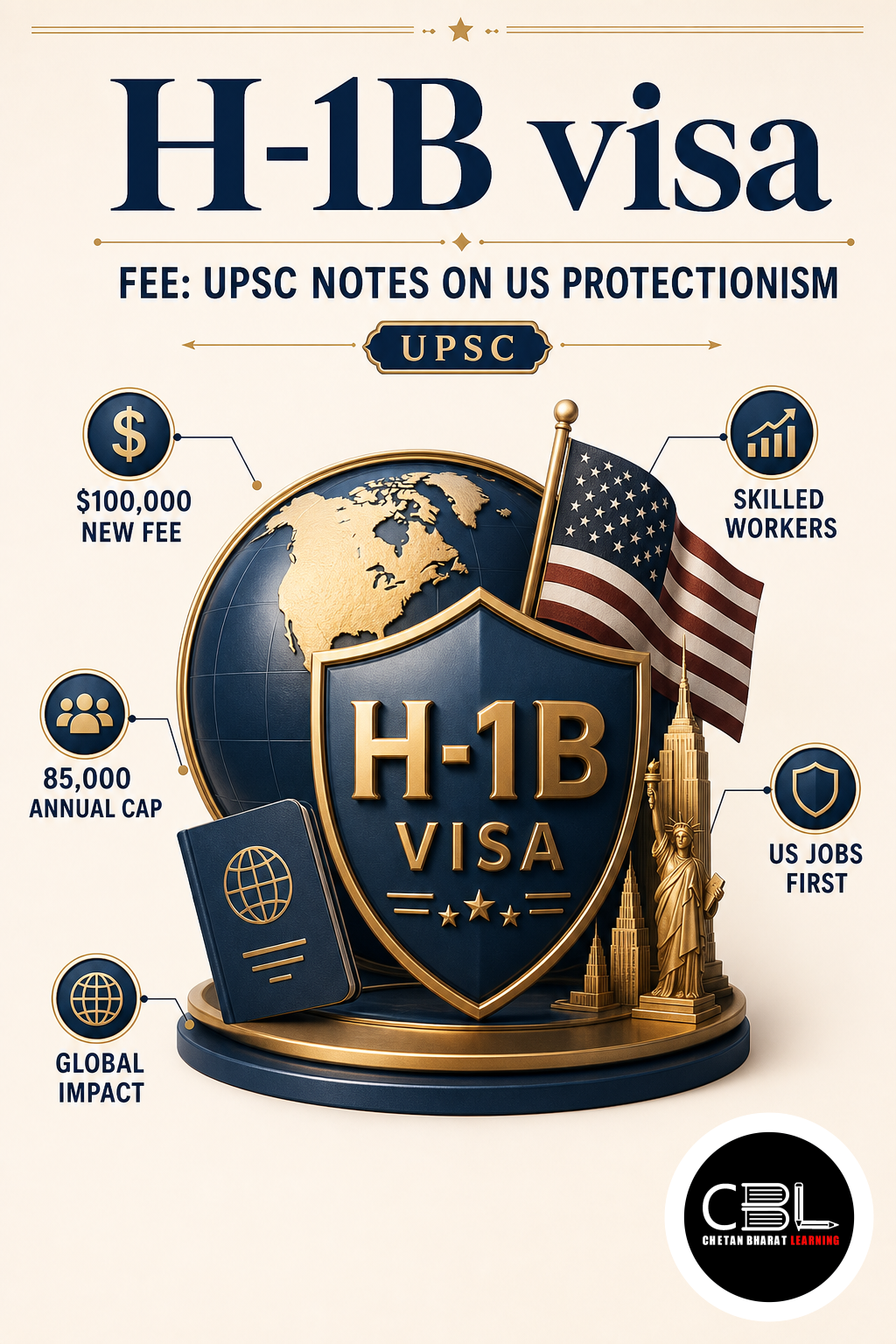
The $100,000 economic logic, as argued by supporters, resembles a market-clearing mechanism: a very high fee can reduce excess demand, raise public revenue, and push employers to prioritise only the highest-value roles. Critics counter that it can operate like a barrier to entry, shifting the selection from skills to budgets and potentially distorting innovation ecosystems that depend on diverse talent pipelines.
Challenges
- Legal and administrative constraints: limit how far fee-setting can go without legislative backing, inviting litigation and policy reversal cycles.
- Impact on Indian professionals: can be direct if employers pass costs through to candidates, reduce sponsorship, or shift hiring to other geographies.
- Impact on Indian IT companies: through higher operating costs, changes in client pricing, and pressure to accelerate local hiring or near-shoring.
- Globalisation vs protectionism: sharper when the US frames talent inflows as a labour threat, while firms frame them as competitiveness needs.
- Unintended substitution: may push demand towards other visa categories, remote contracting, or relocation to third countries, rather than reducing outsourcing incentives.
For UPSC-style evaluation, show how such measures can affect India’s services exports, remittance patterns, and diaspora mobility, while also recognising US domestic drivers like wage politics and electoral signalling. You can revise related diaspora and IR themes from international relations current affairs notes to build a multi-dimensional answer.
A major analytical point is policy credibility over time. When rules swing sharply across administrations, employers treat the programme as unpredictable and redesign workforce strategies, which can permanently alter demand for overseas hiring even if later rules soften.
Way Forward
India’s response should be framed around risk diversification rather than confrontation. Firms can reduce exposure by building deeper local hiring capacity in key markets, strengthening delivery from India through secure remote models, and investing in high-value niches like product engineering, semiconductors, AI safety, and cybersecurity where demand is more resilient.
At the diplomatic level, India can keep focus on transparent, predictable mobility channels, and protect worker welfare through consular outreach and information support. For compliance-linked basics that often surface in debates, candidates can consult the US labour-side framework for employer attestations via US Department of Labor compliance overview and then connect it to GS-II topics like diaspora, bilateral relations, and rule-based economic engagement.
Prelims Practice Corner
-
Q1. The US H-1B category is primarily intended for:
- (a) Tourist travel
- (b) Specialty occupation employment
- (c) Refugee resettlement
- (d) Short-term business meetings without employment
Answer: (b) It is designed for specialty occupations requiring specialised knowledge.
-
Q2. Which US agency administers employer petitions for specialty occupation workers?
- (a) NASA
- (b) USCIS
- (c) IMF
- (d) WTO
Answer: (b) USCIS, under the Department of Homeland Security, processes petitions.
-
Q3. A very large visa fee increase is most likely to ration demand by:
- (a) Random lottery only
- (b) Price
- (c) Coastal location
- (d) Exchange rate targeting
Answer: (b) A higher fee screens applications by willingness and ability to pay.
-
Q4. Which of the following is a plausible impact of sharply higher work-visa costs?
- (a) Lower compliance costs for firms
- (b) Reduced hiring by smaller firms and startups
- (c) Guaranteed higher wages for all workers globally
- (d) Automatic increase in the statutory cap
Answer: (b) Higher costs can disproportionately affect smaller employers with tighter budgets.
-
Q5. In UPSC terms, debates over high-skill migration most directly relate to:
- (a) Only art and culture
- (b) Diaspora, labour markets, and services economy
- (c) Only geomorphology
- (d) Only disaster management
Answer: (b) The topic links IR and diaspora with economic competitiveness and services trade.
Mains Practice Questions
-
Q1. Analyse how sharp increases in US high-skill work visa costs can affect Indian professionals and India’s services sector. (10 marks)
Answer Structure:
- Intro: Link high-skill mobility to India’s diaspora and services-led engagement with the US.
- Body: (1) hiring and sponsorship changes, (2) cost pass-through to workers, (3) impact on Indian IT pricing and onsite delivery, (4) skill pipeline and students, (5) broader signal on protectionism.
- Conclusion: Stress diversification and higher-value positioning rather than dependence on one channel.
-
Q2. Globalisation is witnessing a protectionist push in several economies. Discuss using skilled migration and visa policy as a case study, and suggest India’s way forward. (15 marks)
Answer Structure:
- Intro: Define protectionism beyond tariffs, including restrictions on labour mobility.
- Body: (1) domestic political drivers, (2) economic logic of rationing by price and compliance, (3) innovation and labour market trade-offs, (4) India’s interests: diaspora welfare and services exports, (5) options: market diversification, upskilling, domestic ecosystem, diplomacy on predictable mobility.
- Conclusion: Advocate resilient global engagement with reduced single-market dependency.
FAQs on H-1B visa
Why does this US visa debate matter for India beyond individual job seekers?
It affects India’s services delivery models, talent mobility, and the wider economic linkages created by a large skilled diaspora. It also signals how the US balances competitiveness with domestic labour politics.
Does a very high fee automatically reduce outsourcing?
Not necessarily. Firms can substitute with remote work, local hiring, or relocation to third countries, so the effect depends on enforcement, market conditions, and project needs.
How should I write a balanced UPSC Mains answer on this topic?
Define the programme, then present both sides: labour market protection and revenue logic versus innovation and access concerns. Conclude with India’s practical pathway: diversify markets, move up the value chain, and seek predictable mobility rules through diplomacy.
Related Current Affairs
Preparing for UPSC, PCS or HCS?
Talk to a mentor at Chetan Bharat Learning, Chandigarh. Free guidance on choosing the right exam and building a study plan.
Chat on WhatsAppCall 97793 53345UPSC / IAS / PCS coaching in Chandigarh · Trusted by aspirants across Punjab & Haryana
Leave a Reply
You must be logged in to post a comment.