

UPSC Mapping
| Prelims | Economy |
|---|---|
| Mains | GS Paper 3 |
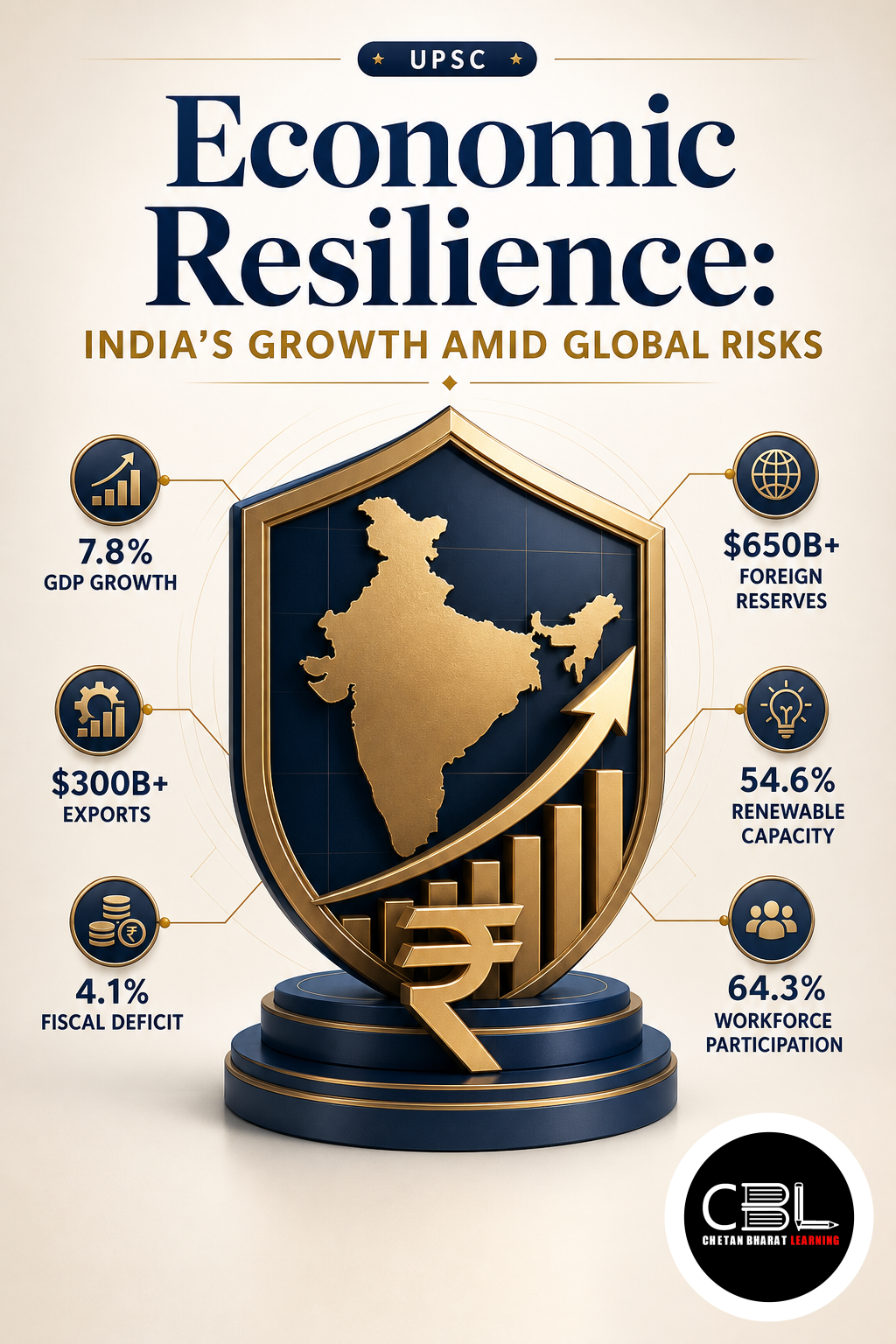
India’s economic resilience is demonstrating notable strength despite a fragile global environment marked by geopolitical tensions and trade uncertainties. According to the Reserve Bank of India’s recent ‘State of the Economy’ article, buoyant domestic demand, a recovery in manufacturing, and improving monsoon conditions are providing crucial support. For a deeper understanding of current economic trends, explore our daily current affairs archive.
Quick Facts
| Repo Rate (Aug 2026) | 5.25% |
|---|---|
| FY27 Growth Forecast | 6.7% (revised up from 6.6%) |
| Inflation Projection (FY27) | 5.0% (revised down from 5.1%) |
What is Economic Resilience?
Economic resilience refers to an economy’s ability to absorb external shocks while maintaining economic activity, employment, investment, and financial stability. It is a key measure of a nation’s macroeconomic strength and policy effectiveness.
For India, this resilience is rooted in its robust macroeconomic fundamentals, including a large domestic market, a stable financial system, and proactive monetary and fiscal policy responses. These factors collectively cushion the economy against global headwinds.
Why is Economic Resilience in News?
The RBI’s ‘State of the Economy’ article, published in its August 2026 bulletin, has brought economic resilience into focus. The report highlights that India’s domestic economy is demonstrating notable resilience to a fragile global environment characterized by geopolitical friction in West Asia, renewed US tariffs, and persistent trade uncertainties.
Despite these headwinds, the RBI noted that domestic demand remains buoyant, supported by a recovery in manufacturing and services activity, improving monsoon conditions, and a rebound in capital inflows. According to a PIB release, the MPC has revised the growth forecast for FY27 upward to 6.7% from 6.6%.
Key Features of India’s Economic Resilience
- Buoyant Domestic Demand: Strong consumption and investment activity, reflected in vehicle and tractor sales, provide a crucial shock absorber against global volatility.
- Recovering Manufacturing & Services: Industrial production recorded its strongest growth in nearly two years, supported by broad-based acceleration in manufacturing.
- Improving Monsoon & Agriculture: The southwest monsoon recovery in July has helped normalise acreage, mitigating risks to the agricultural sector and ensuring food security.
- Rebound in Capital Inflows: Foreign capital inflows have strengthened, reinforcing the external sector and supporting financial stability.
- Stable Core Inflation: Despite headline inflation rising due to supply-side pressures, stable core inflation reaffirms the lower pass-through of cost pressures.
Challenges to Sustained Economic Resilience
- Global Headwinds & Trade Uncertainty: Geopolitical tensions and US tariffs continue to pose risks to global trade and the growth-inflation outlook.
- Inflationary Pressures: Headline CPI inflation is projected to peak at 5.9% in Q3 2026-27, potentially necessitating a rate hike by the MPC to anchor inflation expectations.
- External Vulnerabilities: Dependence on commodity prices and global financial conditions can expose India to external shocks.
- Structural Bottlenecks: Issues like infrastructure gaps, supply chain inefficiencies, and skill mismatches can impede long-term growth potential.
- Fiscal Constraints: Managing fiscal deficits while maintaining social spending and capital expenditure remains a critical challenge.
Way Forward for Strengthening Economic Resilience
To ensure sustained economic resilience, India must focus on a multi-pronged strategy. This includes continuing structural reforms to improve the ease of doing business, boosting infrastructure investment, and encouraging private capital formation. The RBI’s focus on liquidity management and monetary policy calibration is critical to keep inflation in check while supporting growth.
Furthermore, diversifying supply chains, promoting domestic manufacturing, and investing in digital public infrastructure can help reduce external vulnerabilities. As per a NITI Aayog report, enhancing human capital and skill development is vital for improving productivity and ensuring inclusive growth.
Prelims Practice Corner
Q1. According to the RBI’s ‘State of the Economy’ article, what is the revised growth forecast for India for FY27?
(a) 6.5% (b) 6.7% (c) 6.9% (d) 7.0%
Show answer
Answer: (b) The RBI’s Monetary Policy Committee marginally raised the growth forecast for FY27 to 6.7% from 6.6%.
Q2. Which of the following is NOT identified as a global headwind affecting the Indian economy?
(a) Geopolitical tensions (b) Renewed US tariffs (c) Buoyant domestic demand (d) Persistent trade uncertainties
Show answer
Answer: (c) Buoyant domestic demand is a domestic strength, not a global headwind.
Q3. What is the current Repo Rate, as mentioned in the RBI bulletin article?
(a) 4.00% (b) 5.00% (c) 5.25% (d) 6.00%
Show answer
Answer: (c) The RBI’s Monetary Policy Committee kept the key Repo rate unchanged at 5.25% in its August 2026 meeting.
Q4. According to the RBI article, what is the projected peak for headline CPI inflation in Q3 2026-27?
(a) 5.0% (b) 5.5% (c) 5.9% (d) 6.5%
Show answer
Answer: (c) The RBI article indicates that headline inflation is projected to peak to a level as high as 5.9% in Q3 2026-27.
Q5. Which of the following is a key indicator of domestic demand strength mentioned in the article?
(a) Declining capital inflows (b) Vehicle and tractor sales (c) Contraction in manufacturing (d) High government borrowing
Show answer
Answer: (b) Vehicle and tractor sales are highlighted as indicators of buoyant domestic demand.
Mains Practice Questions
Q1. “India’s large domestic market has enhanced its resilience to global economic shocks, but structural and external vulnerabilities persist.” Discuss. (15 Marks)
Intro: Define economic resilience and contextualize India’s position amid global headwinds.
Body: Discuss domestic strengths (demand, manufacturing, services) vs. vulnerabilities (inflation, global shocks, structural issues like skill mismatch). Include government and RBI policy responses.
Conclusion: Suggest way forward focusing on structural reforms and supply chain diversification.
Q2. Discuss the role of the Reserve Bank of India in maintaining economic resilience, with a focus on its monetary policy framework. (10 Marks)
Intro: Briefly describe the RBI’s mandate in ensuring price and financial stability.
Body: Explain the RBI’s tools (repo rate, liquidity management) and their role in managing the growth-inflation trade-off, as seen in the recent MPC decisions.
Conclusion: Emphasize the need for a balanced approach to support growth while anchoring inflation expectations.
FAQs on Economic Resilience
What is economic resilience in the context of the Indian economy?
Economic resilience refers to India’s ability to absorb and recover from external shocks like global recessions, geopolitical tensions, and trade disruptions, while sustaining domestic economic activity and stability.
How does the RBI contribute to India’s economic resilience?
The RBI contributes by managing monetary policy to balance growth and inflation, ensuring adequate liquidity, maintaining financial stability, and building foreign exchange reserves to cushion against external shocks.
What are the major threats to India’s economic resilience?
Major threats include global geopolitical tensions, rising protectionism, commodity price volatility, domestic inflationary pressures, and structural issues such as the education-employment gap that affect long-term productive capacity.
Related Current Affairs
Preparing for UPSC, PCS or HCS?
Talk to a mentor at Chetan Bharat Learning, Chandigarh. Free guidance on choosing the right exam and building a study plan.
Chat on WhatsAppCall 97793 53345UPSC / IAS / PCS coaching in Chandigarh · Trusted by aspirants across Punjab & Haryana
Leave a Reply
You must be logged in to post a comment.