
UPSC Mapping
| Prelims | Mains |
|---|---|
| Agriculture & Environment | GS Paper III |
Quick Facts
| Area covered (NMNF) | 8.80 lakh ha |
|---|---|
| Farmers (NMNF) | 18.19 lakh |
| PDMC coverage | 109 lakh ha (May 2026) |
What is Regenerative Agriculture?
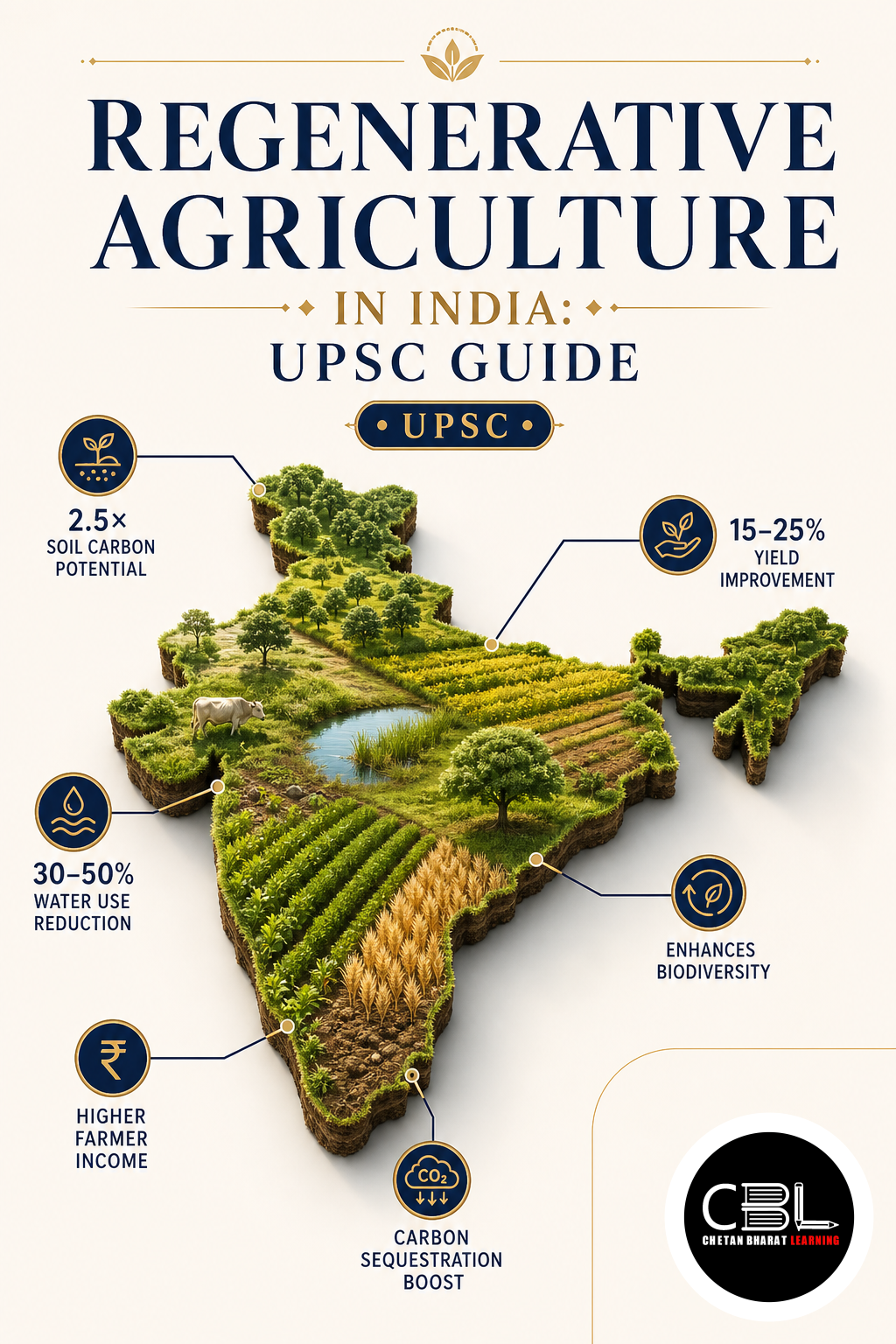
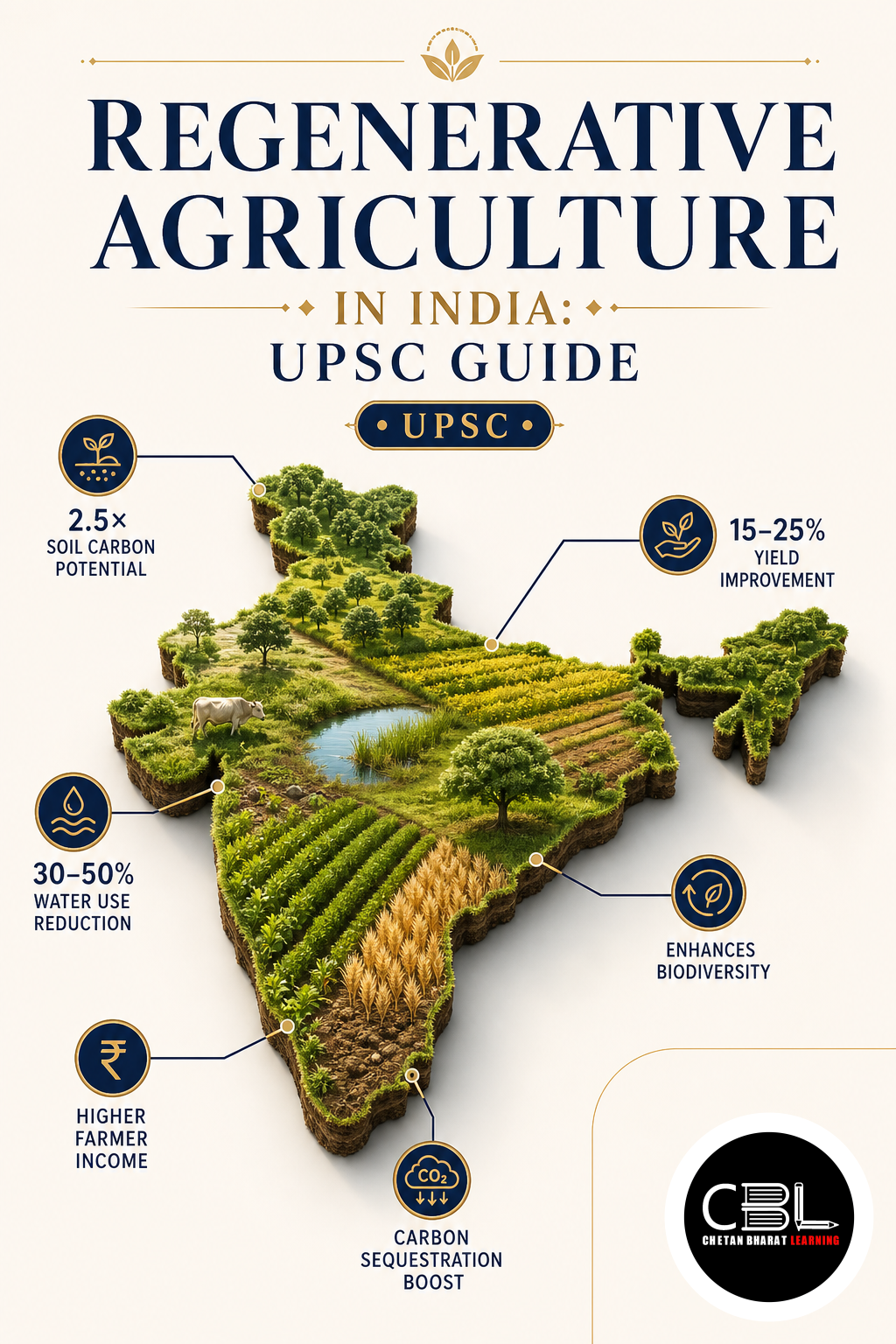
Regenerative agriculture is a holistic farming system that focuses on restoring soil health, enhancing biodiversity, and rebuilding ecosystem resilience rather than merely sustaining degraded baselines. It moves beyond ‘sustainable’ by actively improving the natural resource base through practices like minimal tillage, continuous soil cover, and crop-livestock integration.
Core principles include minimizing soil disturbance, protecting living roots of perennial crops, maintaining continuous soil cover, and integrating livestock. These practices enhance soil organic matter, improve water retention, and sequester carbon, making regenerative agriculture a powerful tool against climate change and land degradation.
Why is Regenerative Agriculture in News?
Regenerative agriculture has gained prominence as India shifts toward sustainable farming to tackle intensive agriculture’s negative impacts—groundwater depletion, soil degradation, and rising input costs. The government’s National Mission on Natural Farming (NMNF) has already covered 8.80 lakh hectares and 18.19 lakh farmers by March 2026, signaling a policy push.
Recent reports highlight that regenerative practices can reclaim 30% of India’s degraded land, reduce cultivation costs by 20–40%, and ease extraction stress in groundwater-overexploited regions. The Union Budget 2025-26 further emphasized natural farming and agroforestry. For official updates, refer to the PIB release on NMNF progress.
Key Features of Regenerative Agriculture
India’s regenerative agriculture model rests on several pillars that differentiate it from conventional farming. These features make it a viable alternative for smallholders.
- Resource efficiency: Drippers, sprinklers, and precision mechanisation optimise water and input use, reducing extraction and emissions.
- Nutrient management: Leaf-colour charts and deep-placed urea cut nitrogen use, while cyanobacteria and legumes enable biological nitrogen fixation.
- Bio-inputs: Beejamrut, Jeevamrut, Neemastra, and Dashparni replace synthetic chemicals, while green manuring and mulching protect topsoil.
- Integrated systems: Combining crops with livestock, horticulture, fisheries, and apiculture, along with agroforestry, regulates temperature and sequesters carbon.
- Carbon sequestration: Perennial root systems and cover crops build soil organic carbon, contributing to climate mitigation.
Challenges Facing Regenerative Agriculture
Despite its benefits, regenerative agriculture faces several adoption barriers that need addressing to scale effectively. These challenges are critical for UPSC aspirants to understand.
- Transition lag: A 2–3-year ecological transition phase often leads to temporary yield declines before soil microbiomes stabilise, discouraging risk-averse farmers.
- Knowledge deficit: Regenerative farming requires higher ecological literacy and bio-input preparation skills, which most smallholders lack.
- Biomass shortage: Competing demands for cattle fodder and widespread stubble burning limit organic matter for mulching and composting.
- Fragmented supply chains: India lacks adequate local bio-input centres, reliable certification systems, and premium-price markets for regenerative produce.
- Subsidy bias: Procurement and pricing support for input-intensive rice and wheat hinders diversification into regenerative multi-cropping.
Way Forward for Regenerative Agriculture
Scaling regenerative agriculture in India requires policy support, capacity building, and market development. The government must strengthen institutional frameworks for bio-input production and certification, while also providing risk mitigation during the transition period through insurance or direct income support. Integrating regenerative practices into the curriculum of agricultural universities can bridge the knowledge gap.
Public procurement systems should be reformed to reward regenerative produce, and private sector engagement through CSR can foster supply chains. International cooperation, such as the FAO’s Global Alliance for Regenerative Agriculture, can provide technical guidance. For global best practices, refer to the FAO website on sustainable food systems.
Prelims Practice Corner
Q1. Which of the following is NOT a core principle of regenerative agriculture?
- (a) Minimise soil disturbance
- (b) Maintain continuous soil cover
- (c) Maximise synthetic fertiliser use
- (d) Integrate livestock
Answer: (c) Regenerative agriculture avoids synthetic fertilisers and emphasises natural inputs.
Q2. What is the primary objective of the National Mission on Natural Farming (NMNF)?
- (a) Increase chemical fertiliser use
- (b) Promote chemical-free, climate-resilient farming
- (c) Export organic produce
- (d) Provide subsidy for pesticides
Answer: (b) NMNF promotes chemical-free, climate-resilient farming via clusters.
Q3. How much assistance does the Per Drop More Crop (PDMC) scheme offer to small and marginal farmers?
- (a) 25%
- (b) 45%
- (c) 55%
- (d) 75%
Answer: (c) PDMC provides 55% assistance for small and marginal farmers and 45% for others.
Q4. Which scheme supports cluster-based Integrated Farming Systems with ₹30,000 per family assistance?
- (a) PKVY
- (b) SMAF
- (c) RAD
- (d) SHC
Answer: (c) Rainfed Area Development Program (RAD) promotes integrated farming systems.
Q5. What percentage of India’s land is undergoing active degradation that regenerative agriculture can help reclaim?
- (a) 10%
- (b) 20%
- (c) 30%
- (d) 40%
Answer: (c) Regenerative agriculture can reclaim 30% of India’s degraded land by restoring soil biota and carbon storage.
Mains Practice Questions
Q1. Analyse the potential of regenerative agriculture to address India’s food security and climate challenges. (15 marks)
Answer Structure:
- Intro: Define regenerative agriculture and its relevance in the context of degrading soils and climate change.
- Body: Discuss benefits: soil restoration, groundwater recharge, cost reduction, emission cuts, and nutritional security. Also address barriers and policy support.
- Conclusion: Emphasise the need for a multi-stakeholder approach and integration with existing government schemes.
Q2. Critically evaluate the government’s initiatives to promote natural farming in India. (10 marks)
Answer Structure:
- Intro: List key schemes: NMNF, PKVY, PDMC, RAD, SMAF.
- Body: Evaluate achievements and shortcomings—coverage, farmer adoption, supply chain gaps, subsidy biases. Suggest improvements.
- Conclusion: Stress the importance of a holistic policy framework and farmer-centric approaches.
FAQs on Regenerative Agriculture
What is the difference between organic and regenerative agriculture?
Organic farming avoids synthetic inputs but may still degrade soil over time. Regenerative agriculture actively restores soil health and ecosystem services, going beyond sustainability to improve natural capital.
What are the main government schemes supporting regenerative agriculture in India?
Key schemes include National Mission on Natural Farming (NMNF), Paramparagat Krishi Vikas Yojana (PKVY), Soil Health Card (SHC), Per Drop More Crop (PDMC), Rainfed Area Development (RAD), and Sub-Mission on Agroforestry (SMAF).
How does regenerative agriculture help in climate change mitigation?
It sequesters carbon in soil through perennial roots and cover crops, reduces nitrous oxide emissions by optimising nitrogen use, and cuts overall greenhouse gas emissions from agriculture.
Related Current Affairs
Preparing for UPSC, PCS or HCS?
Talk to a mentor at Chetan Bharat Learning, Chandigarh. Free guidance on choosing the right exam and building a study plan.
Chat on WhatsAppCall 97793 53345UPSC / IAS / PCS coaching in Chandigarh · Trusted by aspirants across Punjab & Haryana
Leave a Reply
You must be logged in to post a comment.