
UPSC Mapping
| Prelims | Polity & Governance |
|---|---|
| Mains | GS Paper 2 (Social Justice & Governance) |
Article
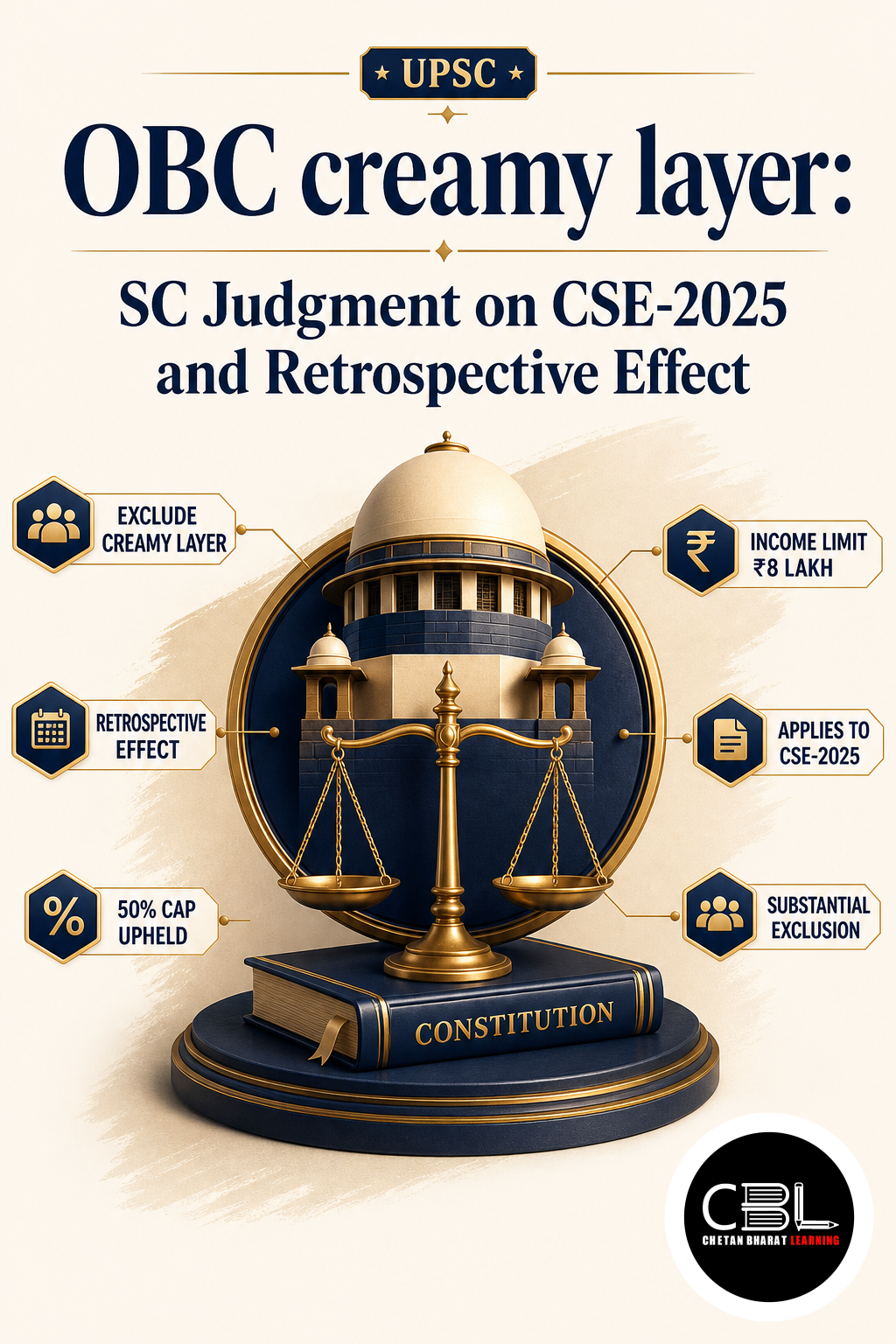
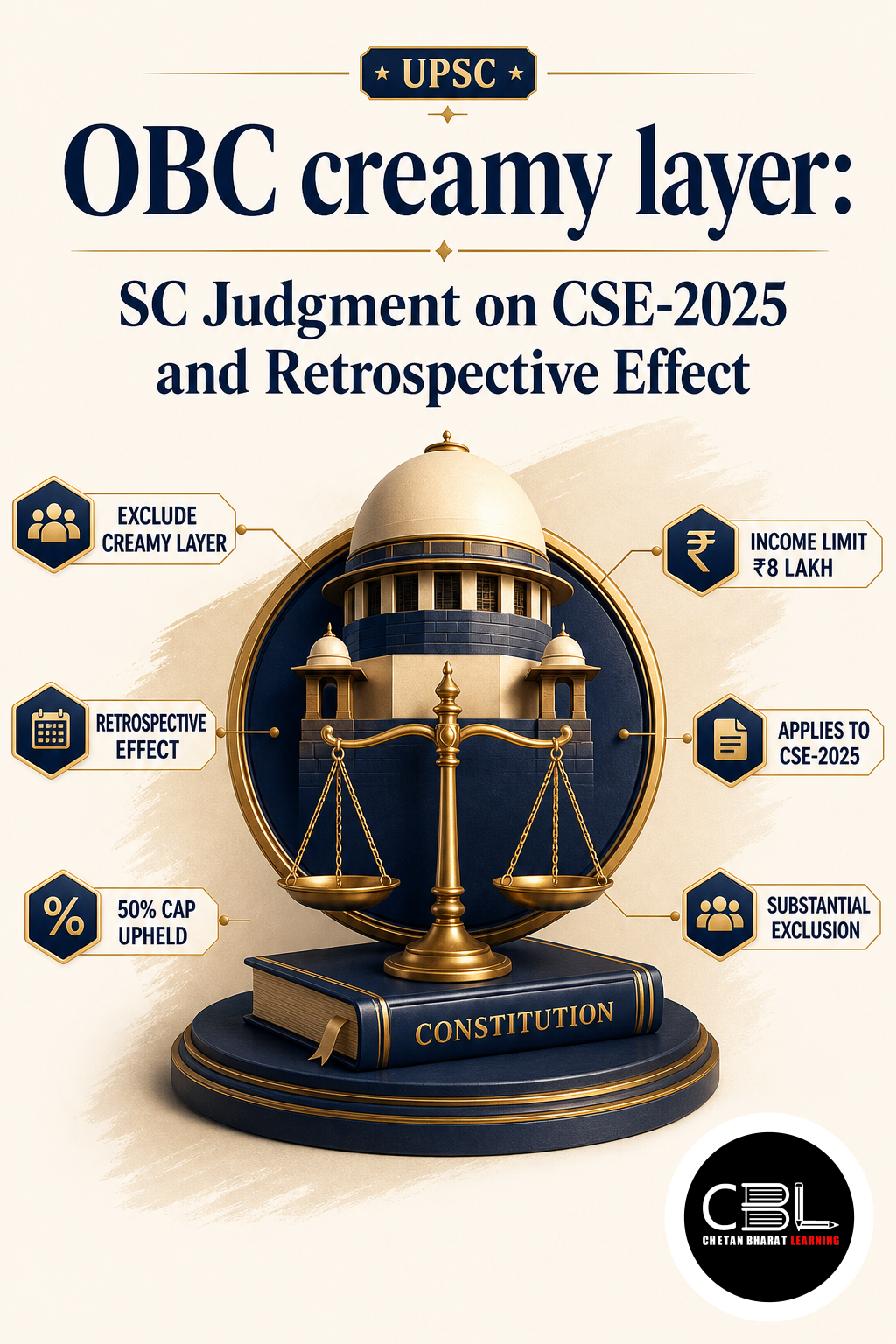
The OBC creamy layer issue has once again come to the fore with the Centre seeking clarifications from the Supreme Court on its March 11, 2026 judgment regarding nearly 100 OBC candidates who were selected in Civil Services Examinations (CSE) since 2016 but rejected by the DoPT based on creamy layer criteria. The government is particularly concerned about the retrospective application of the verdict to CSE-2025, whose final result was declared just five days before the judgment. This has created a legal and administrative dilemma, making it a hot topic for polity current affairs.
Quick Facts
| Key Judgment | SC held income not sole criterion for creamy layer |
|---|---|
| Applicability | Retrospective vs prospective |
What is the OBC Creamy Layer?
The OBC creamy layer refers to the relatively affluent and advanced sections among the Other Backward Classes (OBCs) who are excluded from reservation benefits. The concept was established by the Supreme Court in the Indra Sawhney case (1992), which held that the benefits of reservation should not go to the creamy layer, and it directed the government to evolve criteria for identification. The creamy layer is currently determined based on income, but the recent judgment has held that income cannot be the sole criterion—the nature of employment (Group A/B/C) and social status must also be considered.
The criterion has been controversial because of administrative changes over the years. A 1993 Office Memorandum (OM) excluded salary income from the income test, but a 2004 clarification included salary from PSUs and private sector, leading to litigation. The Supreme Court in March 2026 held that such a distinction was discriminatory and violated Articles 14, 15, and 16.
Why is OBC Creamy Layer in News?
The OBC creamy layer issue is in the news because the Centre has approached the Supreme Court seeking directions to clarify whether the March 11 judgment applies retrospectively to CSE-2025. The final result of CSE-2025 was declared on March 6, 2026, and the DoPT had already processed the list. The government argues that a retrospective application would upset the finalised merit list, delay the foundation course, and have cascading effects on seniority and pay. The Centre also sought a clarification that the judgment should not unsettle completed admissions and degrees.
The petitioners, however, argue that the creamy layer criteria had been incorrectly applied, and the judgment was meant to correct a systemic anomaly. DoPT sources indicated that they were ready to implement the verdict, but the retrospective effect could affect many candidates who had been denied OBC status. For the government’s official statement, check the PIB release on the matter.
Key Issues in the Creamy Layer Debate
- Income vs Social Status: The SC held that income alone is not sufficient; the nature of employment (Group A/B/C) and social disadvantage must be considered.
- Retrospective Effect: Whether the judgment applies to selections already finalised (like CSE-2025) or only future examinations.
- Discriminatory Classification: The earlier policy treated children of government servants and PSU/private employees differently, which was struck down.
- Equality Doctrine: Articles 14, 15, and 16 mandate equal treatment; artificial distinctions violate these provisions.
- Administrative Chaos: Retrospective application could unsettle seniority and training schedules across multiple batches. For more on social justice issues, visit the social justice archive.
Challenges in Implementation
- Verification Burden: Re-examining thousands of applications for creamy layer status is a logistical challenge.
- Legal Uncertainty: The lack of clear criteria on what constitutes ‘social disadvantage’ beyond income creates ambiguity.
- Impact on Completed Processes: Retrospective changes can affect promotions, seniority, and training that are already underway.
- Political Controversy: OBC reservations are politically sensitive, and any change draws strong reactions from various groups.
Way Forward for Creamy Layer Policy
The OBC creamy layer policy needs to be redefined with clear, objective, and updated criteria that are easy to verify. The government should engage with stakeholders to evolve a transparent mechanism that balances the principles of social justice, rule of law, and procedural fairness. The Supreme Court’s directive to consider multiple factors—income, employment grade, and social status—should be operationalised without creating new anomalies.
For CSE-2025, a pragmatic solution might be to apply the judgment prospectively to avoid disrupting the current batch, while compensating affected candidates with appropriate relief. The broader reform should include periodic review of the creamy layer thresholds and ensuring that reservation benefits reach the most disadvantaged sections. As per a PRS India report, the government must also improve data collection on OBC sub-groups to better target welfare.
Prelims Practice Corner
Q1. The concept of creamy layer among OBCs was first established by which Supreme Court judgment?
- (a) Kesavananda Bharati
- (b) Indra Sawhney
- (c) Mandal Commission
- (d) Nagaraj
Answer: (b) Indra Sawhney (1992) also known as the Mandal case.
Q2. What did the March 2026 Supreme Court judgment hold regarding creamy layer?
- (a) Income is the sole criterion
- (b) Income alone is not enough; social status matters
- (c) Creamy layer does not apply to OBCs
- (d) Only government employees are exempt
Answer: (b) The Court held that income cannot be the sole determinant; the nature of employment and social disadvantage must also be considered.
Mains Practice Questions
Q1. “The creamy layer principle seeks to ensure that affirmative action reaches those who continue to face structural disadvantage.” Discuss its constitutional rationale and the challenges in its implementation. (250 words, 15 marks)
Answer Structure
- Intro: Explain the creamy layer concept from Indra Sawhney and its purpose.
- Body: Discuss the constitutional basis (Articles 14, 15, 16), the evolution of criteria, the recent SC judgment, and the challenges of retrospective application and verification.
- Conclusion: Suggest measures for a clear, objective, and non-discriminatory creamy layer policy.
FAQs on OBC Creamy Layer
- What is the OBC creamy layer criterion? The creamy layer includes OBCs who are socially and economically advanced, currently determined mainly by income, but the SC has ruled that income alone is insufficient and other factors like employment grade must be considered.
- Why is the government seeking clarification from the SC? The government wants to know if the March 2026 judgment applies retrospectively to CSE-2025, as the final results were already declared, and any change would disrupt training and seniority.
- What is the 50% reservation ceiling, and is it absolute? The 50% ceiling was set by the Supreme Court in Indra Sawhney as a general rule, but it is not an absolute constitutional mandate; exceptional circumstances can allow exceedance, as seen in some state laws.
Related Current Affairs
Preparing for UPSC, PCS or HCS?
Talk to a mentor at Chetan Bharat Learning, Chandigarh. Free guidance on choosing the right exam and building a study plan.
Chat on WhatsAppCall 97793 53345UPSC / IAS / PCS coaching in Chandigarh · Trusted by aspirants across Punjab & Haryana
Leave a Reply
You must be logged in to post a comment.