
UPSC Mapping
| Exam | Focus Area |
|---|---|
| Prelims | Economy & Investment |
| Mains | GS Paper 3 (Economic Development) |
What is Private Investment India?
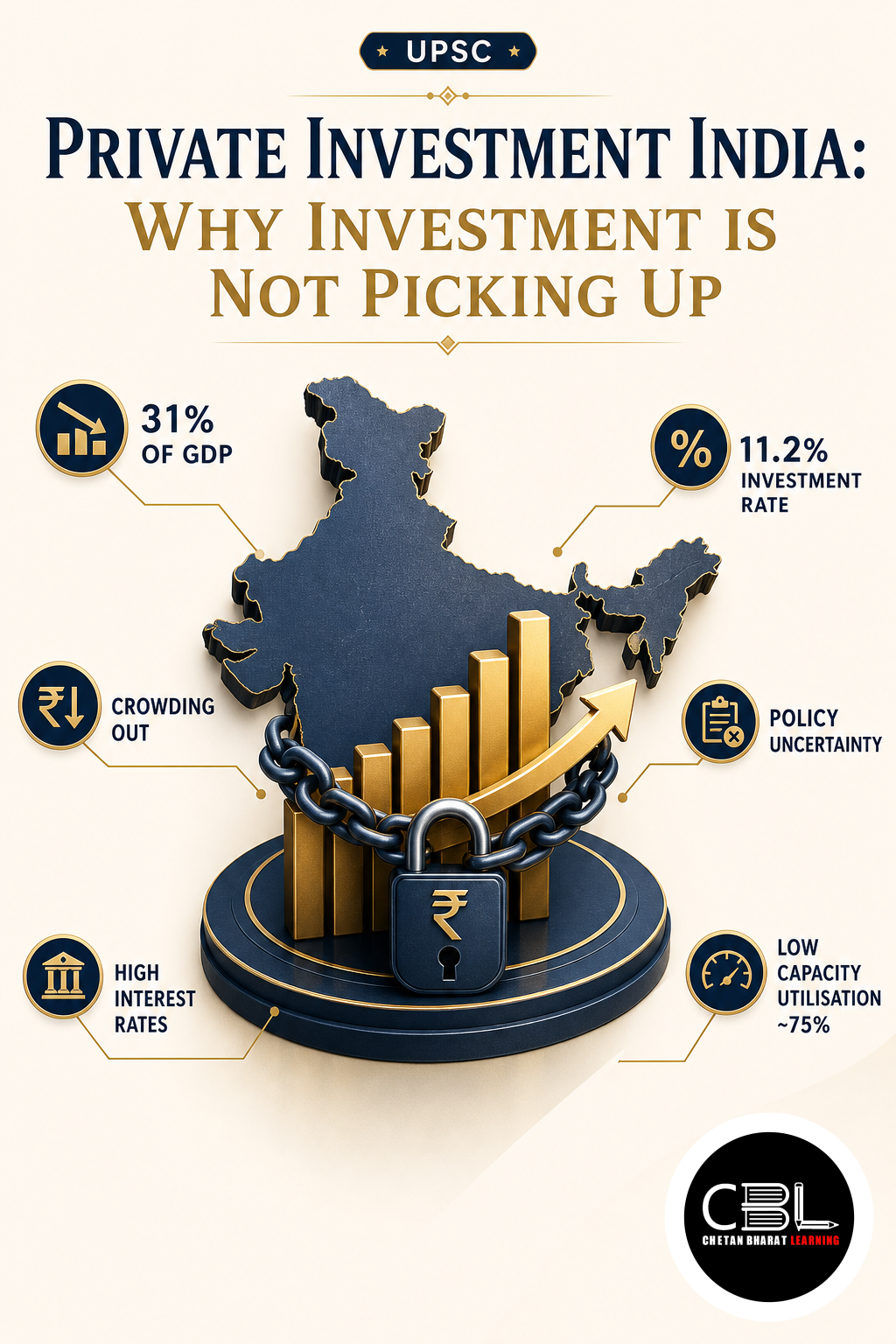
Private Investment India refers to capital expenditure by private companies to expand capacity, create jobs, and drive innovation. It is crucial for economic growth, as it expands capacity, creates employment, improves productivity, and promotes innovation. Sustained high growth ultimately requires a healthy private investment cycle. However, private investment has been a concern, with factors like capacity utilisation, demand uncertainty, cost of capital, and business confidence affecting decisions.
Interest rates matter, but they are not the only determinant. Policy predictability, regulatory certainty, contract enforcement, competition, tax certainty, and property rights are equally important. Businesses invest over 10–20 year horizons, and short-term incentives alone cannot ensure investment.
Why is Private Investment India in News?
Private Investment India is in the news because investment has not picked up despite low interest rates and tax cuts. Capacity utilisation remains below optimal levels, demand uncertainty persists, and global uncertainties (geopolitical tensions, trade restrictions) are weighing on business confidence. The rise of a few dominant firms and MSME constraints are also structural concerns.
The government’s public investment (e.g., infrastructure) is expected to crowd in private investment, but the transmission has been slower than anticipated. For more details, refer to this PIB release.
Key Features of Private Investment India
- Expands Capacity: More factories lead to more production and employment.
- Improves Productivity: New machinery and technology increase output per worker.
- Promotes Innovation: Encourages R&D, new products, and better processes.
- Global Competitiveness: Allows firms to join Global Value Chains.
- Multiplier Effects: Investment in one sector creates demand in others.
Challenges in Private Investment India
- Capacity Utilisation: If existing capacity is underutilised, firms are reluctant to invest in new capacity.
- Demand Uncertainty: Uncertain demand reduces expected returns and investment.
- Cost of Capital: High interest rates make borrowing more expensive.
- Business Confidence: Uncertainty over demand, taxation, and geopolitics postpones investment.
- Policy Credibility: Businesses need confidence that expected returns will be realised over the long term.
Way Forward for Private Investment India
To revive Private Investment India, the government should focus on policy predictability, regulatory certainty, and contract enforcement. Reducing compliance burdens and improving the ease of doing business are essential. Strengthening MSMEs through credit access, technology, and market linkages can broaden the investment base.
Public investment in infrastructure can catalyse private investment by reducing logistics costs and creating industrial clusters. Addressing global uncertainties through trade diversification and supply chain resilience can boost confidence. For international best practices, refer to the World Bank.
Prelims Practice Corner
Q1. Why is private investment important for India’s growth?
(a) It replaces public investment (b) It expands capacity, creates jobs, and drives innovation (c) It reduces inflation (d) It increases imports
Show answer
Answer: (b) Private investment expands capacity, creates jobs, and drives innovation.
Q2. What is a key factor affecting private investment?
(a) Only interest rates (b) Capacity utilisation and demand uncertainty (c) Government subsidies (d) Import duties
Show answer
Answer: (b) Capacity utilisation and demand uncertainty are key factors.
Q3. What is ‘crowding in’ of private investment?
(a) Public investment replacing private investment (b) Public investment catalysing private investment (c) Private investment reducing public investment (d) No relationship
Show answer
Answer: (b) Crowding in means public investment stimulates private investment.
Q4. What is a structural concern for private investment?
(a) Low interest rates (b) Market concentration and MSME constraints (c) High savings (d) Low inflation
Show answer
Answer: (b) Market concentration and MSME constraints are structural concerns.
Q5. What do businesses care about for long-term investment?
(a) Short-term incentives only (b) Policy predictability and regulatory certainty (c) Low taxes only (d) Government grants
Show answer
Answer: (b) Policy predictability and regulatory certainty are crucial for long-term investment.
Mains Practice Questions
Q1. Analyse the reasons for the subdued private investment in India despite a low-interest-rate regime. (250 words, 15 marks)
Answer Structure:
Intro: Introduce the private investment slowdown and its importance.
Body: Discuss capacity utilisation, demand uncertainty, cost of capital, and business confidence. Analyse structural issues: policy credibility, MSME constraints, global uncertainty. Suggest measures: policy predictability, infrastructure, MSME support.
Conclusion: Emphasise the need for a comprehensive investment-friendly ecosystem.
Q2. What is the difference between ‘crowding in’ and ‘crowding out’ of private investment? (150 words, 10 marks)
Answer Structure:
Intro: Define crowding in and crowding out.
Body: Crowding in occurs when public investment stimulates private investment (e.g., infrastructure). Crowding out occurs when public borrowing raises interest rates, reducing private investment.
Conclusion: Conclude that productive public investment can crowd in private investment.
FAQs on Private Investment India
Why is private investment not picking up in India?
Due to capacity underutilisation, demand uncertainty, high cost of capital, and policy credibility issues.
What is the role of policy predictability?
It gives businesses confidence that expected returns will be realised over the long term.
How can public investment stimulate private investment?
By reducing logistics costs, creating industrial clusters, and de-risking large projects.
Related Current Affairs
Preparing for UPSC, PCS or HCS?
Talk to a mentor at Chetan Bharat Learning, Chandigarh. Free guidance on choosing the right exam and building a study plan.
Chat on WhatsAppCall 97793 53345UPSC / IAS / PCS coaching in Chandigarh · Trusted by aspirants across Punjab & Haryana
Leave a Reply
You must be logged in to post a comment.