
UPSC Mapping
| Prelims | Economy & Statistics |
|---|---|
| Mains | GS Paper 3 (Economic Development) |
Quick Facts
| GDP Formula | C + I + G + (X – M) |
|---|---|
| GVA Formula | Output – Intermediate Consumption |
Article
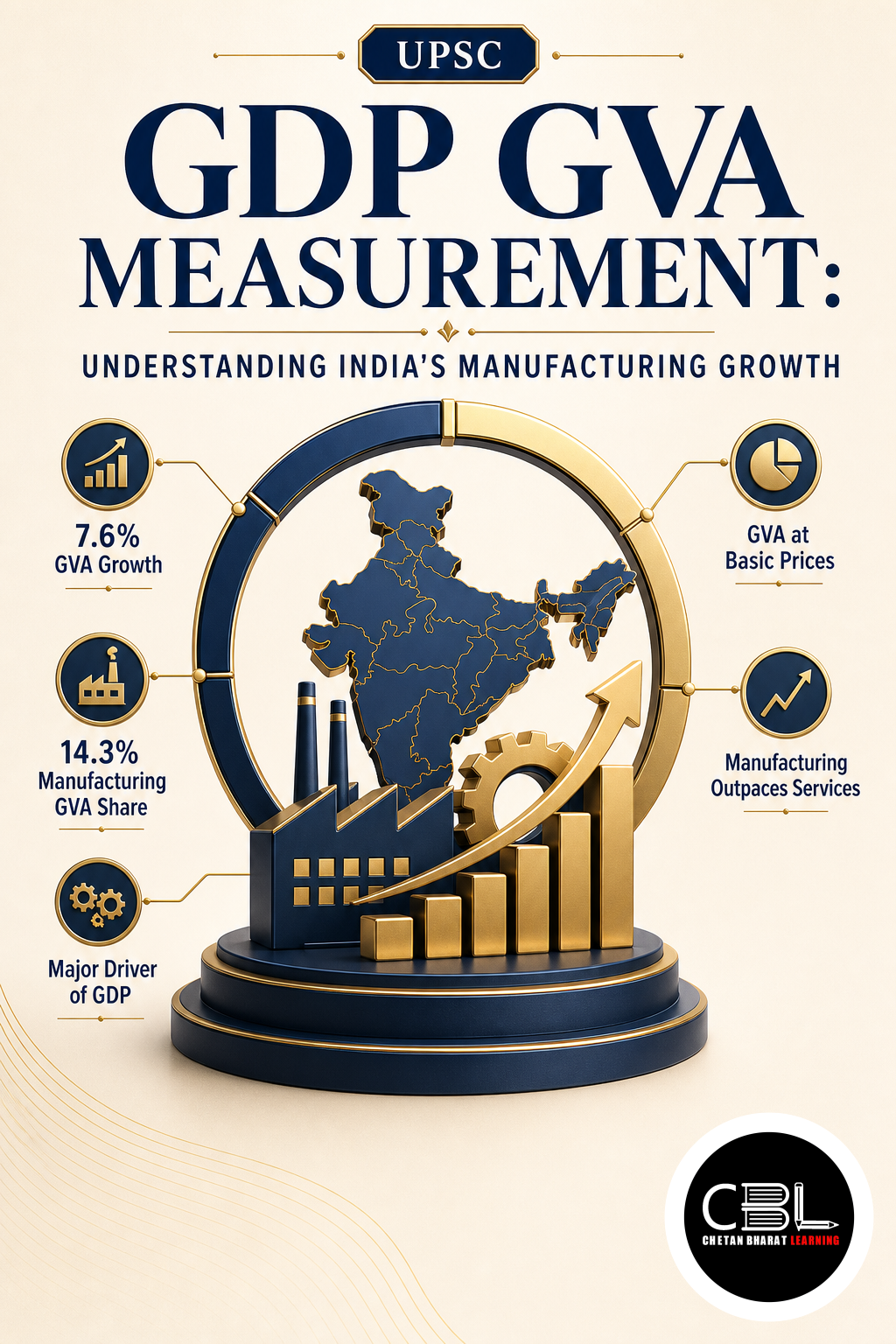
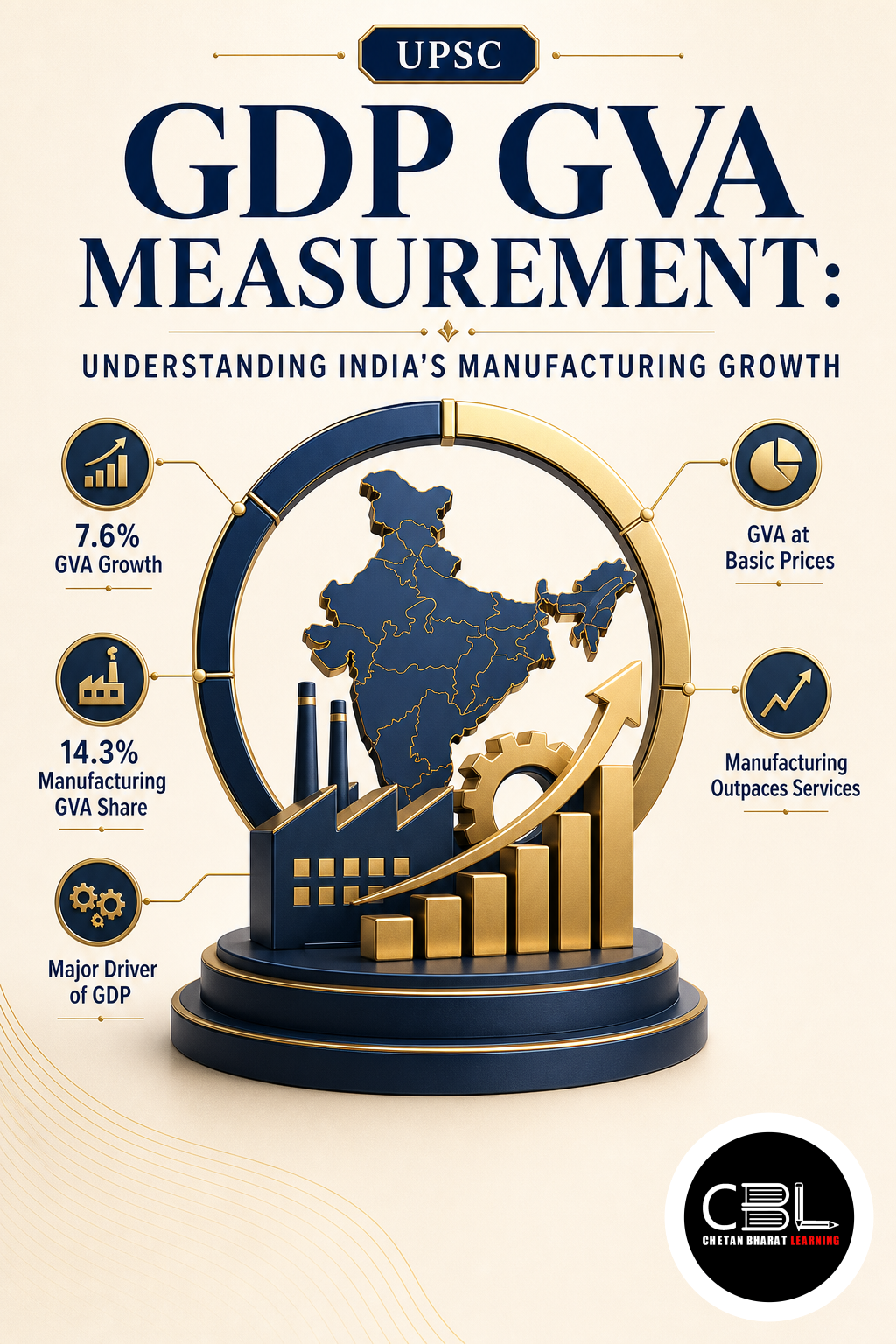
GDP GVA Measurement is a critical debate in India’s economic discourse, as accurate measurement of manufacturing growth is essential for effective policy. Wrong measurement leads to wrong diagnosis and wrong policy. Understanding the distinction between GDP, GVA, IIP, and the role of the deflator is crucial for analysing India’s manufacturing performance. For more such economic updates, explore the economy archive.
What is GDP GVA Measurement?
GDP GVA Measurement involves understanding the difference between Gross Domestic Product (GDP) and Gross Value Added (GVA). GDP measures the value of final goods and services produced domestically (C+I+G+X-M), while GVA measures the value created by producers (Output – Intermediate Consumption). GVA tells us how much value a sector actually adds to the economy, making it a better indicator of sectoral performance.
Nominal GDP can rise due to higher production OR higher prices. The GDP deflator converts nominal values into real values by removing the effect of price changes, isolating actual economic activity. The Index of Industrial Production (IIP) measures changes in industrial output, while Manufacturing GVA measures value added, and they can differ due to output, input costs, and productivity changes.
Why is GDP GVA Measurement in News?
GDP GVA Measurement is in the news because of ongoing debates about the accuracy of India’s manufacturing growth data. The new GDP series and base year changes have affected measurement. Questions are being raised about whether output is rising (IIP), whether value is being created (Manufacturing GVA), and whether growth is real (adjusting for prices).
Manufacturing is crucial for structural transformation, employment, productivity, and exports. However, India faces challenges like low employment intensity, MSME constraints, weak GVC integration, and infrastructure gaps. For more details, refer to this PIB release.
Key Features of GDP GVA Measurement
- GDP: Measures final value of goods and services produced domestically.
- GVA: Measures value added by producers, excluding intermediate consumption.
- Deflator: Converts nominal to real values, isolating actual production changes.
- IIP: Measures change in volume of industrial production.
- Manufacturing GVA: Measures value added by manufacturing, affected by output, input costs, and productivity.
Challenges in GDP GVA Measurement
- Data Quality: Gaps in data collection and reporting affect accuracy.
- Base Year Changes: Frequent changes in base year can make comparisons difficult.
- Informal Sector: A large informal economy is not fully captured.
- Price Deflators: Choosing appropriate deflators is complex.
- Sectoral Disparities: Differences between IIP and GVA can create confusion. For more on economic statistics, visit the economy section.
Way Forward for GDP GVA Measurement
To improve GDP GVA Measurement, India should strengthen data collection and statistical infrastructure. Regular updates to base years and deflators can improve accuracy. Integrating more administrative data and leveraging technology (AI, big data) can enhance real-time monitoring.
Improving the ease of doing business, strengthening MSMEs, integrating with Global Value Chains, and investing in infrastructure and skill development are essential for boosting manufacturing growth. Reliable data is the foundation of sound policy. For international best practices, refer to the IMF.
Prelims Practice Corner
-
Q1. What is the formula for GDP?
- GDP = Output – Intermediate Consumption
- GDP = C + I + G + (X – M)
- GDP = GVA + Taxes – Subsidies
- GDP = National Income + Depreciation
Answer: (b) GDP = C + I + G + (X – M).
-
Q2. What does GVA measure?
- Final value of goods
- Value added by producers
- Total income
- Export earnings
Answer: (b) GVA measures value added by producers.
-
Q3. What is the GDP deflator?
- A measure of inflation
- A tool to convert nominal GDP to real GDP
- A tax rate
- An interest rate
Answer: (b) The deflator converts nominal to real values.
-
Q4. What does IIP measure?
- Industrial production volume
- Agricultural output
- Services growth
- Employment
Answer: (a) IIP measures changes in industrial production volume.
-
Q5. Why is manufacturing important for India?
- It employs the most people
- It drives structural transformation and productivity
- It is the only growing sector
- It has no challenges
Answer: (b) Manufacturing drives structural transformation and productivity.
Mains Practice Questions
-
Q1. Discuss the importance of accurate GDP and GVA measurement for economic policymaking in India. (250 words, 15 marks)
Answer Structure
Intro: Introduce the GDP-GVA debate and its significance.
Body: Explain the differences between GDP, GVA, IIP, and the role of deflators. Analyse the challenges in manufacturing growth measurement and the implications for policy. Suggest ways to improve statistical infrastructure.
Conclusion: Emphasise that reliable data is the foundation of sound policy.
-
Q2. What is the difference between nominal GDP and real GDP? (150 words, 10 marks)
Answer Structure
Intro: Define nominal and real GDP.
Body: Nominal GDP is measured at current prices, while real GDP is adjusted for inflation using a deflator. Real GDP isolates actual changes in production.
Conclusion: Conclude that real GDP is a better indicator of economic growth.
FAQs on GDP GVA Measurement
- What is the difference between GDP and GVA?
- GDP measures final value of goods and services, while GVA measures value added by producers.
- What is the GDP deflator?
- It is a tool to convert nominal GDP to real GDP by removing price effects.
- What is IIP?
- The Index of Industrial Production measures changes in industrial output volume.
Related Current Affairs
Preparing for UPSC, PCS or HCS?
Talk to a mentor at Chetan Bharat Learning, Chandigarh. Free guidance on choosing the right exam and building a study plan.
Chat on WhatsAppCall 97793 53345UPSC / IAS / PCS coaching in Chandigarh · Trusted by aspirants across Punjab & Haryana
Leave a Reply
You must be logged in to post a comment.