
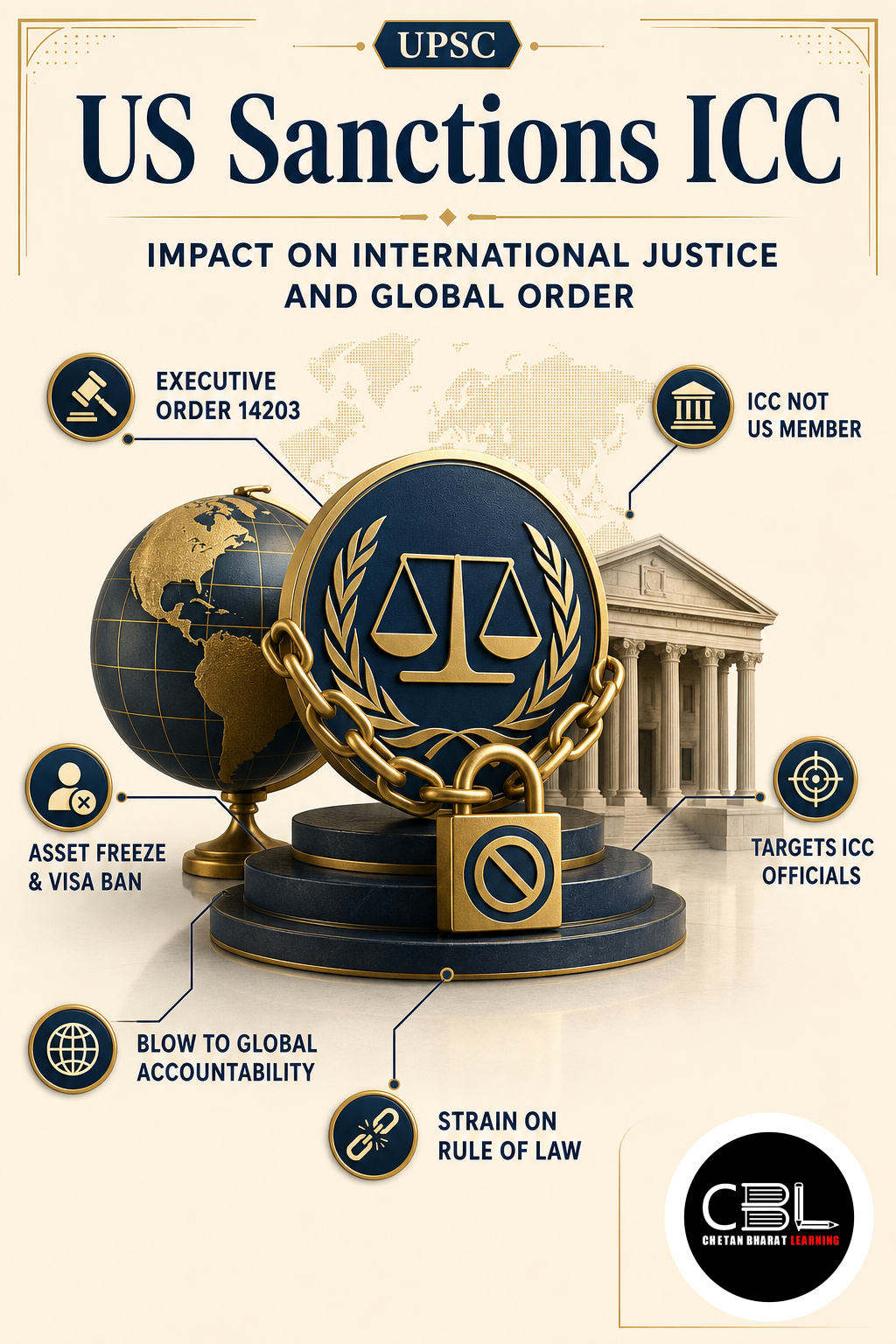

US Sanctions ICC have been imposed on ICC President Tomoko Akane and senior prosecutor Abdoulaye Seye over investigations targeting officials from non-member nations. The sanctions, under Executive Order 14203, use the International Emergency Economic Powers Act to freeze US assets, block financial access, and restrict visas.
UPSC Mapping
| Exam | Topic |
|---|---|
| Prelims | International Relations & Law |
| Mains | GS Paper 2 (International Relations & Law) |
Quick Facts
| Fact | Detail |
|---|---|
| ICC Established | 2002 (Rome Statute, 1998) |
| ICC Members | 125 countries |
| India’s Status | Non-member (abstained) |
What are US Sanctions ICC?
US Sanctions ICC are economic and visa restrictions imposed by the United States on International Criminal Court officials. The sanctions target ICC President Tomoko Akane and senior prosecutor Abdoulaye Seye. Executive Order 14203 sanctions any foreign person aiding the ICC against “protected persons,” which include US citizens and nationals of other non-consenting allied nations. The framework uses the International Emergency Economic Powers Act to freeze US assets, block financial access, and restrict visas.
The ICC, established under the 1998 Rome Statute and operational since 2002, is the world’s only permanent international criminal tribunal. It tries individuals for genocide, war crimes, crimes against humanity, and the crime of aggression. Notable non-members include the US, Israel, China, Russia, and India.
Why are US Sanctions ICC in News?
US Sanctions ICC are in the news because the US has escalated its confrontation with the Court over investigations targeting officials from non-member nations. The sanctions have been condemned by many countries and human rights organisations as an attack on international justice and the rule of law.
India abstained from adopting the Rome Statute, citing concerns over national judicial sovereignty and the UN Security Council’s powers to refer or halt investigations.
Key Features of US Sanctions ICC
- Targeted Officials: ICC President and senior prosecutor.
- Executive Order: EO 14203 sanctions any foreign person aiding the ICC against ‘protected persons’.
- Legal Authority: International Emergency Economic Powers Act.
- Measures: Asset freezes, financial block, visa restrictions.
- Context: US opposes ICC jurisdiction over non-member nations.
Challenges in US Sanctions ICC
- International Law: Sanctions undermine the ICC’s independence and mandate.
- Global Justice: The ICC is the only permanent court for genocide and war crimes; sanctions weaken its authority.
- Diplomatic Tensions: The US action strains relations with countries supporting the ICC.
- Human Rights: Victims of atrocities may lose access to justice.
- Precedent: Other powerful nations may follow the US example.
Way Forward for US Sanctions ICC
To address the US Sanctions ICC, the international community should collectively condemn such measures and reaffirm support for the ICC’s independence. The UN General Assembly could adopt a resolution urging the US to lift the sanctions.
Dialogue between the US and ICC member states could address concerns over jurisdiction and due process. Reforms to the ICC’s mechanisms, such as the role of the UN Security Council, could increase its acceptability to non-member nations.
Prelims Practice Corner
Q1. When did the ICC become operational?
- (a) 1998
- (b) 2002
- (c) 2005
- (d) 2010
Answer: (b) 2002
Q2. Which treaty established the ICC?
- (a) Geneva Convention
- (b) Rome Statute
- (c) UN Charter
- (d) Hague Convention
Answer: (b) Rome Statute (1998)
Q3. How many countries are members of the ICC?
- (a) 80
- (b) 100
- (c) 125
- (d) 150
Answer: (c) 125
Q4. What is the Principle of Complementarity?
- (a) ICC has primary jurisdiction
- (b) ICC acts only when national courts are unwilling or unable
- (c) ICC can override national courts
- (d) ICC does not have jurisdiction
Answer: (b) Last resort principle
Q5. Why did India abstain from the Rome Statute?
- (a) Lack of political will
- (b) Concerns over national judicial sovereignty
- (c) Financial constraints
- (d) No interest
Answer: (b) Sovereignty and UNSC concerns
Mains Practice Questions
Q1. Discuss the implications of the US sanctions on the International Criminal Court for the global justice system and the rule of law. (250 words, 15 marks)
Answer Structure:
- Intro: Introduce the US sanctions and their targets.
- Body: Discuss the ICC’s role, the sanctions’ impact on its independence, and broader implications for international law. Analyse US rationale and global response.
- Conclusion: Suggest dialogue and reforms to uphold the ICC’s integrity.
Q2. What is the International Criminal Court and what is its jurisdiction? (150 words, 10 marks)
Answer Structure:
- Intro: Define the ICC as the permanent international criminal tribunal.
- Body: Explain its jurisdiction over genocide, war crimes, crimes against humanity, and aggression. Mention complementarity.
- Conclusion: Conclude on the ICC’s role in global justice.
FAQs on US Sanctions ICC
What is the International Criminal Court?
It is a permanent international tribunal that prosecutes individuals for genocide, war crimes, crimes against humanity, and aggression.
Why has the US sanctioned ICC officials?
Over investigations targeting officials from non-member nations, including the US.
What is the US sanctions framework?
Executive Order 14203, under the International Emergency Economic Powers Act, freezes assets and restricts visas.
Related Current Affairs
Preparing for UPSC, PCS or HCS?
Talk to a mentor at Chetan Bharat Learning, Chandigarh. Free guidance on choosing the right exam and building a study plan.
Chat on WhatsAppCall 97793 53345UPSC / IAS / PCS coaching in Chandigarh · Trusted by aspirants across Punjab & Haryana
Leave a Reply
You must be logged in to post a comment.