

UPSC Mapping
| Prelims | Economy & Environment |
|---|---|
| Mains | GS Paper 3 (Energy & Agriculture) |
Quick Facts
| Blending Target Achieved | 2025-26 (20%) |
|---|---|
| Older Two-Wheelers | 75-80 million (pre-BS4) |
| Foreign Exchange Saved | ₹1.97 lakh crore |
What is E20 Ethanol Policy?
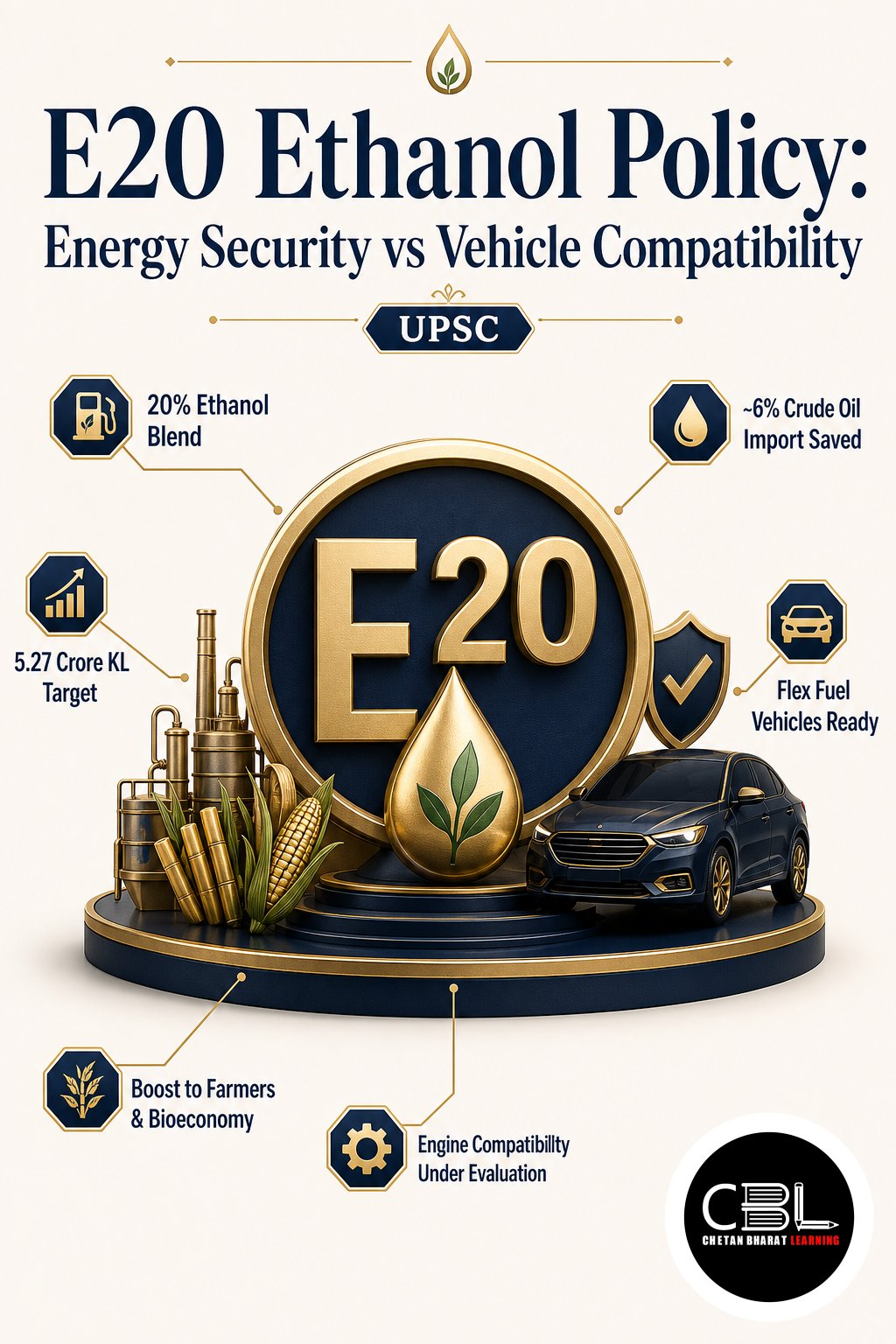
The E20 Ethanol Policy is India’s national programme to blend 20% ethanol with petrol, aimed at reducing crude oil imports, supporting farmers, and lowering emissions. India achieved the 20% blending target in 2025-26, five years ahead of the original 2030 target. The programme has saved over ₹1.97 lakh crore in foreign exchange and substituted nearly 316 lakh metric tonnes of crude oil.
Ethanol is produced from sugarcane, molasses, and maize. The policy has evolved from a pilot blending programme in 2001 to E5 in 2006, and E10 in 2022, culminating in the current E20 push. This is an example of a phased energy transition rather than an overnight shift.
Why is E20 Ethanol Policy in News?
The E20 Ethanol Policy is in the news following social media claims that E20 wrecks engines and reduces fuel economy by 30%. While these concerns are largely unfounded for newer vehicles, a genuine issue exists for India’s older fleet—approximately 75-80 million pre-BS4 two-wheelers running on carburettors, which cannot adjust to the extra oxygen in E20.
Experts have recommended bringing back a lower blend (E10) alongside E20 to protect older vehicles while the retrofit programme catches up. The Chief Economic Advisor has also highlighted the need to thoroughly cost the food-versus-fuel trade-off before pushing beyond E20.
Key Features of E20 Ethanol Policy
- Energy Security: Reduces crude oil import dependence by substituting 316 lakh metric tonnes of crude oil.
- Agricultural Diversification: Creates an additional market for sugarcane, molasses, and maize, boosting farmer incomes.
- Environmental Benefits: Lowers carbon monoxide and unburnt hydrocarbon emissions.
- Phased Approach: Gradual transition from E5 to E10 to E20, allowing technological adaptation.
- Foreign Exchange Savings: ₹1.97 lakh crore saved through reduced oil imports.
Challenges in E20 Ethanol Policy
- Vehicle Compatibility: 75-80 million pre-BS4 two-wheelers with carburettors cannot run on E20 without retrofitting.
- Fuel Economy: Ethanol has lower energy content, causing a 3-5% mileage loss for E10-designed vehicles.
- Food-Fuel Trade-off: Maize now supplies about half of India’s ethanol, competing with other crops for land and water.
- Water Use: Blue water (irrigation) is scarce in states like Maharashtra and Karnataka; water rules must target blue-water use.
- Environmental Uncertainty: Indian life-cycle studies do not agree on whether grain ethanol is cleaner than alternatives.
Way Forward
To make the E20 Ethanol Policy sustainable, the government should bring back a lower blend (E10) for older vehicles while offering E20 as an option. Fixing price and water distortions that favour maize over other crops is essential. Holding at E20 until a thorough cost-benefit analysis of the food-versus-fuel trade-off is conducted is prudent.
Prelims Practice Corner
Q1. When did India achieve the 20% ethanol blending target?
- (a) 2022-23
- (b) 2025-26
- (c) 2027-28
- (d) 2030-31
Answer: (b) India achieved 20% blending in 2025-26, five years ahead of the 2030 target.
Q2. How much foreign exchange has the ethanol programme saved?
- (a) ₹50,000 crore
- (b) ₹1.97 lakh crore
- (c) ₹3.5 lakh crore
- (d) ₹5 lakh crore
Answer: (b) The programme has saved over ₹1.97 lakh crore in foreign exchange.
Q3. How many older two-wheelers are affected by the E20 transition?
- (a) 25-30 million
- (b) 50-60 million
- (c) 75-80 million
- (d) 100 million
Answer: (c) Approximately 75-80 million pre-BS4 two-wheelers are affected.
Q4. What is the approximate mileage loss for E10-designed vehicles on E20?
- (a) 1-2%
- (b) 3-5%
- (c) 10-15%
- (d) 20-30%
Answer: (b) The mileage loss is around 3-5%.
Q5. Which crop now supplies about half of India’s ethanol?
- (a) Sugarcane
- (b) Maize
- (c) Rice
- (d) Wheat
Answer: (b) Maize supplies about half of India’s ethanol.
Mains Practice Questions
Q1. Discuss the rationale and challenges of India’s E20 ethanol blending policy. Suggest measures for a sustainable transition. (250 words, 15 marks)
Answer Structure:
- Intro: Introduce the E20 policy and its achievement.
- Body: Discuss benefits: energy security, farmer incomes, emissions reduction. Analyse challenges: vehicle compatibility, food-fuel trade-off, water use, environmental uncertainty. Suggest a way forward: bring back E10, fix price distortions, hold at E20.
- Conclusion: Emphasise the need for a just and inclusive transition.
Q2. What is the food-versus-fuel trade-off in the context of ethanol blending, and why does it matter for India? (150 words, 10 marks)
Answer Structure:
- Intro: Define the food-versus-fuel trade-off.
- Body: Explain that diverting maize to ethanol competes with other crops for land, raising edible oil prices and impacting food security. India’s edible oil import bill is significant; the trade-off must be carefully weighed.
- Conclusion: Conclude that a balanced policy is needed, prioritising reversible instruments first.
FAQs on E20 Ethanol Policy
- What is E20 ethanol blending?
- It is a policy to blend 20% ethanol with petrol to reduce crude oil imports, support farmers, and lower emissions.
- Does E20 damage engines?
- For newer vehicles, no. However, 75-80 million pre-BS4 two-wheelers with carburettors may face issues, requiring retrofitting.
- What is the food-versus-fuel trade-off?
- It is the conflict between using agricultural land and water for ethanol production versus food production, affecting food security and prices.
Related Current Affairs
Preparing for UPSC, PCS or HCS?
Talk to a mentor at Chetan Bharat Learning, Chandigarh. Free guidance on choosing the right exam and building a study plan.
Chat on WhatsAppCall 97793 53345UPSC / IAS / PCS coaching in Chandigarh · Trusted by aspirants across Punjab & Haryana
Leave a Reply
You must be logged in to post a comment.