

UPSC Mapping
| Exam | Topics |
|---|---|
| Prelims | BNSS, FIR, Criminal Procedure |
| Mains | GS Paper II – Governance, Judiciary and Criminal Justice |
| Criminal Procedure | Key Provision | Judicial Remedy |
|---|---|---|
| Bharatiya Nagarik Suraksha Sanhita | Section 360 BNSS | High Court quashing under Section 528 BNSS |
Article
What is Withdrawal of FIRs?
A First Information Report, or FIR, is the first written record of information received by the police regarding a cognizable offence. Registration of an FIR initiates the criminal investigation process under the applicable criminal procedure law.
The uploaded material makes an important legal distinction: an FIR cannot simply be cancelled by a government through an executive order. Proceedings arising from an FIR may end only through legally recognised procedures prescribed by law and subject to the relevant judicial safeguards.
This distinction matters because an FIR is part of the formal criminal justice process. Once a case enters that process, executive instructions cannot by themselves erase the legal consequences flowing from the registration of the case.
The issue is therefore not merely whether the government wants a case closed. The relevant question is whether the closure, withdrawal or quashing follows the statutory route and respects the role of the police, prosecutor and judiciary.
Why is Withdrawal of FIRs in News?
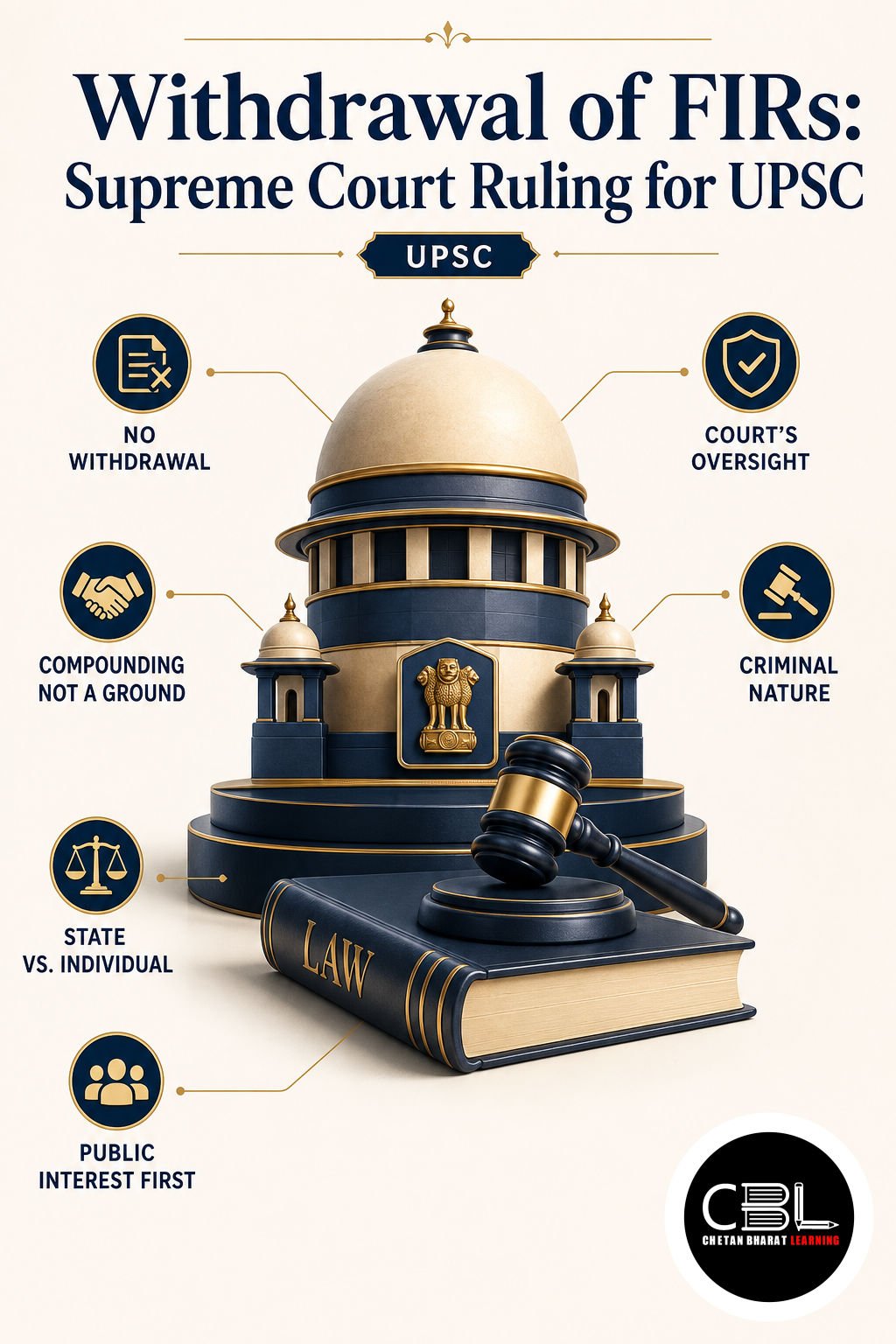
The Supreme Court has clarified that state governments may withdraw or close criminal cases relating to recent student protests, but they must follow the procedure established under the BNSS. Executive instructions alone cannot extinguish an FIR or terminate criminal proceedings.
The ruling is significant because it reinforces the principle that criminal justice decisions must remain anchored in statutory procedure. Government authorities may initiate or support a decision within the legal framework, but the final process must satisfy the requirements of criminal procedure.
The uploaded material identifies three broad legal routes through which proceedings may come to an end: a closure report, withdrawal from prosecution with judicial consent, or quashing by the High Court where legal grounds exist. Each route involves distinct institutional responsibilities.
The Court’s observation is particularly relevant in cases arising from protests. Students and other participants may face criminal proceedings during periods of public mobilisation, but any later decision to end those proceedings must respect the rule of law and applicable procedural safeguards.
For UPSC, the development links judicial review, prosecutorial independence and governance. It also demonstrates how constitutional values such as the rule of law operate through ordinary criminal procedure.
Key Features
The legal framework described in the uploaded material contains several important safeguards:
- Closure report: Police may submit a closure report before the jurisdictional magistrate under Section 193 BNSS where the investigation does not support continuation of the case.
- Withdrawal from prosecution: Under Section 360 BNSS, the Public Prosecutor may seek withdrawal from prosecution before judgment with the consent of the court.
- Prosecutorial independence: The prosecutor must exercise independent judgment rather than simply implementing an executive direction.
- Judicial oversight: Courts examine whether withdrawal is legally justified and consistent with public justice.
- High Court powers: The High Court may exercise its powers under Section 528 BNSS to quash proceedings where the legal requirements are satisfied.
Challenges
The process of ending criminal proceedings raises several governance and rule-of-law concerns:
- Political misuse: Executive pressure may create concerns when governments seek withdrawal of politically sensitive criminal cases.
- Rule of law: Arbitrary closure can weaken public confidence in the fairness and consistency of criminal justice.
- Judicial burden: Courts may need to examine withdrawal requests carefully to ensure that statutory safeguards are respected.
- Victims’ interests: Decisions concerning criminal proceedings must consider public justice and the concerns of affected parties.
- Procedural compliance: Failure to follow the BNSS can undermine the legality of the proposed withdrawal or closure.
Way Forward
States should ensure that every decision concerning Withdrawal of FIRs follows the statutory framework and remains subject to the appropriate institutional checks. Government authorities, police officials and prosecutors should clearly distinguish policy preference from legal procedure.
Independent prosecutorial assessment should remain central to decisions concerning withdrawal from prosecution. Judicial scrutiny can ensure that the process serves the interests of justice rather than becoming a mechanism for arbitrary disposal of criminal cases.
The uploaded material also refers to Sheonandan Paswan v. State of Bihar (1986) as an important Supreme Court precedent concerning withdrawal from prosecution. The case remains relevant for understanding the principle that withdrawal must be bona fide and consistent with public justice.
For stronger governance outcomes, procedural transparency and reasoned decisions are important. Clear documentation of the grounds for closure or withdrawal can strengthen accountability and reduce the scope for arbitrary decision-making.
The broader UPSC lesson is that criminal justice reform requires institutional balance. Executive authority, prosecutorial independence and judicial oversight must operate together to preserve the rule of law.
Prelims Package
- Q1: Which law governs criminal procedure in the context discussed in the uploaded material?
Answer: (b) Bharatiya Nagarik Suraksha Sanhita — the uploaded material discusses criminal procedure under the BNSS. - Q2: Who may submit a closure report under the procedure described in the uploaded material?
Answer: (a) Police — the material states that police may submit a closure report before the jurisdictional magistrate. - Q3: Under which BNSS provision may the Public Prosecutor seek withdrawal from prosecution before judgment?
Answer: (b) Section 360 — the uploaded material identifies this provision for withdrawal from prosecution with court consent. - Q4: Which BNSS provision is identified in the uploaded material in relation to High Court quashing powers?
Answer: (c) Section 528 — the material identifies it in relation to the High Court’s quashing powers. - Q5: The Sheonandan Paswan case is associated with:
Answer: (a) Withdrawal from prosecution — the uploaded material cites Sheonandan Paswan v. State of Bihar (1986) in this context.
Mains Package
- Q1. Explain the legal mechanisms through which criminal proceedings may end after registration of an FIR under the BNSS. (10 Marks)
- Intro: Explain an FIR as the formal starting point of investigation into a cognizable offence.
- Body: Discuss closure reports, withdrawal from prosecution under Section 360, High Court quashing under Section 528, prosecutorial discretion and judicial oversight.
- Conclusion: Emphasise that criminal proceedings must end through statutory mechanisms rather than executive instructions alone.
- Q2. Examine the importance of prosecutorial independence and judicial oversight in preventing arbitrary withdrawal of criminal cases. (15 Marks)
- Intro: Introduce the tension between executive policy choices and the rule of law in criminal proceedings.
- Body: Cover prosecutorial independence, judicial scrutiny, political misuse, victims’ interests, statutory compliance and the Sheonandan Paswan precedent.
- Conclusion: Independent prosecution and meaningful judicial review can protect public confidence in criminal justice.
FAQs
Can the government cancel an FIR through an executive order?
According to the uploaded material, an FIR cannot simply be cancelled through an executive order. Proceedings arising from an FIR must end through legally recognised procedures under the BNSS.
Who can withdraw prosecution under Section 360 BNSS?
The uploaded material states that the Public Prosecutor may seek withdrawal from prosecution before judgment with the consent of the court. The process therefore involves both prosecutorial discretion and judicial oversight.
Why is judicial oversight important in withdrawal of cases?
Judicial oversight helps ensure that withdrawal serves the interests of justice and does not become an arbitrary administrative action. It also protects the rule of law and public confidence in criminal justice.
Related Current Affairs
Preparing for UPSC, PCS or HCS?
Talk to a mentor at Chetan Bharat Learning, Chandigarh. Free guidance on choosing the right exam and building a study plan.
Chat on WhatsAppCall 97793 53345UPSC / IAS / PCS coaching in Chandigarh · Trusted by aspirants across Punjab & Haryana
Leave a Reply
You must be logged in to post a comment.