
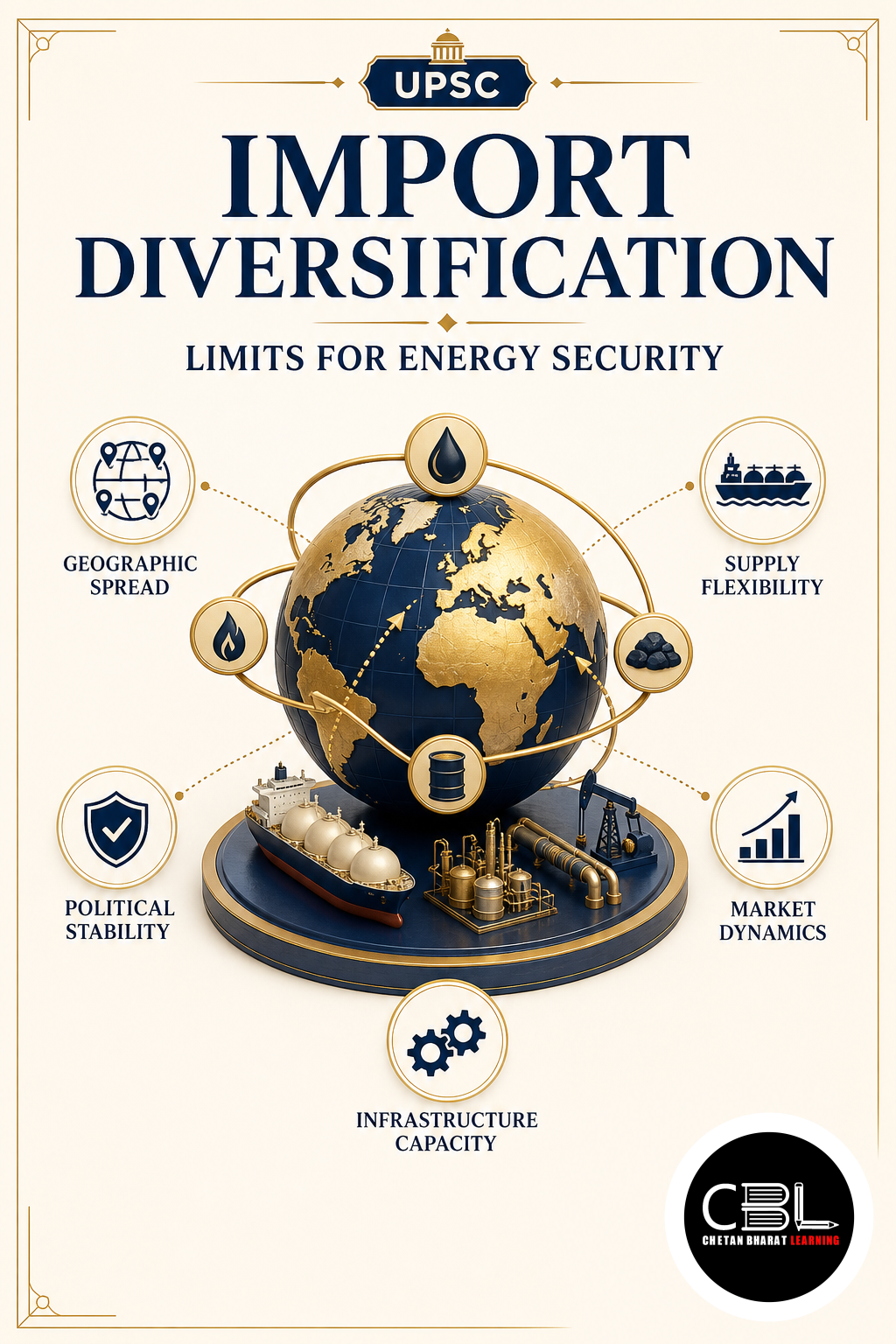

Import Diversification is in the news after the passage argued that diversifying crude oil suppliers alone cannot guarantee India’s energy security. India can reduce dependence on any single exporter, but transport routes, maritime chokepoints and geopolitical disruptions can still threaten supplies. For more UPSC updates, visit the daily current affairs archive.
What is Import Diversification?
Import Diversification means purchasing crude oil from multiple supplier countries instead of depending on a single source. The infographic identifies suppliers including Saudi Arabia, Iraq, the UAE, Russia, the United States and Brazil.
This approach reduces supplier risk because disruption in one exporting country need not halt India’s entire crude supply. Yet diversification at the source does not automatically remove vulnerabilities in shipping, logistics or geopolitical conditions.
Why is Import Diversification in News?
According to the passage, India imports more than 85% of its crude oil requirement. The article argues that changing suppliers reduces dependence on individual exporters but may leave India exposed to disruption along shared maritime routes.
The key distinction is between source risk and route risk. Crude purchased from several countries may still travel through strategic sea lanes, making transport infrastructure and maritime security central to energy resilience. More background can be found through the CBL current affairs resources.
Key Features
- Supplier diversification: Buying from multiple exporters lowers dependence on any one country.
- Route diversification: Alternative transport corridors can strengthen supply resilience during disruptions.
- Maritime chokepoints: The Strait of Hormuz and Bab-el-Mandeb are important strategic routes for oil movement.
- Strategic Petroleum Reserves: Emergency crude stocks can provide temporary protection during supply disruptions.
- Comprehensive energy security: Security requires availability, affordability, accessibility and continuity of supply.
Challenges
- Route dependence: Different suppliers may still rely on the same shipping corridor.
- Geopolitical risks: Conflict around strategic waterways can disrupt international oil flows.
- Limited substitutability: Oil remains difficult to replace quickly across several sectors, including transport and petrochemicals.
- Risk migration: Diversification can shift exposure from supplier concentration towards transport and logistics risks.
- Reserve limitations: Strategic reserves provide temporary protection and cannot replace long-term supply resilience.
For wider GS Paper III preparation, aspirants should also study energy and economy current affairs alongside static concepts.
Way Forward
The passage recommends moving beyond supplier diversification towards a broader energy resilience strategy. India needs attention to transport routes, domestic refining capacity, renewable energy, demand-side efficiency, strategic petroleum reserves and wider energy partnerships.
For UPSC preparation, the issue connects energy security with import dependence, maritime security, infrastructure and economic resilience. Official information on India’s petroleum sector can be accessed through the Ministry of Petroleum and Natural Gas.
FAQs on Import Diversification
What is import diversification?
The passage describes it as purchasing crude oil from multiple countries instead of relying on a single supplier. It primarily reduces concentration at the source.
Why is supplier diversification alone insufficient?
Different suppliers may still depend on the same maritime transport routes. Route disruptions can therefore affect supplies despite a diversified supplier base.
Why is this topic important for UPSC?
It links energy security with import dependence, maritime security, strategic petroleum reserves, infrastructure and economic resilience. These themes are relevant to GS Paper III.
Related Current Affairs
Preparing for UPSC, PCS or HCS?
Talk to a mentor at Chetan Bharat Learning, Chandigarh. Free guidance on choosing the right exam and building a study plan.
Chat on WhatsAppCall 97793 53345UPSC / IAS / PCS coaching in Chandigarh · Trusted by aspirants across Punjab & Haryana
Leave a Reply
You must be logged in to post a comment.