

UPSC Mapping
| Prelims | PLI Scheme, Solar Value Chain, Polysilicon |
|---|---|
| Mains | GS Paper III – Economy, Energy Security and Infrastructure |
Article
Introduction
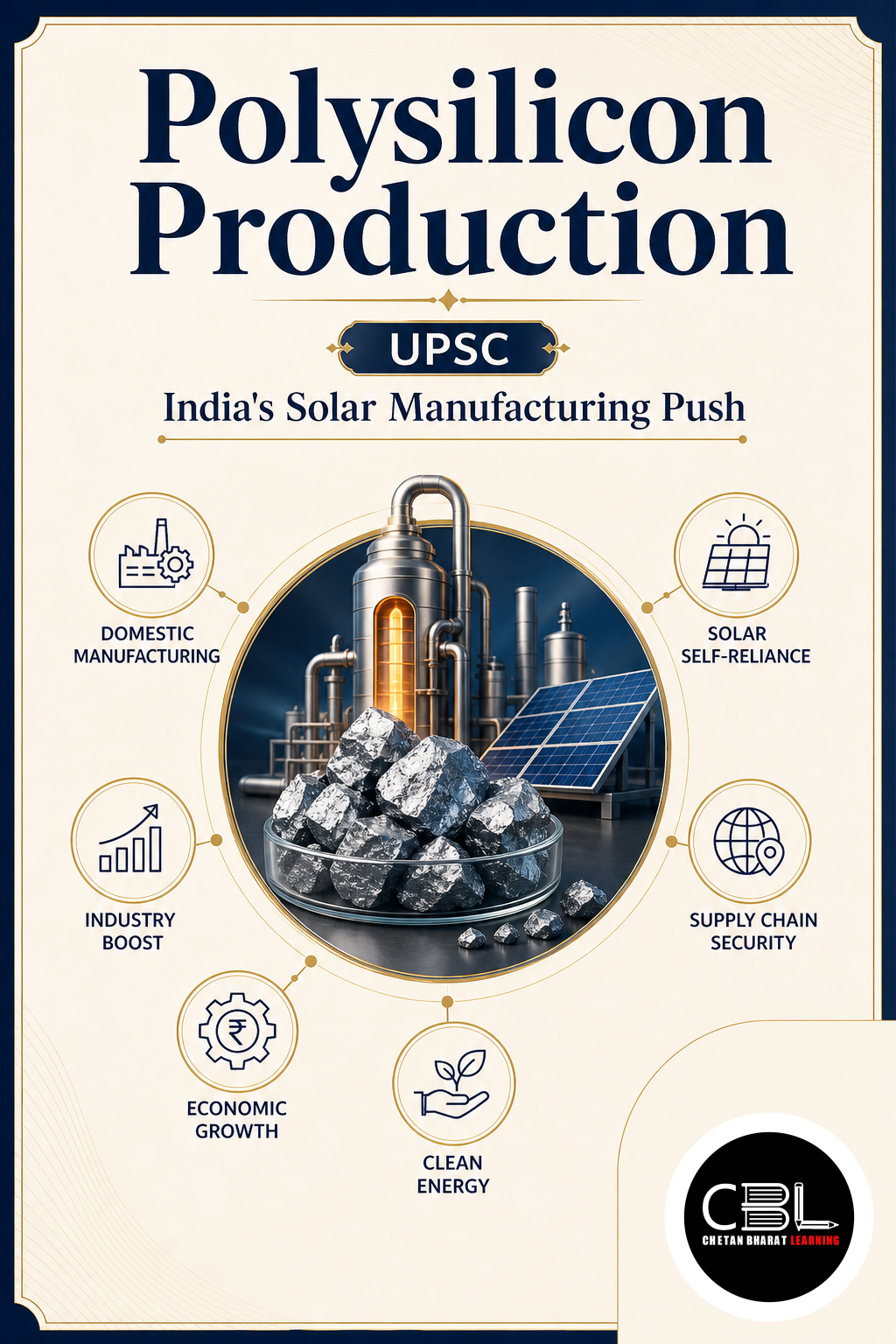
Polysilicon Production is in the news after the Government considered a Production Linked Incentive (PLI) scheme to encourage domestic manufacturing of polysilicon, a critical raw material for solar modules. India aims to strengthen the upstream segment of the solar manufacturing value chain and reduce import dependence.
What is Polysilicon Production?
Polysilicon is a high-purity crystalline form of silicon that serves as the fundamental feedstock for conventional crystalline-silicon solar cells. It is the starting material for the entire solar photovoltaic manufacturing chain.
According to the infographic, the solar manufacturing value chain progresses from quartz/silica → polysilicon → ingot → wafer → solar cell → solar module/panel → solar power plant. Each solar module contains multiple solar cells, making upstream materials crucial for the industry’s growth.
Why is Polysilicon Production in News?
The Government is considering a Production Linked Incentive (PLI) scheme for domestic polysilicon manufacturing. The objective is to build capacity in the upstream solar manufacturing ecosystem rather than depending mainly on imports for essential raw materials.
While India has expanded domestic manufacturing of solar modules, it remains dependent on imports for key upstream components such as polysilicon, ingots and wafers. Official policy updates may be followed through the Ministry of New and Renewable Energy website.
Key Features
- Strengthening upstream manufacturing: Focuses on domestic production of polysilicon rather than only finished solar modules.
- Energy security: Reduced import dependence can improve resilience in the renewable energy sector.
- Integrated value chain: Domestic capacity across the manufacturing chain may support long-term industrial competitiveness.
- Policy support: Instruments such as the PLI Scheme and the Approved List of Models and Manufacturers (ALMM).
- Renewable energy ecosystem: Domestic manufacturing can reinforce India’s clean energy ambitions.
Challenges
- Capital-intensive production: Polysilicon manufacturing requires significant investment.
- High electricity consumption: Competitive power costs are essential for viability.
- Technological complexity: Sophisticated manufacturing processes and specialised expertise are necessary.
- Global competition: Established international producers enjoy economies of scale.
- Supply-chain gaps: Upstream capabilities remain limited despite growth in module manufacturing.
Way Forward
Targeted PLI support, reliable and affordable electricity, technology partnerships and integrated manufacturing facilities could strengthen India’s upstream solar ecosystem. Building capacity across the entire value chain is essential for long-term competitiveness.
For UPSC, aspirants should connect this development with the themes of Atmanirbhar Bharat, energy security, industrial policy, renewable energy transition and manufacturing competitiveness.
Prelims Practice Corner
-
Q1. Polysilicon is primarily used in the manufacture of:
(a) Wind turbines (b) Solar photovoltaic cells (c) Lithium batteries (d) Fuel cells
Answer
Answer: (b) It is the primary feedstock for crystalline silicon solar cells.
-
Q2. Which scheme is proposed to support domestic polysilicon manufacturing?
Answer
Production Linked Incentive (PLI) Scheme.
-
Q3. Which sequence correctly represents the solar manufacturing value chain?
Answer
Quartz → Polysilicon → Ingot → Wafer → Cell → Module.
-
Q4. According to the passage, which factor is critical for polysilicon competitiveness?
Answer
Low-cost electricity.
-
Q5. ALMM stands for:
Answer
Approved List of Models and Manufacturers.
Mains Practice Questions
-
Q1. Discuss the importance of domestic polysilicon production for India’s renewable energy ambitions. (10 Marks)
Answer Structure:
- Introduction: Explain the role of polysilicon in the solar value chain.
- Body: Energy security, import dependence, industrial competitiveness, policy support.
- Conclusion: Integrated manufacturing can strengthen India’s clean energy ecosystem.
-
Q2. Evaluate the role of Production Linked Incentive schemes in developing strategic manufacturing sectors in India. (15 Marks)
Answer Structure:
- Introduction: Briefly explain the PLI approach.
- Body: Objectives, benefits, implementation challenges, relevance for renewable energy manufacturing.
- Conclusion: Long-term success depends on technology, infrastructure and competitive production costs.
FAQs on Polysilicon Production
What is polysilicon?
The passage describes it as a high-purity crystalline form of silicon that acts as the basic feedstock for conventional solar photovoltaic cells.
Why is India focusing on domestic polysilicon production?
The objective is to reduce dependence on imported upstream solar materials and strengthen manufacturing resilience.
Why is this topic important for UPSC?
It connects industrial policy, renewable energy, energy security, manufacturing competitiveness and the PLI Scheme under GS Paper III.
Related Current Affairs
Preparing for UPSC, PCS or HCS?
Talk to a mentor at Chetan Bharat Learning, Chandigarh. Free guidance on choosing the right exam and building a study plan.
Chat on WhatsAppCall 97793 53345UPSC / IAS / PCS coaching in Chandigarh · Trusted by aspirants across Punjab & Haryana
Leave a Reply
You must be logged in to post a comment.