
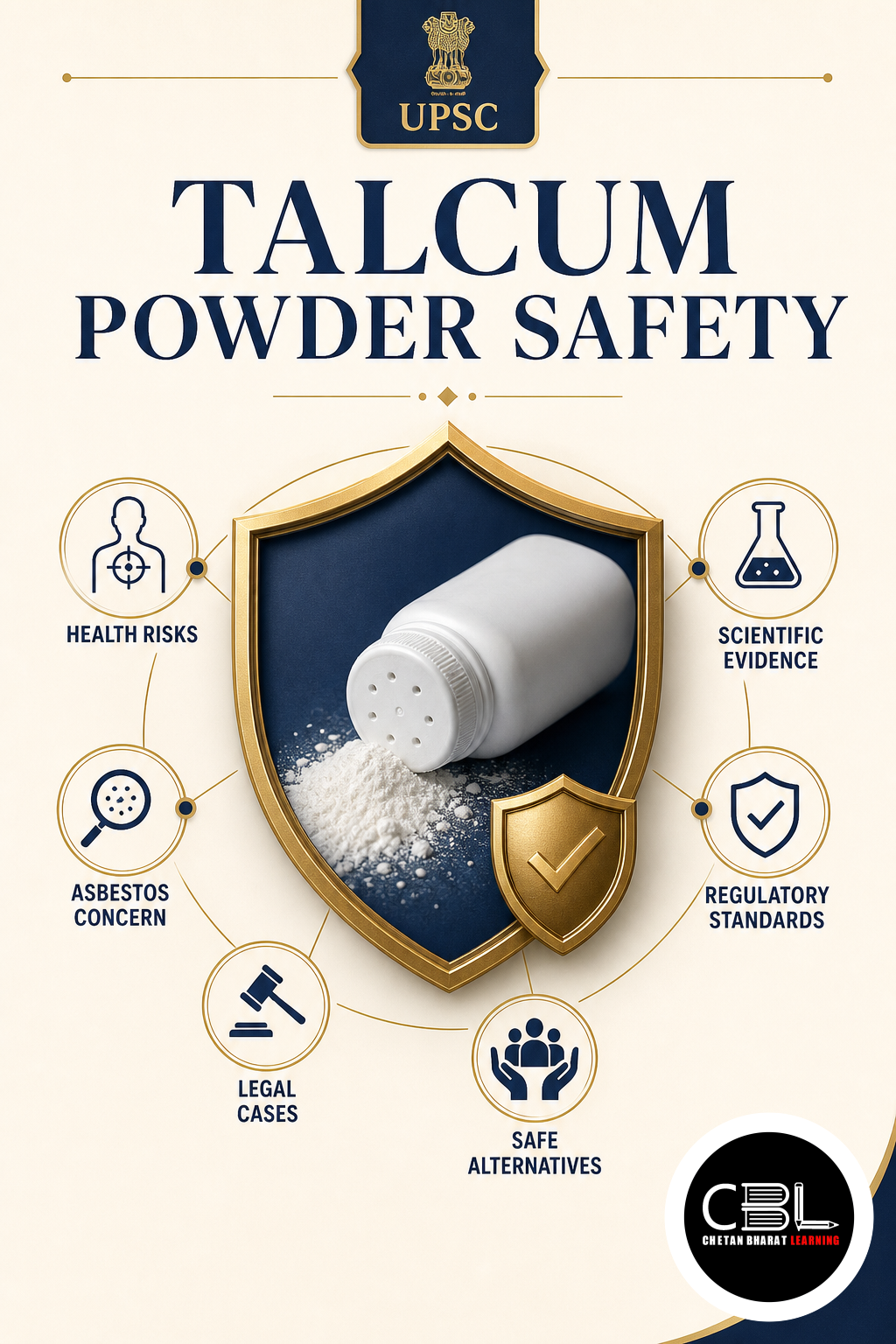

Talcum Powder Safety has gained attention after the passage reported legal proceedings involving talcum powder products and renewed debate over asbestos contamination. The article emphasises that the primary concern is contamination with asbestos rather than talc itself, and recommends a cautious, evidence-based approach.
Why in News?
Johnson & Johnson was mentioned in connection with legal settlements relating to allegations that asbestos-contaminated talcum powder caused cancer. The company, according to the passage, has denied the allegations and stated that settlements do not amount to an admission of liability.
The passage’s key message is that concern centres on asbestos contamination, not every talcum powder product.
What is Talc?
The passage defines talc as a naturally occurring mineral composed mainly of hydrated magnesium silicate. It is soft, smooth and highly absorbent.
Common applications mentioned include:
- Baby powder.
- Cosmetics.
- Face powder.
- Pharmaceutical products.
What is Asbestos?
The passage describes asbestos as a group of naturally occurring fibrous silicate minerals that are heat-resistant, fire-resistant and chemically stable.
Earlier applications listed in the passage include:
- Roofing materials.
- Cement products.
- Brake linings.
- Pipes.
- Thermal insulation.
Why is Asbestos Dangerous?
When asbestos fibres become airborne and are inhaled, they may remain trapped in the lungs for long periods.
Diseases mentioned include:
- Asbestosis (lung fibrosis).
- Lung cancer.
- Mesothelioma (cancer of the lining of the lungs).
The infographic notes that the International Agency for Research on Cancer (IARC) classifies asbestos among substances associated with cancer risk.
Why Can Talc Contain Asbestos?
According to the passage, talc and asbestos may occur naturally in nearby geological formations. During mining, extraction or processing, asbestos fibres may contaminate talc if adequate safeguards are not maintained.
The key point highlighted is that the concern is contaminated talc, not talc itself.
Does Talc Cause Cancer?
The passage distinguishes between talc contaminated with asbestos and talc without asbestos.
- Talc containing asbestos: Prevent exposure because asbestos is a recognised health hazard.
- Talc without asbestos: Scientific evidence remains under study and states that conclusions are not definitive.
The editorial therefore advises caution while acknowledging that research continues.
Hazard vs Risk
| Hazard | Risk |
|---|---|
| Potential to cause harm. | Probability that harm will actually occur. |
| Exists because of inherent properties. | Depends on dose, duration and route of exposure. |
The passage uses asbestos as an example of a hazard whose actual risk depends upon the nature and extent of exposure.
What is a Carcinogen?
The passage defines a carcinogen as a substance capable of causing cancer.
Examples shown include:
- Tobacco smoke.
- Asbestos.
- Ultraviolet radiation.
- High-dose ionising radiation.
Exposure alone does not always result in cancer because risk depends on dose, duration, route of exposure and individual susceptibility.
Safe Use of Talcum Powder
- Avoid inhaling powder.
- Avoid applying to broken or irritated skin.
- Use carefully around infants.
- Individuals with asthma or chronic respiratory disease should exercise additional caution.
- The passage mentions alternatives such as cornstarch-based talc-free powders.
India Perspective
Mining of asbestos is banned in India. It also notes that legal products and imported raw materials remain regulated and that limited domestic industries continue processing imported raw materials.
The passage calls for stronger testing, quality control, consumer protection and better enforcement of safety standards.
Precautionary Principle
The uploaded infographic explains the Precautionary Principle as the idea that where there is a possibility of serious or irreversible harm, lack of complete scientific certainty should not delay preventive action.
The passage suggests manufacturers and regulators should strengthen quality control, testing and monitoring to minimise consumer risk.
Public Health Lessons
- Evidence-based policy.
- Product safety through scientific regulation.
- Consumer awareness.
- Transparent communication.
- Regular regulatory oversight.
Ethical Dimensions
- Corporate Responsibility: Product safety, transparency and accountability.
- Government Responsibility: Regulation, quality monitoring and public communication.
- Scientific Integrity: Evidence-based decision making and continued research.
UPSC Relevance
GS Paper III: Science and Technology, Environment and Public Health.
GS Paper II: Health governance and consumer protection.
Prelims: Asbestos, carcinogens, precautionary principle, hazard vs risk.
Mains: Public health regulation, environmental health, scientific evidence and consumer safety.
Prelims Practice
- According to the passage, what is the principal concern in the talcum powder controversy? Answer: Asbestos contamination.
- What is talc primarily composed of? Answer: Hydrated magnesium silicate.
- Which disease listed in the passage is specifically associated with asbestos exposure? Answer: Asbestosis.
- What does the Precautionary Principle advocate? Answer: Preventive action despite scientific uncertainty where serious harm is possible.
- According to the passage, what determines risk besides the existence of a hazard? Answer: Dose, duration, route of exposure and individual susceptibility.
Mains Practice
Q1. Discuss the importance of the Precautionary Principle in public health regulation using the talcum powder controversy as an example.
Q2. Differentiate between hazard and risk. Why is this distinction important in science-based policymaking?
Source Note
This UPSC current affairs summary is prepared exclusively from the passage article and infographic. The content preserves the framing, terminology and emphasis of the uploaded source and follows the CBL editorial, SEO and UPSC content frameworks.
Related Current Affairs
Preparing for UPSC, PCS or HCS?
Talk to a mentor at Chetan Bharat Learning, Chandigarh. Free guidance on choosing the right exam and building a study plan.
Chat on WhatsAppCall 97793 53345UPSC / IAS / PCS coaching in Chandigarh · Trusted by aspirants across Punjab & Haryana
Leave a Reply
You must be logged in to post a comment.