

UPSC Relevance
GS Paper III: Environment, Energy, Climate Change and Infrastructure.
Prelims: Hydropower, El Niño, reservoir storage, hydraulic head, energy security.
Mains: Climate resilience, renewable energy, water resource management and sustainable development.
Reservoir Levels India
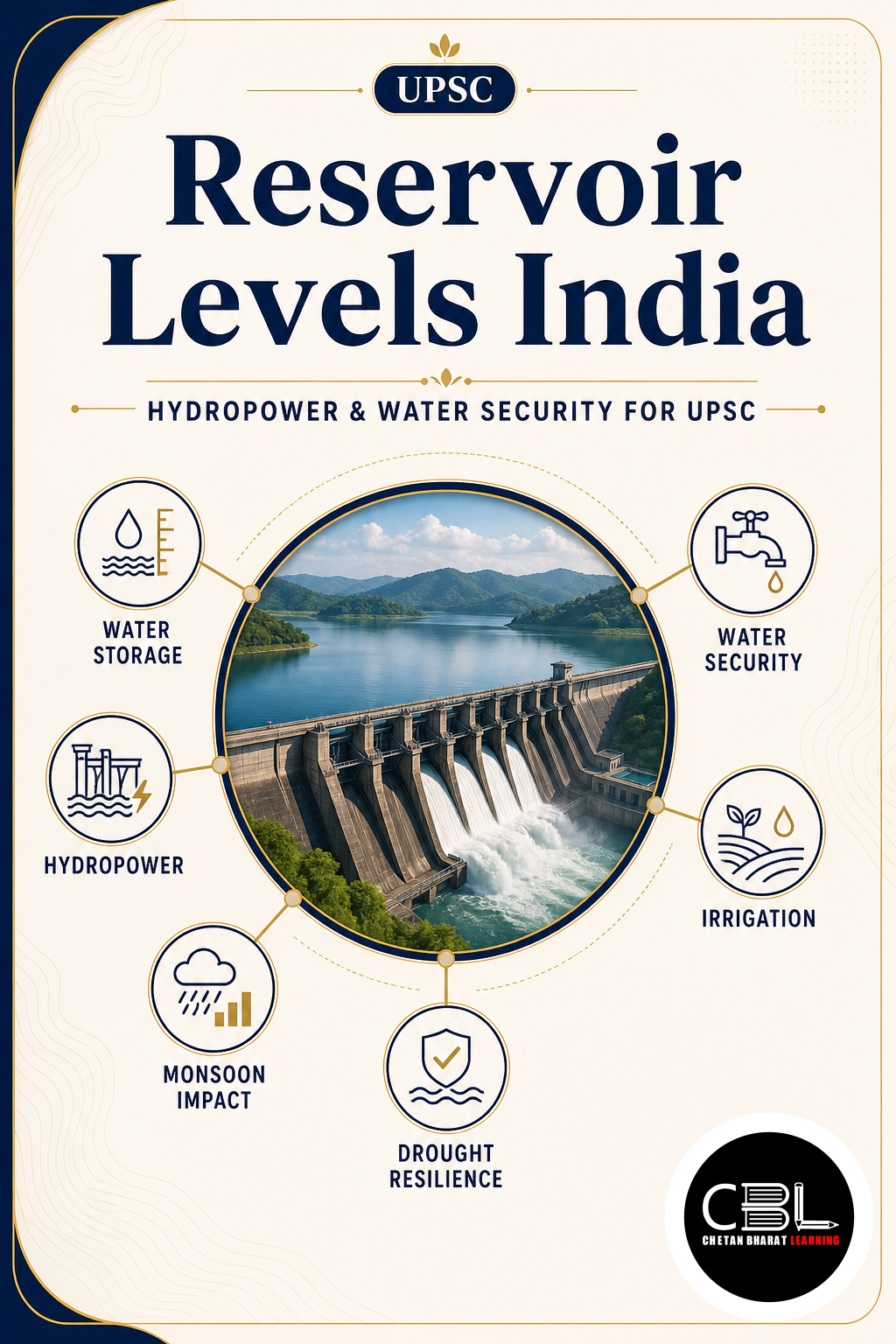
Reservoir Levels India has emerged as an important environment and energy issue after the passage reported that India’s major reservoirs have recorded their lowest water levels since 2023, affecting hydropower generation. The development highlights the close relationship between climate variability, water availability and energy security.
Why in News?
Reservoir levels across India’s major reservoirs have fallen to their lowest levels since 2023. As a consequence, hydropower generation has declined, increasing pressure on the country’s electricity system during periods of high demand.
The report also notes that rainfall variability, extreme weather events and climatic factors have influenced reservoir storage, thereby affecting electricity production from hydropower stations.
How Does Hydropower Work?
- Dam/Reservoir: Water is stored at a higher elevation.
- Penstock: Water flows through pipes under pressure.
- Turbine: Moving water rotates the turbine.
- Generator: The rotating turbine drives the generator.
- Electricity: The generator converts mechanical energy into electrical energy.
Why are Reservoir Levels Falling?
- Erratic Monsoon: Rainfall has become less uniform, reducing reservoir recharge.
- El Niño: El Niño can weaken monsoon circulation and reduce rainfall in some years.
- Rising Temperatures: Higher evaporation lowers stored water.
- Increasing Water Demand: Irrigation, drinking water and industrial consumption reduce available storage.
- Climate Change: Greater rainfall variability and more frequent extreme weather events affect water availability.
Impact of El Niño
The passage describes El Niño as the abnormal warming of sea surface temperatures in the central and eastern equatorial Pacific Ocean.
According to the passage, its possible effects on India include:
- Weakening of monsoon circulation.
- Delay in monsoon onset.
- Reduced reservoir storage.
- Increased drought risk in some regions.
El Niño increases drought risk but does not always cause drought.
Why Does Hydropower Generation Decline?
- Lower Water Volume: Less water is available for turbines.
- Reduced Hydraulic Head: Falling reservoir levels decrease the pressure available for electricity generation.
- Result: Less water and lower hydraulic head together reduce electricity generation.
Regional Trend Mentioned
The passage highlights a broad decline in reservoir storage across multiple regions of India, including northern, western, southern and central regions. The infographic emphasizes the trend rather than exact numerical comparisons.
Why is Hydropower Important?
- Renewable Energy: Produces electricity without burning fossil fuels.
- Peak Load Management: Helps meet periods of high electricity demand.
- Grid Stability: Supports balancing of electricity supply.
- Energy Storage: Reservoirs act as stored energy resources.
- Multipurpose Benefits: Reservoirs also support irrigation, drinking water and flood management.
Implications of Reduced Hydropower
- Electricity Shortage: Greater pressure on the power system.
- Higher Power Cost: Thermal power generally costs more than hydropower.
- Climate Impact: Greater dependence on fossil fuels may increase greenhouse gas emissions.
- Agriculture: Water availability for irrigation may decline.
Water-Energy-Climate Nexus
The passage illustrates a feedback cycle linking climate change, rainfall variability, reservoir storage, hydropower generation and increasing dependence on conventional fuels. Reduced hydropower can increase fossil-fuel dependence, contributing to further emissions and reinforcing climate-related challenges.
What is Energy Security?
The passage defines energy security as ensuring reliable, affordable, sustainable and uninterrupted energy supply for households, industries, agriculture and national development. Declining hydropower generation weakens these dimensions.
Way Forward
- Improve Reservoir Management: Use better forecasting and scientific water management.
- Diversify Renewable Energy: Expand solar, wind and hybrid projects.
- Pumped Storage Hydropower: Use surplus renewable energy for water pumping and storage.
- Rainwater Harvesting: Strengthen groundwater recharge and catchment management.
- Climate-Resilient Infrastructure: Improve reservoir design and operational planning.
- Demand-side Management: Promote energy efficiency and reduce peak electricity demand.
Prelims Practice
- Which climatic phenomenon discussed in the passage is associated with warming of the equatorial Pacific Ocean? Answer: El Niño.
- What primarily drives turbines in a hydropower plant? Answer: Flowing water under pressure.
- What happens to hydropower generation when reservoir levels decline? Answer: Electricity generation decreases because water volume and hydraulic head reduce.
- Which sector besides electricity benefits directly from reservoirs according to the passage? Answer: Irrigation and water supply.
- What is meant by energy security? Answer: Reliable, affordable, sustainable and uninterrupted energy supply.
Mains Practice
Q1. Discuss how declining reservoir levels affect India’s energy security and sustainable development.
Q2. Explain the water-energy-climate nexus with suitable examples from recent developments.
FAQs
No frequently asked questions available.
Related Current Affairs
Preparing for UPSC, PCS or HCS?
Talk to a mentor at Chetan Bharat Learning, Chandigarh. Free guidance on choosing the right exam and building a study plan.
Chat on WhatsAppCall 97793 53345UPSC / IAS / PCS coaching in Chandigarh · Trusted by aspirants across Punjab & Haryana
Leave a Reply
You must be logged in to post a comment.