
UPSC Relevance
This topic is important for GS Paper III (Indian Economy), particularly monetary policy, inflation targeting, RBI, banking, liquidity management and macroeconomic stability.
Article
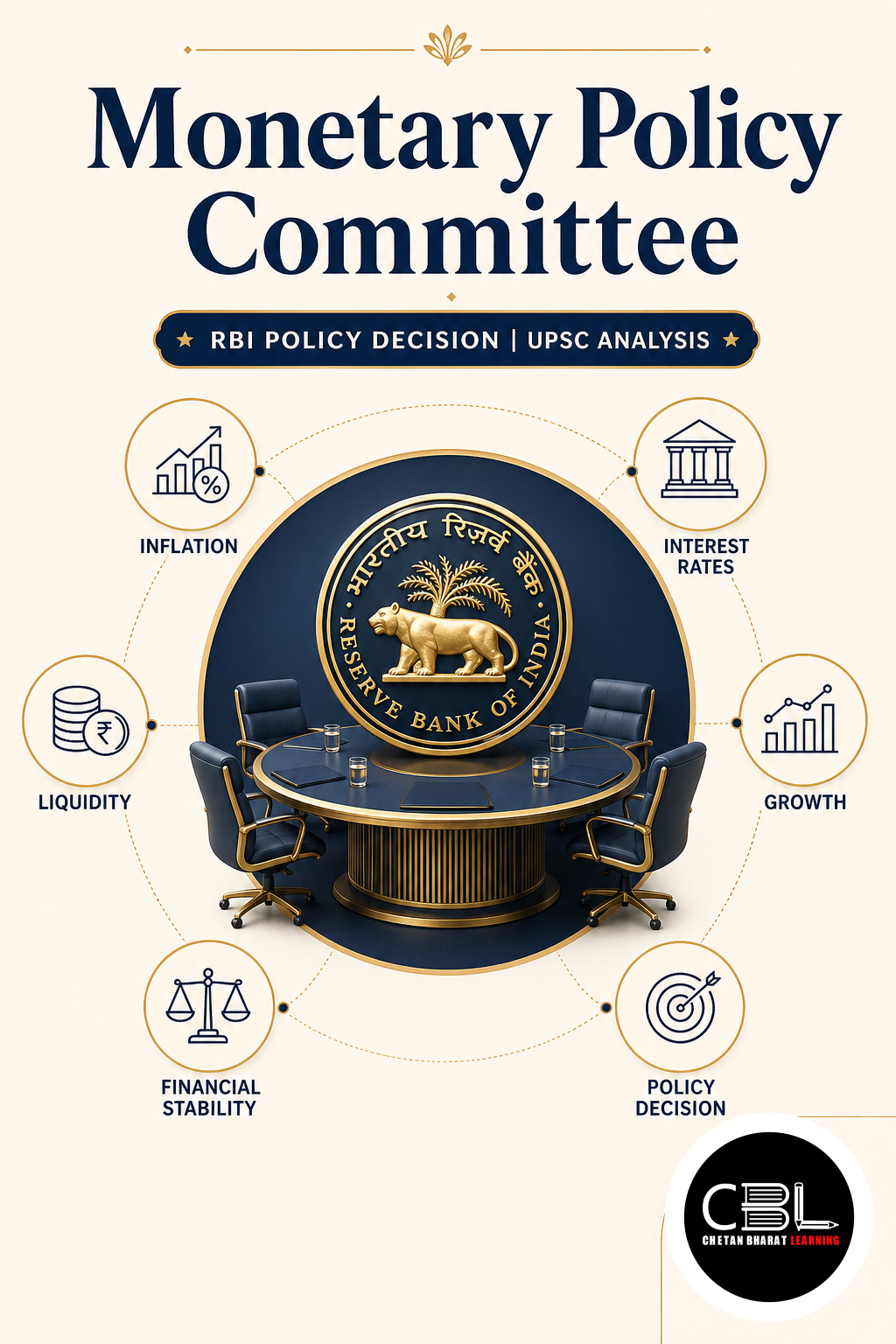
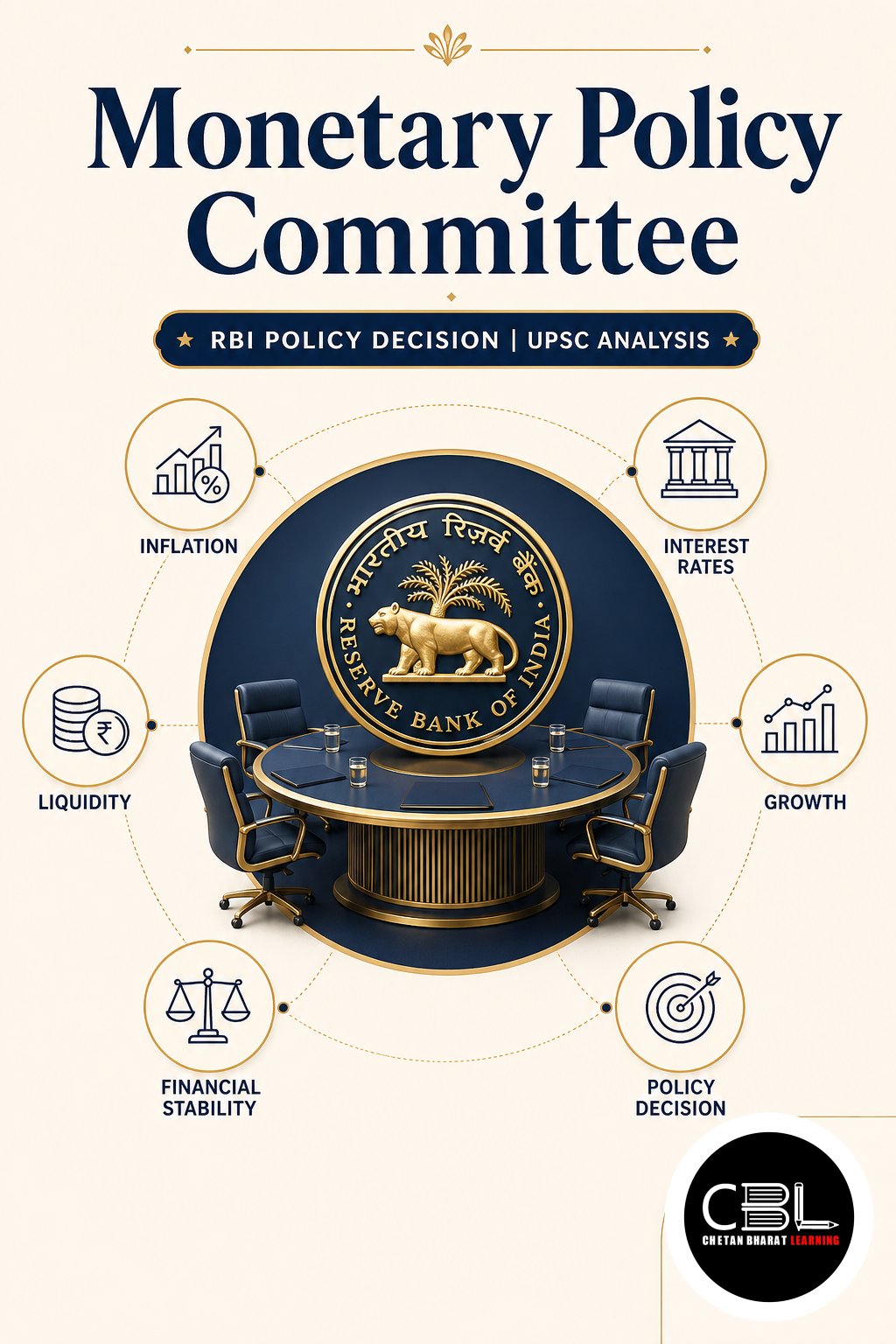
Monetary Policy Committee is in the news after the Reserve Bank of India (RBI) prepared to announce its latest monetary policy decision. The passage explains how the RBI decides whether to cut, hike or maintain the repo rate while balancing inflation, growth and financial stability.
Why in News
According to the passage, the RBI’s Monetary Policy Committee (MPC) is scheduled to announce its latest policy decision. The report notes that retail inflation has edged higher while the repo rate has steadily declined in previous policy cycles, leading many economists to expect a status quo in the current meeting.
Quick Facts
| Institution | Reserve Bank of India (RBI) |
|---|---|
| Decision-Making Body | Monetary Policy Committee (MPC) |
| Primary Objective | Maintain price stability while supporting economic growth |
| Key Instrument | Repo Rate |
What is Monetary Policy?
The passage defines monetary policy as the policy through which the RBI regulates the supply, cost and availability of money and credit in the economy. Its key objectives include maintaining price stability, supporting sustainable economic growth and preserving financial stability.
Who Makes Monetary Policy?
According to the passage, monetary policy decisions are taken by the Monetary Policy Committee (MPC), functioning under the Reserve Bank of India. The infographic notes that the MPC was established under the RBI Act, 1934 following the 2016 amendment.
Composition of the Monetary Policy Committee
The MPC consists of six members:
- Three RBI Members: RBI Governor (Chairperson), Deputy Governor in charge of Monetary Policy and one RBI official.
- Three External Members: Appointed by the Central Government.
Each member has one vote, decisions are taken by majority, and the Governor has a casting vote in case of a tie.
RBI’s Main Objective: Price Stability
The infographic highlights the Flexible Inflation Targeting (FIT) framework under which inflation is targeted at 4%, with a tolerance band of 2% to 6%. Temporary deviations are permitted within this range.
Why is 4% Inflation Considered Ideal?
- If Inflation is Too High: Purchasing power declines, cost of living increases, savings lose value and business uncertainty rises.
- If Inflation is Too Low: Demand weakens, investment may decline and economic growth slows.
Around 4% seeks to balance price stability with economic growth.
What is the Repo Rate?
The repo rate is the rate at which the RBI lends short-term funds to commercial banks against eligible government securities. It is the principal policy rate used by the RBI to influence liquidity and borrowing costs.
What Happens When RBI Cuts the Repo Rate?
- Banks borrow funds more cheaply.
- Lending rates decline.
- Loans become cheaper.
- Consumers spend more.
- Businesses invest more.
- Economic growth receives support.
What Happens When RBI Hikes the Repo Rate?
- Borrowing becomes more expensive.
- Banks increase lending rates.
- Loans become costlier.
- Demand moderates.
- Inflationary pressures ease.
What Does Status Quo Mean?
A status quo means no change in the repo rate. Economists expect this when inflation risks persist while economic growth also requires policy support.
Key Factors Considered by RBI
- Retail inflation (Consumer Price Index).
- Economic growth (GDP).
- Crude oil prices.
- US-Iran conflict and global developments.
- Monsoon performance.
- Exchange rate movements.
- Banking system liquidity.
- Global interest rates.
Other Monetary Policy Tools
- Reverse Repo Rate: Absorbs excess liquidity.
- Standing Deposit Facility (SDF): Liquidity absorption tool.
- Cash Reserve Ratio (CRR): Portion of deposits kept with the RBI.
- Statutory Liquidity Ratio (SLR): Portion of deposits invested in liquid assets.
- Open Market Operations (OMO): Purchase or sale of government securities.
- Marginal Standing Facility (MSF): Emergency borrowing window for banks.
Why Can’t RBI Always Cut Rates?
Lower interest rates stimulate demand, but excessive demand can increase inflation and reduce purchasing power. The RBI therefore balances growth, inflation and financial stability while making policy decisions.
Advantages and Risks of Monetary Policy
- If RBI Cuts Rates: Supports growth, employment, investment and credit expansion but may increase inflation, weaken the rupee or create asset bubbles.
- If RBI Raises Rates: Helps control inflation and stabilise the currency but may slow growth, reduce borrowing and lower investment.
Flexible Inflation Targeting
The RBI targets inflation while simultaneously considering growth, employment, financial stability and the external sector. Hence, inflation targeting in India is flexible rather than rigid.
Prelims Practice Questions
- Q1. The Monetary Policy Committee is primarily responsible for: (a) Fiscal policy (b) Monetary policy decisions (c) Trade policy (d) Industrial policy. Answer: (b).
- Q2. The repo rate is the rate at which: (a) Banks lend to customers (b) RBI lends to commercial banks (c) Government borrows from RBI (d) RBI lends to NBFCs only. Answer: (b).
- Q3. According to the passage, India’s inflation target under the Flexible Inflation Targeting framework is: (a) 2% (b) 4% (c) 6% (d) 8%. Answer: (b).
- Q4. A repo rate cut generally aims to: (a) Increase borrowing costs (b) Reduce liquidity (c) Encourage borrowing and investment (d) Increase CRR automatically. Answer: (c).
- Q5. A status quo in monetary policy means: (a) Repo rate is reduced (b) Repo rate is increased (c) No change in the repo rate (d) CRR is abolished. Answer: (c).
Mains Practice Questions
- Q1 (10 Marks): Explain the role of the Monetary Policy Committee in maintaining price stability while supporting economic growth.
- Q2 (15 Marks): Discuss the significance of Flexible Inflation Targeting in India’s monetary policy framework. How does the RBI balance inflation and growth?
FAQs
- What is the Monetary Policy Committee? According to the passage, it is the RBI’s decision-making body responsible for monetary policy.
- Why is the repo rate important? It influences borrowing costs, lending rates, liquidity and overall economic activity.
- Why do economists expect a status quo? Inflation has risen while growth considerations remain important, leading many economists to expect no change in the repo rate.
Related Current Affairs
Preparing for UPSC, PCS or HCS?
Talk to a mentor at Chetan Bharat Learning, Chandigarh. Free guidance on choosing the right exam and building a study plan.
Chat on WhatsAppCall 97793 53345UPSC / IAS / PCS coaching in Chandigarh · Trusted by aspirants across Punjab & Haryana
Leave a Reply
You must be logged in to post a comment.