
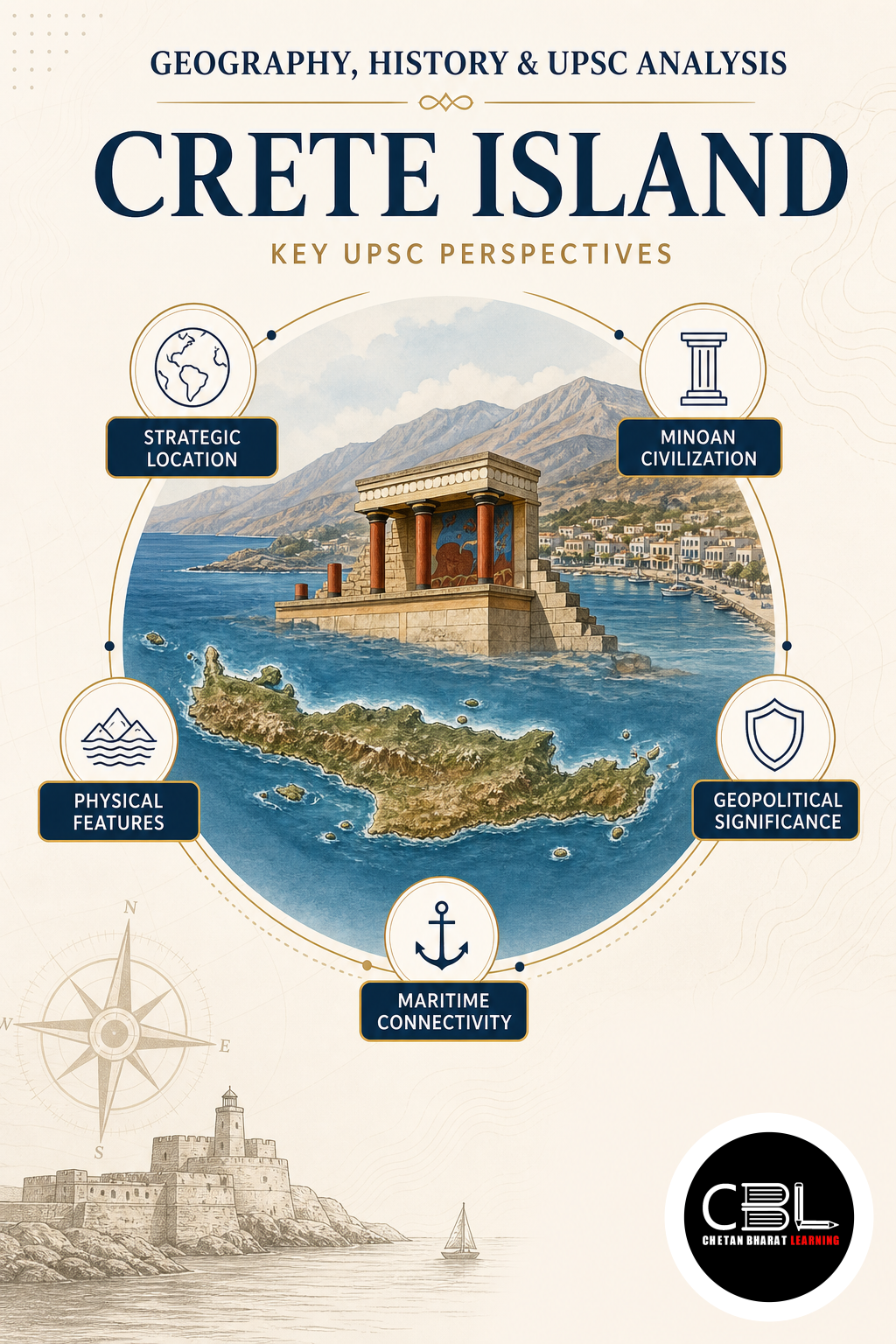

UPSC Mapping
Prelims
- World Geography
- Mediterranean Region
- Ancient Civilizations
Mains
- GS Paper I – Geography and World History
Quick Facts
| Country | Greece |
|---|---|
| Sea | Southern Aegean Sea |
| Area | 8,336 sq. km |
| Capital | Heraklion |
Article
What is Crete Island?
Crete Island is the largest island of Greece and the fifth-largest island in the Mediterranean Sea, covering an area of approximately 8,336 square kilometres. It lies about 160 km south of mainland Greece in the southern part of the Aegean Sea, which forms part of the Mediterranean Sea.
The island stretches roughly 260 km from east to west and reaches a maximum width of about 60 km. Crete features a diverse landscape comprising mountain ranges, fertile plains, deep gorges and sandy beaches, making it one of Greece’s most significant geographical regions.
Why is Crete Island in News?
Crete Island recently witnessed severe wildfires that forced the evacuation of thousands of residents and tourists. Strong winds accelerated the spread of the fires, posing major challenges to emergency response teams and affecting tourism across parts of the island.
The incident has drawn attention to the increasing frequency of climate-related disasters across the Mediterranean region. Official updates on disaster management are available through the Hellenic Civil Protection (civilprotection.gov.gr).
Geographical Features of Crete Island
Crete occupies a strategically important position between Europe, Asia and Africa.
- Strategic location: Situated in the southern Aegean Sea, linking the eastern Mediterranean with mainland Greece.
- Surrounding seas: Bordered by the Sea of Crete to the north, Libyan Sea to the south, Myrtoan Sea to the west and Carpathian Sea to the east.
- Mountainous terrain: A continuous mountain chain runs across the island, creating varied climatic zones.
- Rich agricultural plains: Fertile valleys support olive cultivation, vineyards and citrus farming.
- Coastal diversity: The island is known for numerous beaches, bays and natural harbours.
Economy of Crete Island
The economy of Crete is driven by a combination of tourism, agriculture and shipping. Tourism remains the largest contributor, attracting millions of visitors annually because of the island’s historical sites, beaches and cultural heritage.
Agriculture also plays an important role through the production of olives, olive oil, grapes, fruits and vegetables. Maritime activities complement the island’s economy due to its strategic Mediterranean location.
History of Crete Island
Crete Island has been inhabited since the Paleolithic Age. It became the birthplace of the Minoan Civilization, regarded as the earliest advanced civilisation in Europe, which flourished between approximately 2700 BCE and 1420 BCE.
Following the decline of the Minoans, the island came under the control of the Mycenaeans. In subsequent centuries, Crete was ruled by the Romans, Byzantines, Andalusians, Venetians and Ottomans before eventually becoming part of modern Greece.
During the Second World War, Crete was occupied by Nazi Germany and witnessed the famous Battle of Crete, one of the earliest major airborne military operations in history.
Significance of Crete Island
Crete occupies a strategic maritime location in the eastern Mediterranean and has historically served as an important crossroads between Europe, Asia and Africa. Its geographical position has shaped trade routes, cultural exchanges and military strategy for thousands of years.
The island also represents a valuable case study for UPSC in world geography, ancient civilisations, climate-related disasters and Mediterranean geopolitics.
Challenges
- Wildfires: Rising temperatures and strong seasonal winds increase fire risks.
- Climate change: Extreme weather affects agriculture, biodiversity and tourism.
- Tourism pressure: Seasonal tourism places stress on natural resources and infrastructure.
- Water scarcity: Dry summers create increasing pressure on freshwater resources.
- Environmental conservation: Protecting coastal ecosystems remains an ongoing priority.
Way Forward
Strengthening wildfire preparedness, promoting sustainable tourism and conserving natural ecosystems will enhance the long-term resilience of Crete Island. Improved climate adaptation strategies are essential for protecting local communities and economic activities.
International cooperation on disaster management and environmental conservation can support Mediterranean islands facing similar climate challenges. Additional information is available through the UNESCO World Heritage Centre (whc.unesco.org).
Prelims Package
- Q1. Crete is the largest island of: (a) Italy (b) Greece (c) Cyprus (d) Turkey — Answer: (b) Greece.
- Q2. The earliest advanced European civilisation that flourished on Crete was: (a) Roman (b) Byzantine (c) Minoan (d) Phoenician — Answer: (c) Minoan Civilization.
- Q3. The capital of Crete is: (a) Athens (b) Chania (c) Heraklion (d) Rhodes — Answer: (c) Heraklion.
- Q4. Crete is located in which sea? (a) Black Sea (b) Southern Aegean Sea (c) Adriatic Sea (d) Baltic Sea — Answer: (b) Southern Aegean Sea.
- Q5. The famous Battle of Crete took place during: (a) First World War (b) Peloponnesian War (c) Second World War (d) Crimean War — Answer: (c) Second World War.
Mains Package
- Q1. Discuss the geographical significance of Crete Island in the Mediterranean region. (10 marks)
- Intro: Introduce Crete’s location.
- Body: Strategic position, physical geography, economy, climate and geopolitical relevance.
- Conclusion: Highlight its importance in Mediterranean affairs.
- Q2. Explain the contribution of the Minoan Civilization to the development of early European civilisation. (15 marks)
- Intro: Briefly introduce the Minoans.
- Body: Maritime trade, art, architecture, administration, decline and legacy.
- Conclusion: Assess its historical significance.
FAQs on Crete Island
Where is Crete Island located?
Crete is located in the southern part of the Aegean Sea, approximately 160 km south of mainland Greece.
Why is Crete historically important?
Crete was the centre of the Minoan Civilization, the earliest advanced civilisation in Europe, and later witnessed the famous Battle of Crete during the Second World War.
Why is Crete Island important for UPSC?
The topic is relevant for world geography, Mediterranean geography, ancient civilisations, climate change and GS Paper I.
Related Current Affairs
Preparing for UPSC, PCS or HCS?
Talk to a mentor at Chetan Bharat Learning, Chandigarh. Free guidance on choosing the right exam and building a study plan.
Chat on WhatsAppCall 97793 53345UPSC / IAS / PCS coaching in Chandigarh · Trusted by aspirants across Punjab & Haryana
Leave a Reply
You must be logged in to post a comment.