

UPSC Mapping
| Stage | Topics |
|---|---|
| Prelims | One Health, Zoonotic Diseases, WHO, Vaccine Development |
| Mains | GS Paper II (Health) & GS Paper III (Science and Disaster Management) |
Quick Facts
| Concept | One Health |
|---|---|
| Focus | Pandemic Preparedness |
| Global Agency | World Health Organization |
Article
One Health approach has gained renewed attention as experts emphasize that viruses do not respect national borders and that equitable access to vaccines is essential for global health security. The topic is highly relevant for UPSC because it connects public health, environment, international cooperation and disaster preparedness. Read more from the daily current affairs archive.
What is One Health approach?
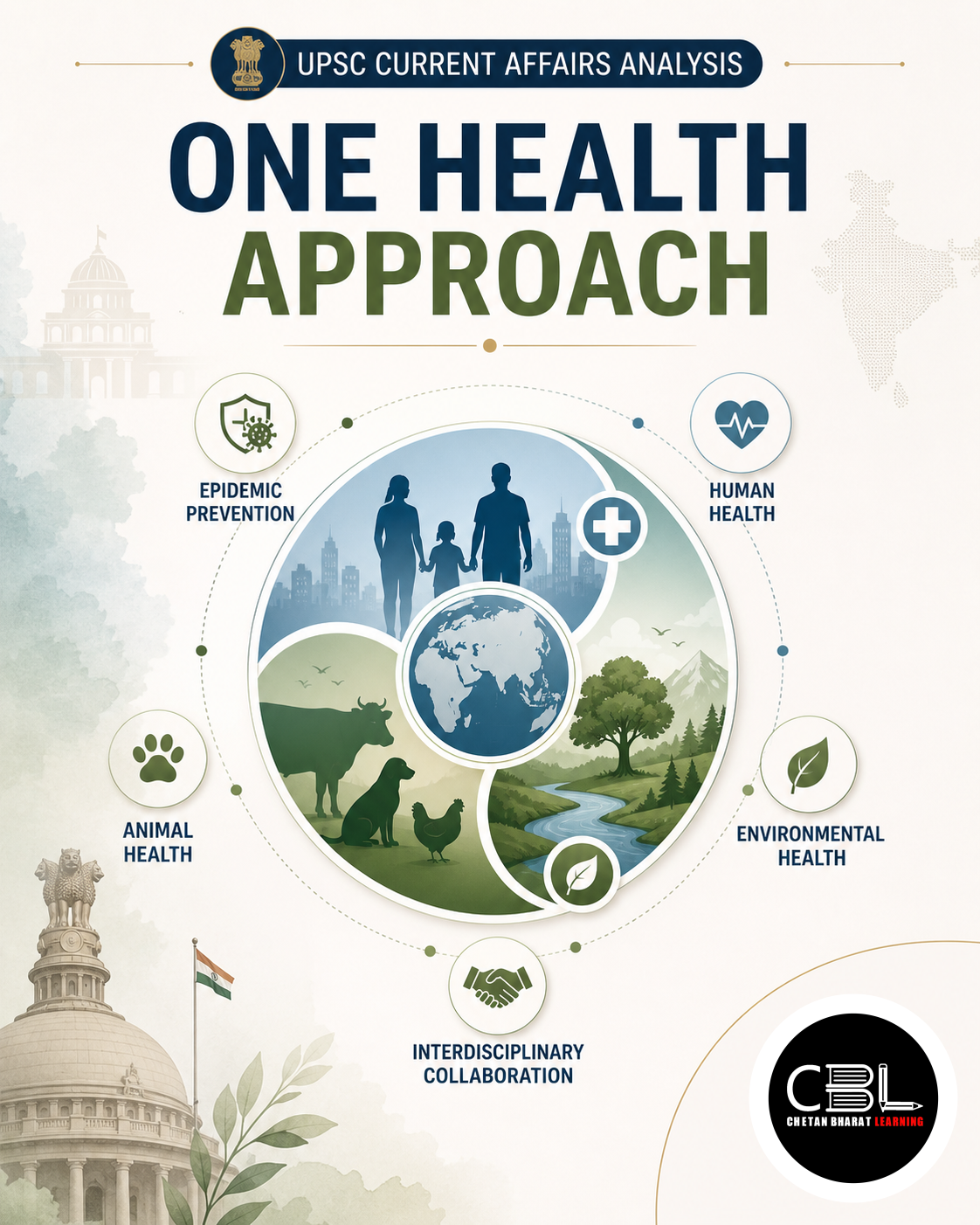
One Health approach is an integrated framework recognizing that human health, animal health and environmental health are interconnected. It promotes collaboration among doctors, veterinarians, ecologists and public health experts to prevent and control disease outbreaks.
Many emerging infectious diseases originate in animals before spreading to humans. Early surveillance across wildlife, livestock and human populations helps detect threats before they become epidemics or pandemics.
Why is One Health approach in News?
The world must prepare for future epidemics before they occur and ensure timely, fair and affordable access to vaccines. It argues that international cooperation, research investment and manufacturing capacity are essential to strengthen global health security.
The article also stresses that emerging diseases are becoming more frequent because of increasing human-animal interaction, climate change and global travel. Official guidance is available through the World Health Organization (WHO).
Key Features
The One Health framework supports comprehensive pandemic preparedness.
- Integrated surveillance: Monitors diseases across humans, animals and the environment.
- Zoonotic disease prevention: Focuses on infections that spread from animals to humans, such as avian influenza and Nipah.
- Global collaboration: Encourages countries to share scientific knowledge, vaccines and public health resources.
- Research and innovation: Promotes vaccine platforms, diagnostics and genomic surveillance.
- Equitable vaccine access: Seeks timely and affordable distribution of vaccines during health emergencies.
Challenges
Several obstacles continue to affect pandemic preparedness.
- Unequal vaccine access: Low-income countries often receive vaccines later than high-income nations.
- Weak surveillance systems: Limited laboratory capacity delays outbreak detection.
- Climate change: Expands the geographical range of disease vectors such as mosquitoes.
- Habitat destruction: Increased human-wildlife interaction raises the risk of zoonotic spillovers.
- Limited global coordination: Differences in policies and resources can delay collective responses.
Explore additional public health topics in the UPSC current affairs archive.
Way Forward
Countries should strengthen disease surveillance, invest in research infrastructure and expand vaccine manufacturing capacity before future outbreaks occur. Coordinated preparedness is more effective than reactive responses.
India can deepen implementation of the One Health framework through collaboration between health, veterinary and environmental institutions while strengthening genomic surveillance and primary healthcare. Further information is available from the WHO.
Prelims Practice Corner
-
Q1. The One Health approach primarily integrates:
- (a) Agriculture and Industry
- (b) Human, Animal and Environmental Health
- (c) Banking and Trade
- (d) Climate and Space
Answer: (b). One Health recognizes the interdependence of human, animal and environmental health.
-
Q2. A zoonotic disease is one that:
- (a) Spreads only through water
- (b) Spreads between animals and humans
- (c) Affects only plants
- (d) Occurs only in hospitals
Answer: (b).
-
Q3. Which organization leads international public health coordination?
- (a) WTO
- (b) WHO
- (c) IMF
- (d) FAO
Answer: (b).
-
Q4. Which factor increases the emergence of infectious diseases?
- (a) Reduced travel
- (b) Human-wildlife interaction
- (c) Lower temperatures only
- (d) Declining urbanization
Answer: (b).
-
Q5. Vaccine development usually begins with:
- (a) Clinical trials
- (b) Basic research
- (c) Mass production
- (d) Regulatory approval
Answer: (b).
Mains Practice Questions
-
Q1. Explain the significance of the One Health approach in strengthening India’s pandemic preparedness. (10 Marks)
Answer Structure:
- Intro: Define One Health.
- Body: Surveillance, zoonoses, inter-sectoral coordination, research and benefits.
- Conclusion: Importance for resilient public health systems.
-
Q2. Discuss the importance of equitable vaccine access in global health governance. (15 Marks)
Answer Structure:
- Intro: Explain vaccine equity.
- Body: Public health, manufacturing, international cooperation, challenges and reforms.
- Conclusion: Shared global responsibility.
FAQs on One Health approach
- What is the One Health approach?
- It is a collaborative framework integrating human, animal and environmental health to prevent and manage disease outbreaks.
- Why are zoonotic diseases important for UPSC?
- Most emerging infectious diseases originate in animals, making zoonoses important for health security, environment and disaster management.
- Why is vaccine equity important?
- Timely and affordable access to vaccines helps reduce disease spread, saves lives and strengthens global preparedness against future pandemics.
Related Current Affairs
Preparing for UPSC, PCS or HCS?
Talk to a mentor at Chetan Bharat Learning, Chandigarh. Free guidance on choosing the right exam and building a study plan.
Chat on WhatsAppCall 97793 53345UPSC / IAS / PCS coaching in Chandigarh · Trusted by aspirants across Punjab & Haryana
Leave a Reply
You must be logged in to post a comment.