

UPSC Syllabus Mapping
| GS Paper | GS-II |
|---|---|
| Subject | International Relations, Regional Groupings, ASEAN and Indo-Pacific |
What is ASEAN Regional Forum?
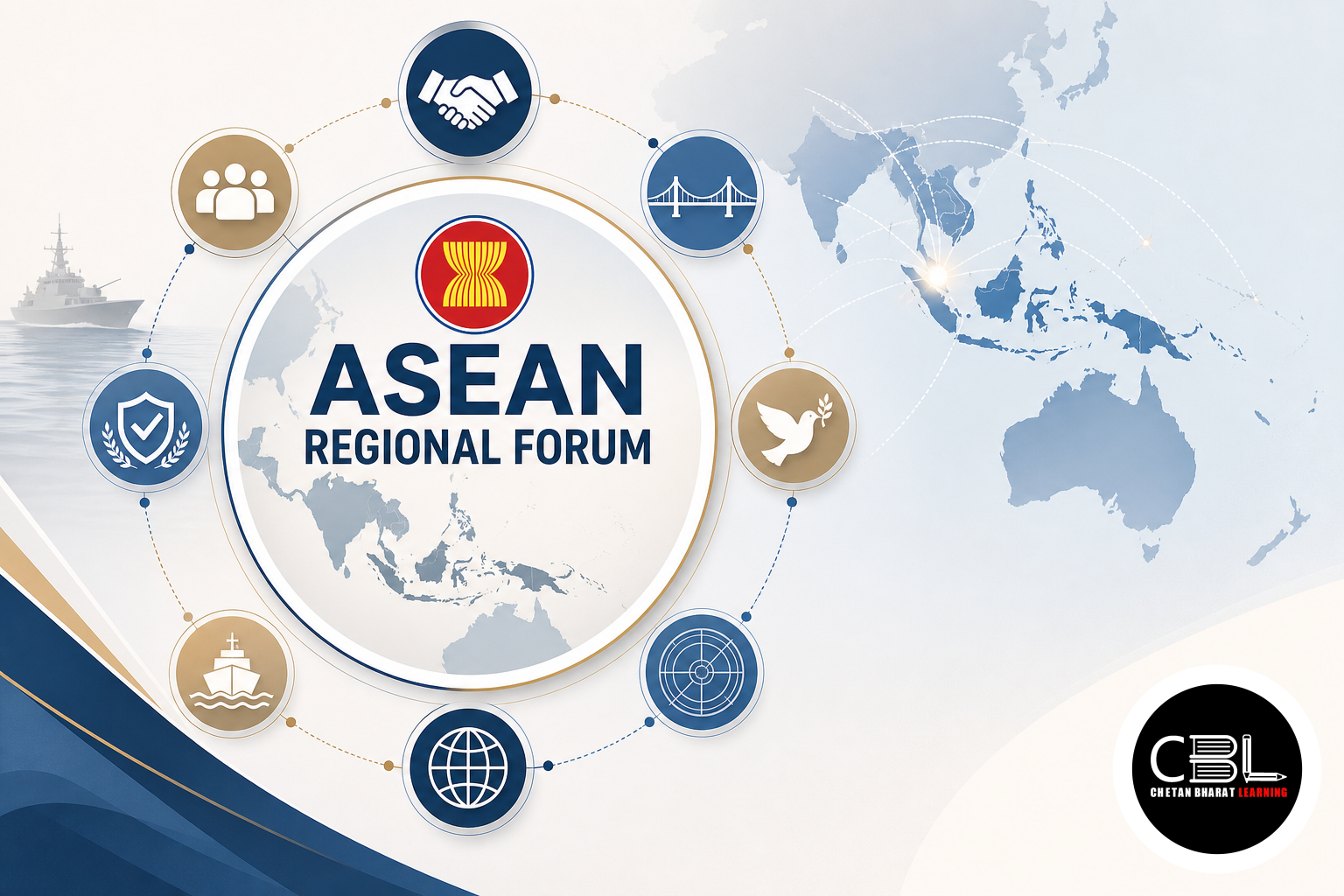
The forum began in 1994 as an ASEAN-led mechanism for dialogue on political and security questions. It gives participating countries a common setting to discuss regional challenges without creating a military alliance. Therefore, its core value lies in sustained communication among countries that may hold sharply different strategic positions. Dialogue can reduce misunderstanding even when participants cannot immediately resolve their disputes.
Its objectives include constructive consultation on political and security issues of common concern. It also seeks to strengthen confidence-building and preventive diplomacy. Preventive diplomacy aims to stop disagreements from escalating into serious disputes or conflicts. Consequently, consultation, transparency and practical cooperation form important parts of the forum’s approach.
The mechanism follows ASEAN’s preference for consultation and consensus. Participants generally seek agreement through dialogue rather than majority voting or binding enforcement. Moreover, this approach allows countries with different political systems and strategic interests to remain within the same process. However, consensus can also slow collective responses when members disagree strongly.
Participation extends well beyond Southeast Asia. The forum brings ASEAN members together with dialogue partners and other important regional participants. These include India, China, Japan, the United States, Russia, Australia, the Republic of Korea, New Zealand, Canada and the European Union, alongside other participants. Therefore, it provides an unusually broad security-dialogue platform centred on ASEAN.
The ASEAN Chair for the relevant year chairs the forum. This arrangement reinforces the principle of ASEAN centrality, under which Southeast Asian countries seek to remain institutionally central to wider regional cooperation. Furthermore, ASEAN-led mechanisms allow major powers to engage within an established multilateral framework. This institutional design distinguishes the forum from exclusive strategic coalitions.
Why is ASEAN Regional Forum in News?
India’s External Affairs Minister recently underlined the forum’s role in discussing political and security issues across the Indo-Pacific. The observation comes as the region faces increasingly complex strategic competition. Maritime disputes, geopolitical rivalry and transnational threats all require channels for communication. Consequently, inclusive diplomatic forums retain value even when participants disagree on major issues.
The Indo-Pacific contains some of the world’s busiest maritime trade routes. Stability in these waters directly affects commerce, energy flows and supply chains. Moreover, competing territorial and maritime claims can increase strategic uncertainty. Regional dialogue can therefore complement international law and bilateral diplomacy by maintaining regular communication among governments.
For India, ASEAN-led institutions form an important component of the Act East Policy. India seeks stronger economic, political, connectivity and security engagement with Southeast Asia. Furthermore, India’s Indo-Pacific approach supports an open and inclusive regional architecture. Participation in ASEAN-centred mechanisms helps translate these principles into sustained diplomatic engagement.
The forum also provides space for discussion of non-traditional security challenges. Terrorism, cyber threats, maritime crime and disaster response can cross national boundaries. No country can address all such problems independently. Therefore, practical cooperation in these fields can continue even when strategic disagreements limit progress elsewhere.
The Ministry of External Affairs provides India’s official perspective on ASEAN engagement and regional diplomacy. For UPSC, the latest development should trigger revision of ASEAN-led institutions rather than the forum alone. Candidates should particularly distinguish it from the East Asia Summit and ASEAN Defence Ministers’ Meeting Plus.
Key Features
Inclusiveness represents one of the mechanism’s most distinctive characteristics. Countries with competing strategic interests participate within the same ASEAN-led framework. This provides opportunities for direct diplomatic communication. Moreover, repeated interactions can gradually create habits of consultation even when governments disagree over substantive security questions.
Confidence-building forms an important pillar. Measures can include information exchange, greater transparency, workshops and cooperation among officials. Such activities may appear modest compared with formal treaties. However, they can reduce uncertainty about other states’ intentions and create channels that remain useful during periods of tension.
Preventive diplomacy represents a more advanced objective. It seeks to address emerging tensions before they become open conflicts. Consequently, the process emphasises consultation and peaceful management of disputes. The forum does not function as a supranational authority, so successful preventive diplomacy depends heavily on political willingness among participants.
Non-traditional security cooperation broadens the agenda beyond conventional military threats. Maritime security, counter-terrorism, transnational crime, disaster relief and cyber issues can feature in regional discussions. Furthermore, practical cooperation in these areas may generate trust among countries with otherwise difficult relations. Functional cooperation therefore complements political dialogue.
ASEAN centrality provides the institutional foundation. ASEAN convenes major powers rather than allowing any single external power to dominate the process formally. This creates diplomatic space for Southeast Asian states collectively. Consequently, ASEAN-led mechanisms have become important components of the broader Indo-Pacific institutional architecture.
Challenges
Consensus can protect inclusiveness but also constrain decisive action. A broad membership naturally contains different threat perceptions and national interests. Therefore, participants may agree on general principles while avoiding strong collective positions on contentious disputes. This produces a recurring tension between participation and effectiveness.
Major-power rivalry creates another difficulty. Strategic competition between powerful states increasingly shapes the Indo-Pacific environment. ASEAN countries often prefer not to choose rigid geopolitical camps. Consequently, ASEAN-led institutions must preserve space for dialogue while preventing great-power competition from weakening regional cohesion.
The region also contains unresolved maritime and territorial disputes. Dialogue can reduce risks, but it cannot substitute for political settlements or adherence to international law. Moreover, conflicting interpretations of security issues can limit consensus. The forum therefore works best as one layer within a broader diplomatic and legal architecture.
Institutional overlap poses a further challenge. The Indo-Pacific contains several ASEAN-led and other regional mechanisms, each with different membership and functions. These include the East Asia Summit, ADMM-Plus and various subregional arrangements. Therefore, policymakers must avoid unnecessary duplication while preserving the distinctive value of each platform.
Finally, confidence-building produces gradual rather than dramatic results. This can create perceptions that dialogue mechanisms lack effectiveness during immediate crises. However, regular communication can still reduce miscalculation and preserve diplomatic channels. Aspirants can follow related regional institutions through our UPSC current affairs library.
Way Forward
Participants can strengthen the forum by expanding practical cooperation in areas where interests converge. Maritime safety, disaster response, cyber security and counter-terrorism offer useful opportunities. Moreover, joint exercises and expert-level exchanges can convert political dialogue into operational familiarity. Practical cooperation can thereby reinforce trust over time.
Preventive diplomacy should receive greater institutional attention. Early communication during emerging crises can reduce the risk of miscalculation. Therefore, participants can improve information-sharing and diplomatic consultation mechanisms. Such measures would not eliminate strategic competition, but they could help manage its consequences.
ASEAN members also need to maintain internal cohesion. ASEAN centrality depends not merely on chairing meetings but on the organisation’s ability to develop meaningful common positions. Furthermore, stronger coordination can improve its credibility with external partners. Institutional centrality must therefore rest on substantive diplomatic capacity.
India can support this architecture through sustained engagement rather than episodic participation. Cooperation in maritime domain awareness, disaster relief, connectivity and capacity building can complement diplomatic consultations. Moreover, India can continue emphasising an inclusive Indo-Pacific where ASEAN retains a central institutional role. This approach aligns regional security with India’s wider Act East engagement.
The Association of Southeast Asian Nations provides official information on ASEAN-led regional mechanisms and cooperation. The forum’s long-term relevance will depend on its ability to combine inclusiveness with practical results. Therefore, confidence-building, preventive diplomacy and sustained dialogue remain essential tools for managing Indo-Pacific security challenges.
Prelims Practice Corner
-
1. The ASEAN-led security dialogue mechanism discussed above was established in:
(a) 1985
(b) 1994
(c) 2005
(d) 2015Answer: (b) It was established in 1994 as a regional platform for political and security dialogue.
-
2. Which of the following best describes its principal objectives?
(a) Establishing a common currency
(b) Creating a collective military alliance
(c) Confidence-building and preventive diplomacy
(d) Establishing a regional customs unionAnswer: (c) Its objectives emphasise political-security dialogue, confidence-building and preventive diplomacy.
-
3. Consider the following countries:
1. India
2. China
3. United States
4. Japan
Which of the above participate in the forum?
(a) 1 and 4 only
(b) 1, 2 and 4 only
(c) 2 and 3 only
(d) 1, 2, 3 and 4Answer: (d) All four participate in the ASEAN-led security dialogue.
-
4. The forum is chaired by:
(a) UN Secretary-General
(b) ASEAN Chair of the relevant year
(c) President of the World Bank
(d) A permanently elected Secretary-GeneralAnswer: (b) The ASEAN Chair for that year chairs the forum.
-
5. Consider the following statements:
1. It is an ASEAN-led mechanism.
2. It functions as a collective defence alliance.
3. It includes discussion of non-traditional security issues.
Which statements are correct?
(a) 1 only
(b) 1 and 3 only
(c) 2 and 3 only
(d) 1, 2 and 3Answer: (b) Statements 1 and 3 are correct. The forum is a dialogue mechanism, not a collective defence alliance.
Mains Practice Questions
-
Examine the role of ASEAN-led institutions in maintaining an inclusive security architecture in the Indo-Pacific. (10 marks)
Outline: Explain ASEAN centrality; discuss inclusive membership, dialogue and confidence-building; mention preventive diplomacy and non-traditional security; assess consensus limitations; conclude with continued relevance. -
India’s engagement with ASEAN is increasingly important to both its Act East Policy and its Indo-Pacific vision. Discuss. (15 marks)
Outline: Explain strategic importance of Southeast Asia; cover maritime security, connectivity, trade and regional institutions; discuss ASEAN centrality and major-power competition; recommend sustained diplomatic and functional cooperation.
FAQs on ASEAN Security Dialogue
When was the regional security forum established?
ASEAN established the forum in 1994 to provide a platform for political and security dialogue. Its work subsequently developed around confidence-building and preventive diplomacy.
Is it a military alliance?
No. It is an inclusive dialogue and cooperation mechanism rather than a collective defence organisation. Its participants use consultation and consensus instead of mutual-defence commitments.
Why is the forum important for India?
It gives India an ASEAN-centred platform to engage major Indo-Pacific countries on political and security concerns. Participation also complements India’s Act East Policy and support for ASEAN centrality.
Related Current Affairs
Preparing for UPSC, PCS or HCS?
Talk to a mentor at Chetan Bharat Learning, Chandigarh. Free guidance on choosing the right exam and building a study plan.
Chat on WhatsAppCall 97793 53345UPSC / IAS / PCS coaching in Chandigarh · Trusted by aspirants across Punjab & Haryana
Leave a Reply
You must be logged in to post a comment.