
UPSC Syllabus Mapping
- GS Paper: GS-III
- Subject: Defence Technology, Ballistic Missiles and International Security
Article
What is Kheybar Shekan Missile?
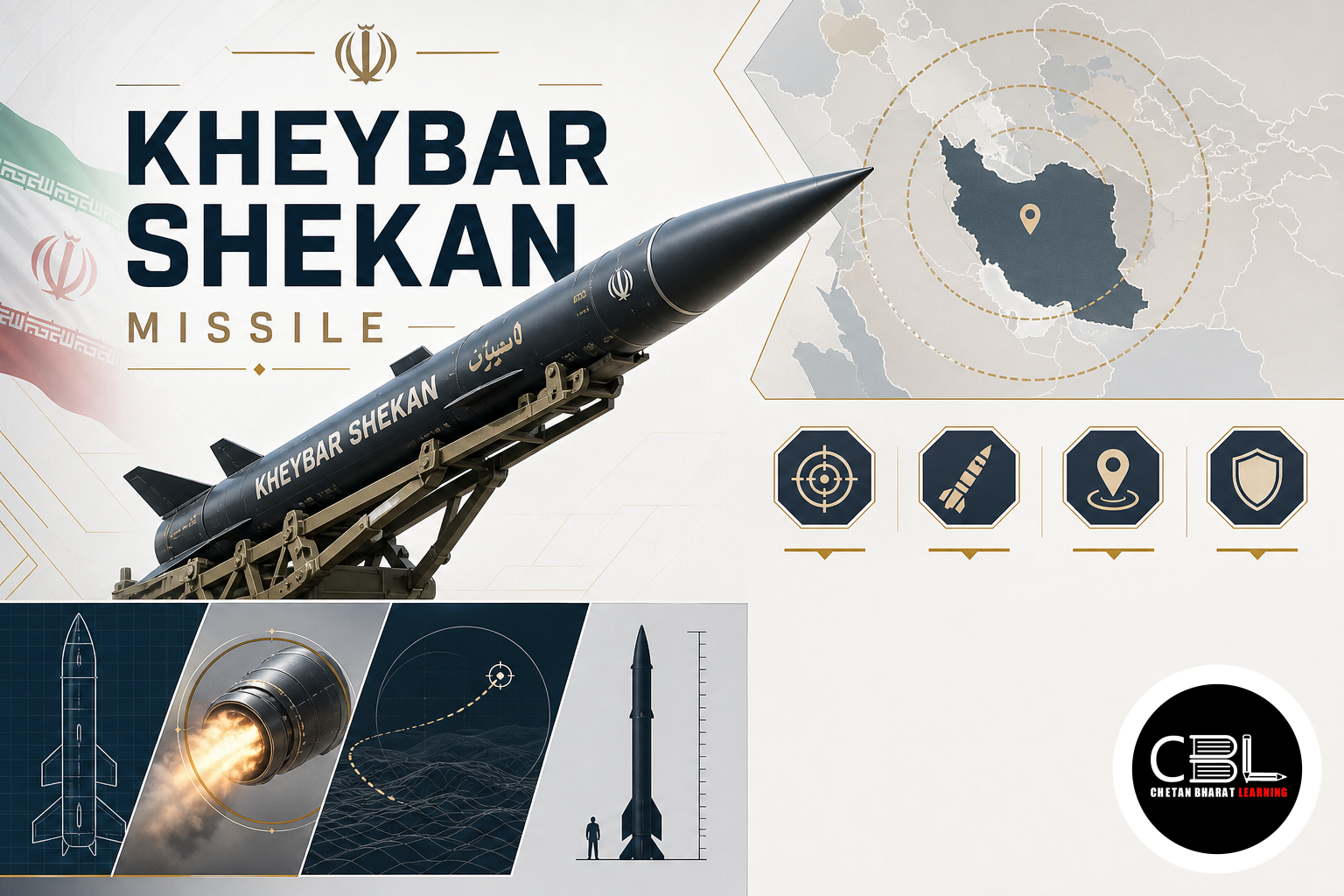
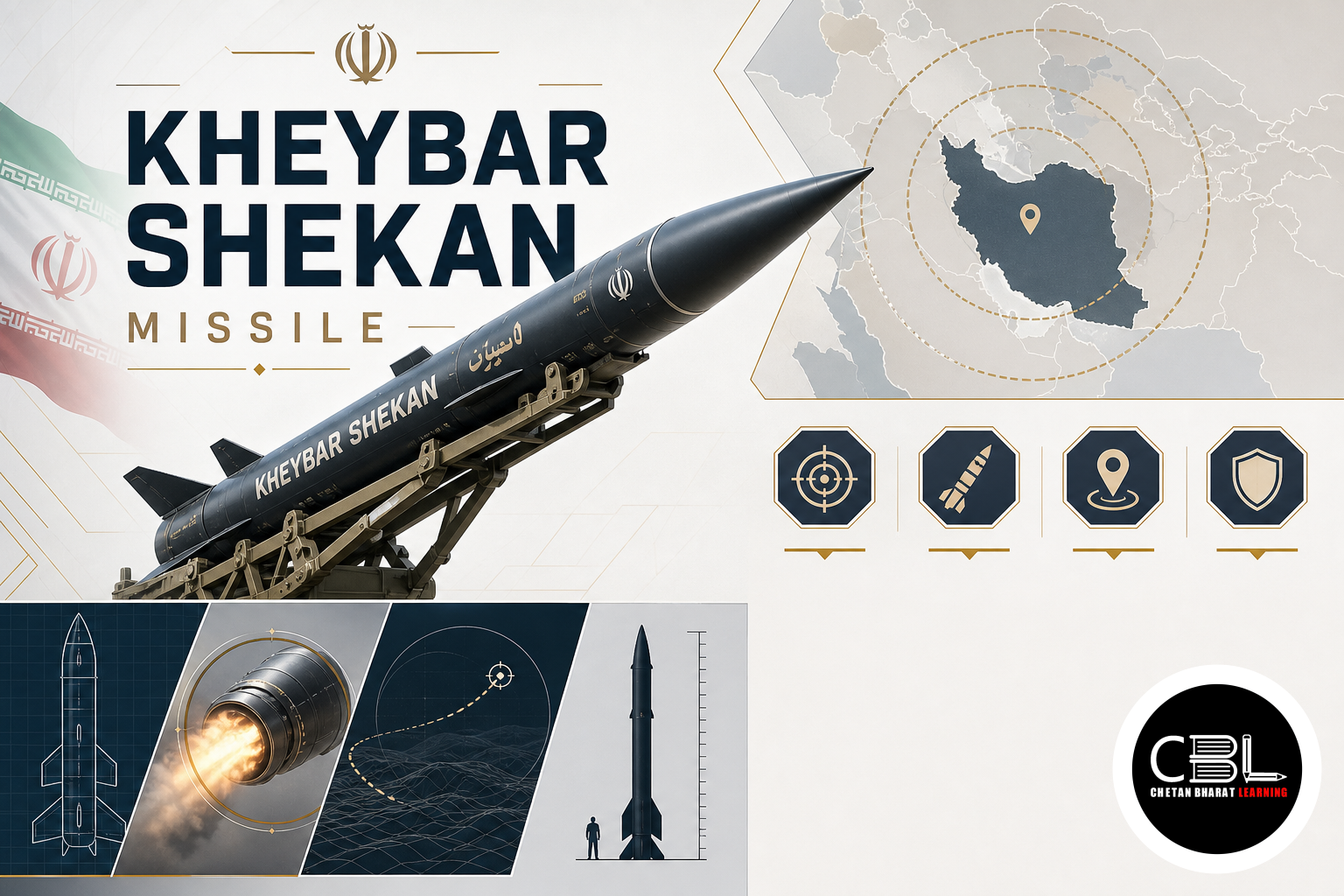
Iran developed the system as part of its expanding family of ballistic missiles. The name is commonly translated as breaker of Khyber and carries a historical reference. Iran publicly unveiled the weapon in 2022. Consequently, it represents a relatively recent addition to the country’s missile inventory.
A ballistic missile receives powered acceleration during the initial portion of its flight and then follows a largely ballistic trajectory for much of its journey. This differs from a cruise missile, which generally remains powered through most of its flight and travels aerodynamically through the atmosphere. Therefore, propulsion and flight profile provide useful distinctions for UPSC objective questions.
The Iranian system uses solid propellant. Solid-fuel missiles generally require less launch preparation than comparable liquid-fuel systems that need fuelling shortly before launch. Moreover, solid propellant can support storage and rapid deployment. These characteristics can increase the survivability of mobile missile forces by reducing their exposure before launch.
Open-source assessments generally describe the weapon as having a reported range of about 1,450 km. That range places many potential targets across West Asia within reach depending on the launch location. However, range figures associated with strategic weapons should be treated as reported estimates unless independently established. Payload, trajectory and operational configuration can also affect practical performance.
Another notable characteristic is road mobility. Mobile launch platforms can relocate before firing and complicate continuous tracking by an adversary. Furthermore, dispersed launch units reduce dependence on fixed missile sites. This makes mobility an important element of survivability in contemporary missile strategy.
Why is Kheybar Shekan Missile in News?
The missile has returned to attention amid continuing analysis of Iran’s long-range strike capabilities and the changing security environment in West Asia. Recent regional confrontations have increased scrutiny of missile inventories, air-defence systems and deterrence strategies. Consequently, Iranian ballistic missile technology has acquired significance beyond conventional defence reporting.
The system attracts attention because it combines solid propellant with mobile deployment and a re-entry vehicle designed for manoeuvrability. These characteristics seek to reduce warning time and complicate interception. However, no missile should automatically be considered impossible to intercept. Actual outcomes depend on trajectory, sensors, interceptor capabilities, electronic warfare and the wider architecture of an air and missile defence network.
Ballistic missile defence involves several stages. Early-warning systems first detect and track a launch, while command networks estimate its trajectory and possible target. Interceptors may then attempt engagement during suitable phases of flight. Therefore, speed matters, but successful defence depends on an integrated chain of sensors, decision-making and interception systems.
The issue also illustrates the importance of missile proliferation to international security. Longer-range systems can alter strategic calculations because they expand the geographical area vulnerable to strikes. Moreover, missile development can trigger investments in layered air defence and counter-strike capabilities. This interaction can intensify regional security dilemmas.
For UPSC, candidates should connect the topic with broader missile classifications and non-proliferation mechanisms. The United Nations Office for Disarmament Affairs provides official material on international disarmament and weapons issues. Aspirants should nevertheless avoid treating unverified manufacturer claims about speed, precision or interception probability as settled technical facts.
Key Features
- Solid propulsion allows storage and rapid launch readiness by eliminating pre-launch fuelling requirements.
- Mobile launch capability increases survivability by enabling concealment, dispersal and relocation before firing.
- Manoeuvrable re-entry vehicle complicates interception by altering trajectory during the terminal phase.
- Guidance systems and terminal manoeuvring contribute to precision, though public accuracy claims require cautious interpretation.
- Ballistic missiles naturally reach hypersonic speeds but differ from hypersonic glide vehicles, which sustain atmospheric manoeuvring after boost.
Challenges
- Regional strategic stability: Longer-range missiles can strengthen deterrence but may trigger arms races and security dilemmas.
- Interception complexities: Detecting, tracking and intercepting manoeuvring targets within limited engagement windows.
- Verification difficulties: Limited independent access to test data makes it hard to distinguish confirmed specifications from promotional claims.
- Diplomatic obstacles: Absence of a universal treaty on ballistic missiles complicates proliferation control, relying on export controls and confidence-building measures.
Way Forward
- Enhance diplomatic channels and crisis communication to reduce misinterpretation and unintended escalation during confrontations.
- Promote transparency through pre-notification arrangements and confidence-building measures for missile tests and launches.
- Apply and harmonize export controls under frameworks like the Missile Technology Control Regime to restrict proliferation of missile-related technology.
- Invest in indigenous research on integrated sensors, command networks, interceptors and surveillance systems to bolster defence preparedness.
Prelims Practice Corner
- 1. The Kheybar Shekan system was developed by: (a) Israel; (b) Iran; (c) Turkey; (d) Saudi Arabia. Answer: Iran
- 2. Which propulsion type is associated with this missile? (a) Solid propellant; (b) Nuclear propulsion; (c) Electric propulsion; (d) Ramjet propulsion. Answer: Solid propellant
- 3. Which statement best distinguishes a ballistic missile from a cruise missile? (a) Ballistic missiles cannot carry conventional warheads; (b) Cruise missiles remain aerodynamically powered for most of their flight; (c) Cruise missiles always travel faster than ballistic missiles; (d) Ballistic missiles operate only inside the atmosphere. Answer: Cruise missiles remain powered and fly aerodynamically for most of their trajectory.
- 4. Consider the following statements: 1. Solid-fuel missiles can generally support faster launch readiness than systems requiring pre-launch liquid fuelling. 2. Road mobility can increase the survivability of missile forces. 3. Every ballistic missile travelling above Mach 5 is necessarily a hypersonic glide vehicle. Which statements are correct? (a) 1 only; (b) 1 and 2 only; (c) 2 and 3 only; (d) 1, 2 and 3. Answer: 1 and 2 only
- 5. The Missile Technology Control Regime is primarily associated with: (a) Export controls concerning missiles and related technology; (b) Regulation of commercial shipping; (c) Nuclear power-plant safety inspections; (d) Global civil aviation regulation. Answer: Export controls concerning missiles and related technology
Mains Practice Questions
- 1. Explain how solid propulsion, mobility and manoeuvrable re-entry technology influence the survivability and interception of modern ballistic missiles. (10 marks)
Outline: Define ballistic missiles; explain rapid readiness of solid fuel, concealment through mobility and terminal manoeuvring; discuss detection and interception challenges; conclude with layered missile defence. - 2. The proliferation of increasingly sophisticated ballistic missiles can strengthen deterrence while simultaneously intensifying regional security dilemmas. Discuss. (15 marks)
Outline: Explain deterrence and survivability; discuss arms races, compressed decision times and interception challenges; mention export controls and confidence-building measures; conclude with diplomacy and technological preparedness.
FAQs on Iranian Ballistic Missiles
What is the reported range of the Iranian system?
Open-source descriptions commonly report a range of approximately 1,450 km. Such figures should be treated as reported specifications because independent operational verification can remain limited.
Why is solid fuel important in a ballistic missile?
Solid propellant can support storage and relatively rapid launch preparation. This can reduce the time a mobile launcher remains exposed before firing and thereby improve operational survivability.
Is every very fast ballistic missile a hypersonic glide weapon?
No. Ballistic missiles can naturally reach hypersonic speeds during portions of flight. A hypersonic glide vehicle follows a different flight concept involving a specialised vehicle capable of substantial atmospheric manoeuvring after its boost phase.
Related Current Affairs
Preparing for UPSC, PCS or HCS?
Talk to a mentor at Chetan Bharat Learning, Chandigarh. Free guidance on choosing the right exam and building a study plan.
Chat on WhatsAppCall 97793 53345UPSC / IAS / PCS coaching in Chandigarh · Trusted by aspirants across Punjab & Haryana
Leave a Reply
You must be logged in to post a comment.