

UPSC Mapping
- GS Paper: GS-III
- Subject: Agriculture, Intellectual Property Rights and Agricultural Marketing
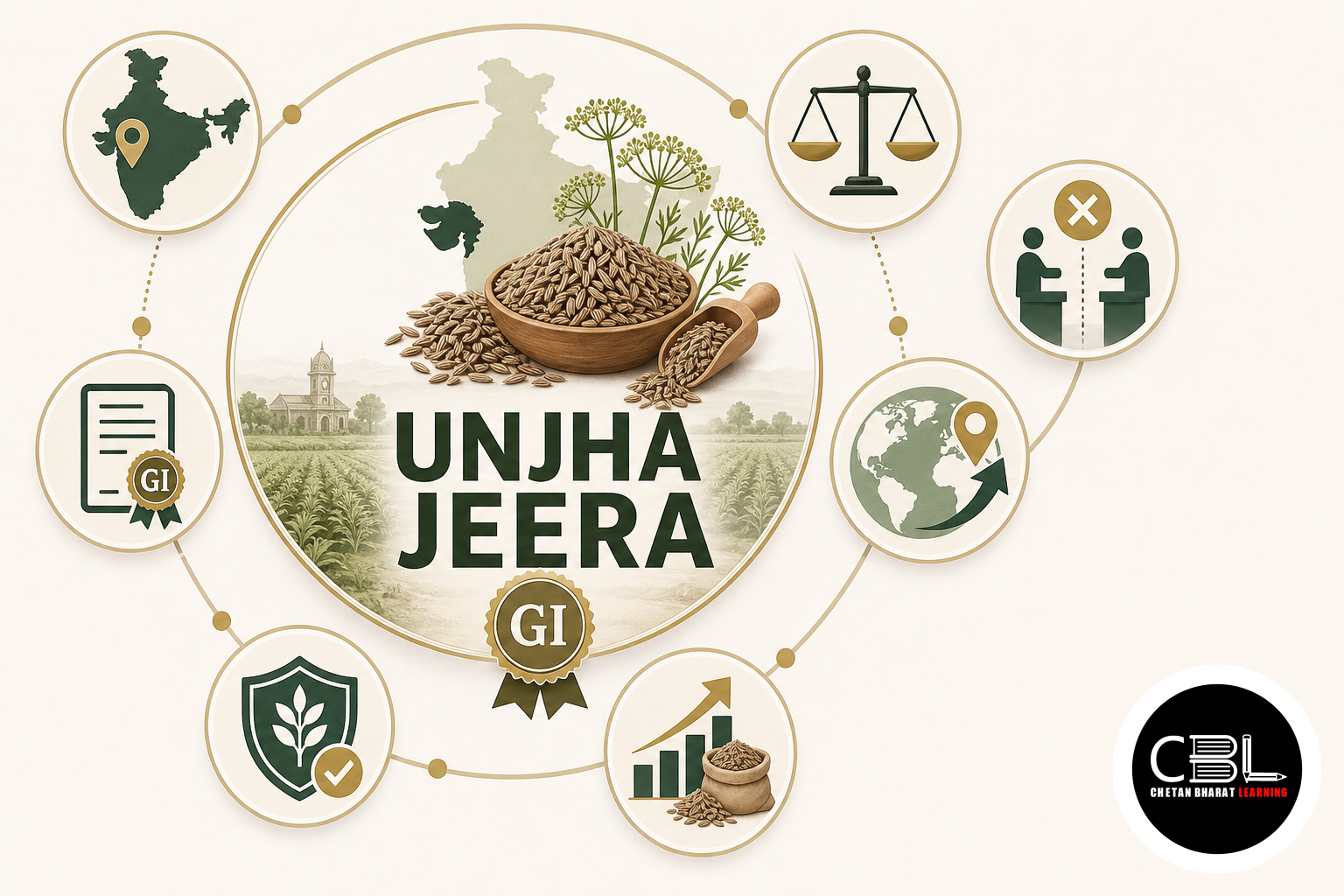
What is Unjha Jeera?
Jeera, or cumin, is an important seed spice used extensively in Indian cuisine and food processing. Farmers cultivate it mainly as a rabi crop in suitable dry climatic conditions. Gujarat and Rajasthan are important cumin-producing regions. Consequently, the crop supports farm livelihoods as well as processing, trading and export activities.
Unjha in Gujarat has developed a prominent reputation as a trading and marketing centre for agricultural commodities, particularly spices. Its organised market ecosystem connects farmers, traders, processors and buyers. Therefore, the commercial identity of cumin can extend beyond the field where farmers cultivate it. This distinction becomes important when geographical reputation enters intellectual property law.
A Geographical Indication, or GI, identifies goods that possess a quality, reputation or other characteristic attributable to geographical origin. India protects such indications through the Geographical Indications of Goods (Registration and Protection) Act, 1999. Moreover, GI protection differs fundamentally from an ordinary private brand. It protects a geographical association for qualifying producers rather than simply identifying one commercial enterprise.
This legal framework makes the cumin dispute especially relevant. A GI inquiry need not examine only the physical location of cultivation. Reputation and other qualifying characteristics connected with geography can also matter under the law. Therefore, authorities must examine the precise application, evidence, product specifications and geographical linkage before reaching a determination.
Why is Unjha Jeera in News?
Farmers from Rajasthan have objected to GI applications for Unjha Jeera and Unjha Fennel. The applications are associated with the Agricultural Produce Market Committee at Unjha in Mehsana district, Gujarat. Farmers from Rajasthan, particularly spice-growing areas, have challenged the basis of the proposed geographical association. Thus, competing understandings of origin and reputation have entered the registration debate.
The Rajasthan argument focuses strongly on cultivation. Farmers contend that they grow substantial quantities of cumin and therefore should not lose recognition or economic opportunities because of a market-centred geographical claim. Moreover, agricultural production creates livelihoods and local knowledge in the cultivating regions. Their concerns consequently raise questions about producer inclusion within GI-based value chains.
The Gujarat perspective highlights Unjha’s longstanding commercial reputation in the spice trade. A major agricultural market can develop a distinctive identity through organised trading, grading, processing and commercial networks. Therefore, the legal debate cannot automatically treat cultivation volume as the only relevant consideration. The dispute requires examination of the geographical connection claimed in the GI application.
Importantly, an application or objection does not itself settle the legal question. The GI registration framework provides procedures for examination and opposition before contested rights become final. Aspirants can consult the Intellectual Property India portal for official information about geographical indications. Therefore, UPSC answers should describe the development as a dispute over GI claims rather than presume a final outcome.
Key Features
India’s GI system protects origin-linked goods through a specialised intellectual property framework. The Geographical Indications Registry operates at Chennai under the Controller General of Patents, Designs and Trade Marks. Applicants must demonstrate the required connection between the goods and the claimed geographical territory. In addition, the registration process provides opportunities for scrutiny and opposition.
A GI differs from a trademark in its underlying purpose. Businesses generally use trademarks to distinguish their goods or services from competitors. In contrast, geographical indications identify goods through their relationship with a territory. Consequently, eligible producers connected with that protected geographical framework may share the economic value of the indication.
GI protection can help preserve traditional knowledge and regional reputation. Moreover, it can reduce misleading marketing by parties that lack the required geographical connection. Successful geographical branding may improve product differentiation and market visibility. However, these benefits depend on effective enforcement, quality standards and meaningful producer participation.
The Unjha Jeera controversy highlights the significance of reputation as a legal concept. A commodity may develop commercial recognition around a trading centre even when farmers cultivate it across a wider region. Similarly, cultivation areas may possess their own historical associations and production knowledge. The authorities must therefore examine evidence rather than assume that either market reputation or cultivation automatically overrides the other.
Challenges
Determining geographical boundaries presents the first major challenge. Crops frequently cross district and state borders because agro-climatic zones do not follow administrative boundaries. Consequently, narrowly drawn geographical specifications may exclude producers who cultivate similar products nearby. Authorities need strong historical and technical evidence when defining the protected territory.
The second challenge concerns the distinction between origin and reputation. A famous market may become synonymous with a commodity because traders have handled it there for generations. However, cultivators may argue that the crop’s agricultural identity originates in their fields. Therefore, GI authorities must carefully establish whether the claimed reputation satisfies the statutory geographical connection.
A third concern involves distribution of economic benefits. GI recognition can increase branding opportunities, but farmers do not automatically receive higher prices. Traders, processors or larger enterprises may capture a disproportionate share when producer organisations remain weak. Furthermore, certification and compliance requirements can create additional burdens for small cultivators.
Inter-state competition can further complicate the process. The Unjha Jeera dispute involves economic interests connected with both production and trade. Therefore, transparent adjudication becomes essential to maintain confidence in the GI regime. Aspirants can connect this topic with agricultural marketing and intellectual property through our UPSC current affairs library.
Way Forward
The GI authorities should examine documentary, historical and technical evidence before deciding contested claims. They should assess cultivation patterns alongside evidence of commercial reputation and product characteristics. Moreover, authorities should clearly explain the geographical link that justifies any eventual protection. A reasoned decision can strengthen public confidence in the registration system.
Stakeholder consultation should remain central to the process. Farmers, producer associations, market committees and other legitimate participants need meaningful opportunities to present evidence. Consequently, the opposition mechanism can help authorities identify competing claims before registration. Transparent participation also reduces the risk that smaller producers remain unheard.
Policymakers should also connect geographical indications with wider agricultural development. Farmer producer organisations can improve collective marketing, traceability and quality control. Furthermore, better storage, grading and export infrastructure can help cultivators capture more value. GI protection works best when these institutions support rather than replace ordinary agricultural reforms.
International intellectual property principles also provide useful context. The World Intellectual Property Organization explains how geographical indications protect products whose qualities or reputation connect with geographical origin. Therefore, India should pursue GI protection that rewards genuine reputation while maintaining fairness among legitimate producers. For UPSC, the controversy illustrates the intersection of intellectual property, agriculture, markets and cooperative federalism.
Prelims Practice Corner
- The Geographical Indications Registry of India is located at:
- (a) Mumbai
- (b) Chennai
- (c) Hyderabad
- (d) Ahmedabad
Answer: (b) Chennai.
- Geographical indications in India receive statutory protection primarily under:
- (a) Patents Act, 1970
- (b) Copyright Act, 1957
- (c) Geographical Indications of Goods (Registration and Protection) Act, 1999
- (d) Biological Diversity Act, 2002
Answer: (c) The Geographical Indications of Goods (Registration and Protection) Act, 1999 provides the principal statutory framework.
- Consider the following statements regarding geographical indications:
- Reputation linked with geographical origin can be relevant for GI protection.
- A GI necessarily belongs to one private company.
- GI protection can prevent unauthorised use of protected indications.
Answer: (b) Statements 1 and 3 are correct.
- Unjha, recently discussed in relation to agricultural geographical indications, is located in:
- (a) Rajasthan
- (b) Gujarat
- (c) Madhya Pradesh
- (d) Maharashtra
Answer: (b) Unjha is in Gujarat.
- Which agreement under the World Trade Organization deals with intellectual property rights?
- (a) AoA
- (b) TRIPS
- (c) GATS only
- (d) TFA
Answer: (b) The Agreement on Trade-Related Aspects of Intellectual Property Rights, or TRIPS, covers intellectual property within the WTO framework.
Mains Practice Questions
- Geographical indication disputes reveal the difficulty of balancing place of production with established market reputation. Discuss with reference to agricultural products. (10 marks)
Outline: Define GI; explain origin, quality and reputation; discuss cultivation versus trading-centre claims; examine producer inclusion and regional interests; conclude with transparent evidence-based adjudication.
- Examine the potential of geographical indications to improve farmer incomes and rural value addition in India. What challenges limit these benefits? (15 marks)
Outline: Discuss collective branding, authenticity, market differentiation, exports and traditional knowledge. Examine weak producer organisations, certification costs, benefit concentration, enforcement and geographical disputes. Suggest traceability, farmer participation, infrastructure and transparent governance.
FAQs on the Cumin GI Dispute
What is the dispute involving Unjha cumin?
Rajasthan farmers have objected to GI applications associated with Unjha in Gujarat. The controversy raises questions about how cultivation, geographical origin and established commercial reputation should influence GI protection.
Can reputation matter when deciding a geographical indication?
Yes. India’s GI framework recognises quality, reputation or other characteristics attributable to geographical origin. However, applicants must establish the required geographical connection through the registration process.
Why is this issue important for UPSC?
The dispute connects the GI Act, intellectual property rights, agricultural marketing, farmer interests and inter-state economic issues. It also provides a contemporary example for GS-III answers on agriculture and intellectual property.
Related Current Affairs
Preparing for UPSC, PCS or HCS?
Talk to a mentor at Chetan Bharat Learning, Chandigarh. Free guidance on choosing the right exam and building a study plan.
Chat on WhatsAppCall 97793 53345UPSC / IAS / PCS coaching in Chandigarh · Trusted by aspirants across Punjab & Haryana
Leave a Reply
You must be logged in to post a comment.