
UPSC Syllabus Mapping
| GS Paper | GS-I & GS-III |
|---|---|
| Subject | Indian Geography, Disaster Management and Environment |
What is Assam Floods?
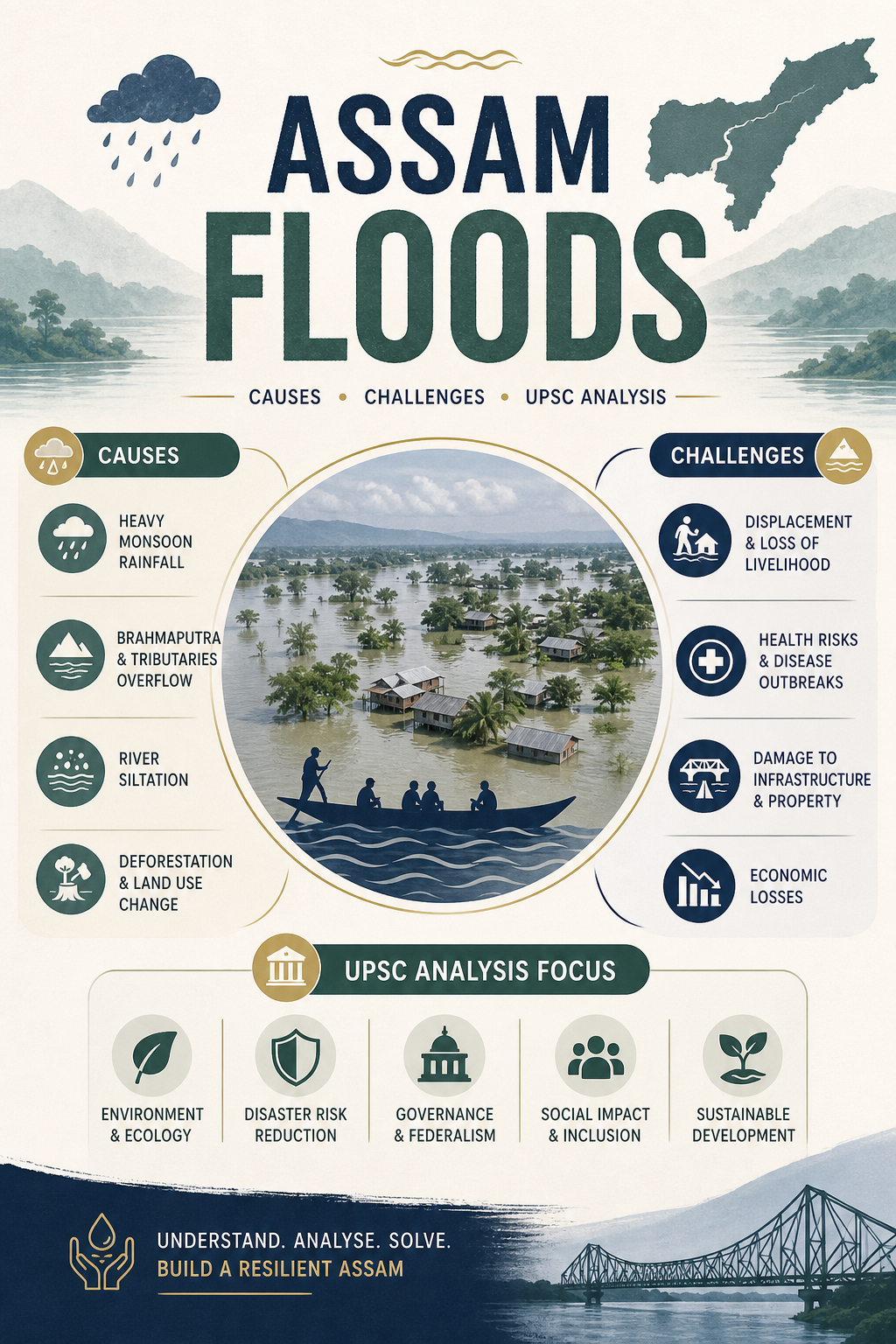
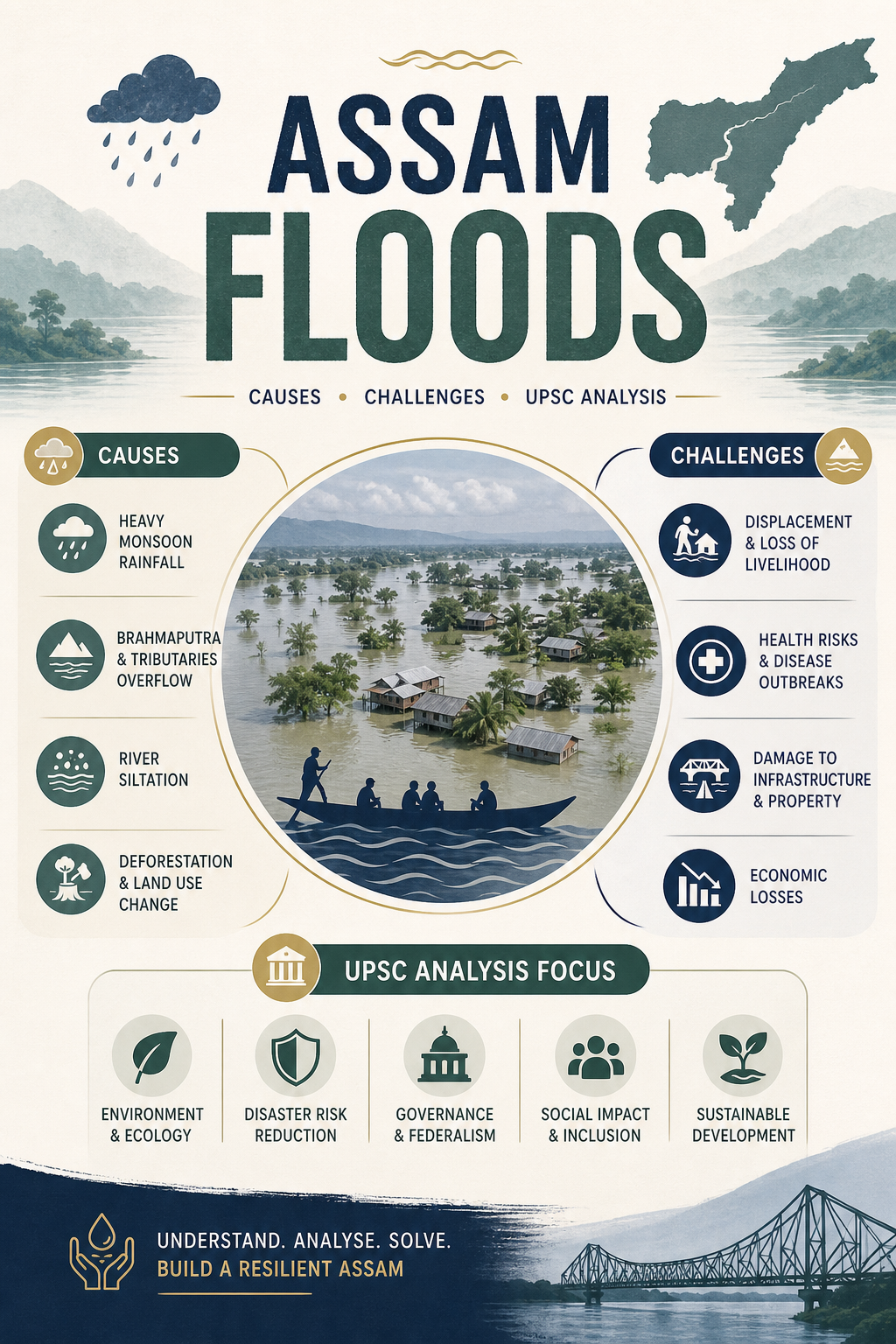
Assam Floods refer to the recurrent inundation experienced across the Brahmaputra and Barak river basins during the southwest monsoon. The state’s unique geographical setting, heavy rainfall, braided river channels and extensive floodplains make it one of India’s most flood-prone regions.
The Brahmaputra receives enormous volumes of water from the Eastern Himalayas and numerous tributaries. During intense rainfall, river discharge rises rapidly, often causing rivers to overflow into surrounding floodplains.
Why is Assam Floods in News?
According to the passage report, prolonged monsoon rainfall caused widespread flooding across several districts of Assam, affecting lakhs of people and resulting in loss of lives. Rescue operations were carried out by the National Disaster Response Force (NDRF), State Disaster Response Force (SDRF), the Army and local administration.
The flooding was intensified by heavy rainfall over upstream catchments, saturated soils and swollen tributaries that drained into the Brahmaputra system. Official disaster updates are available through the National Disaster Management Authority.
Key Features of Assam Floods
- Driven by intense southwest monsoon rainfall.
- Brahmaputra receives water from numerous Himalayan tributaries.
- Heavy sediment load reduces river carrying capacity.
- Braided river channels frequently shift course and erode riverbanks.
- Extensive low-lying floodplains experience seasonal inundation.
- Climate variability and extreme rainfall events are increasing flood intensity.
- Floods affect agriculture, infrastructure, biodiversity and human settlements.
Challenges Related to Assam Floods
Recurring floods lead to displacement of communities, crop losses, damage to roads and public infrastructure, disruption of livelihoods and increased health risks. Encroachment of floodplains, deforestation in upstream areas and sediment deposition further aggravate flood vulnerability.
While embankments provide temporary protection, they cannot fully eliminate flood risks and often require continuous maintenance. For related geography and disaster management topics, visit the UPSC current affairs library.
Way Forward for Assam Floods
A long-term strategy should emphasise integrated river basin management, scientific flood forecasting, watershed conservation, restoration of wetlands, sustainable embankment design, catchment treatment and climate-resilient infrastructure. Strengthening early warning systems and community-based disaster preparedness will improve resilience.
Additional information on disaster preparedness is available through PIB Official Release.
Prelims Practice Corner
- Which river is primarily responsible for recurring floods in Assam?
- Which mountain range is the main source of the Brahmaputra’s upper catchment?
- What is meant by a braided river?
- Which force is primarily responsible for specialised flood rescue operations in India?
- Which GS Paper deals with Disaster Management?
Answers
- Brahmaputra
- Himalayas
- A river divided into multiple interconnected channels due to heavy sediment deposition
- NDRF
- GS-III
Mains Practice Questions
Q1. Discuss the geographical and climatic factors responsible for recurrent floods in Assam.
Answer Outline
- Brahmaputra basin
- Monsoon
- Himalayan rivers
- Sediment load
- Floodplains
- Climate change
Q2. Evaluate the effectiveness of structural and non-structural measures for flood management in Northeast India.
Answer Outline
- Embankments
- Forecasting
- Watershed management
- Integrated river basin management
- Disaster preparedness
FAQs on Assam Floods
Why does Assam experience floods every year?
Heavy monsoon rainfall, Himalayan river systems, sediment deposition, braided channels and extensive floodplains make Assam highly flood-prone.
How does climate change influence Assam Floods?
Climate change increases the frequency of intense rainfall events, leading to higher flood peaks and greater flood risks.
Why is Assam Floods important for UPSC?
The topic links geography, environment, climate change, disaster management and governance, making it highly relevant for both Prelims and Mains.
Related Current Affairs
Preparing for UPSC, PCS or HCS?
Talk to a mentor at Chetan Bharat Learning, Chandigarh. Free guidance on choosing the right exam and building a study plan.
Chat on WhatsAppCall 97793 53345UPSC / IAS / PCS coaching in Chandigarh · Trusted by aspirants across Punjab & Haryana
Leave a Reply
You must be logged in to post a comment.