
UPSC Syllabus Mapping
- GS Paper: GS-III
- Subject: Environment, Biodiversity and Conservation
What is Indian Grey Hornbill?
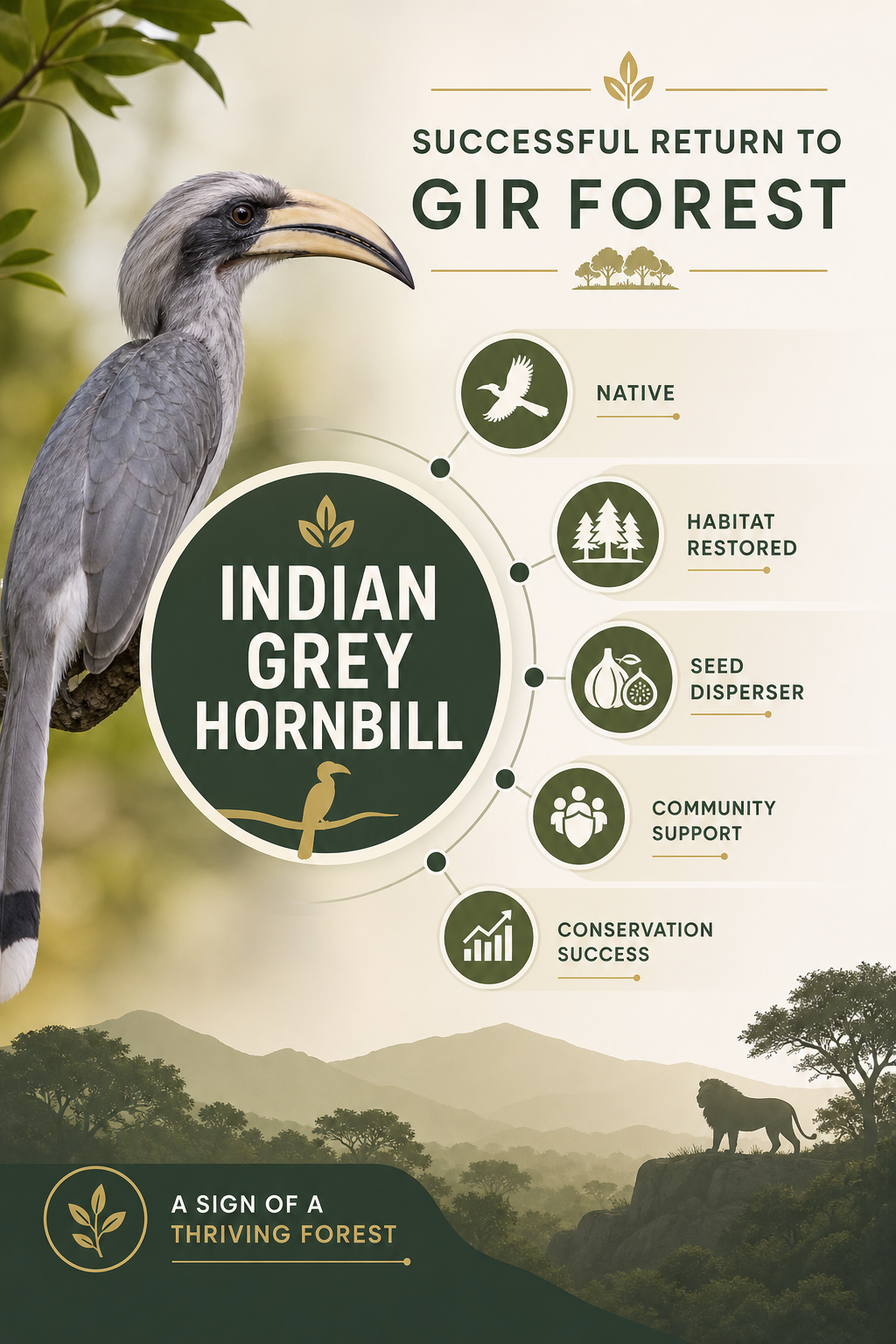
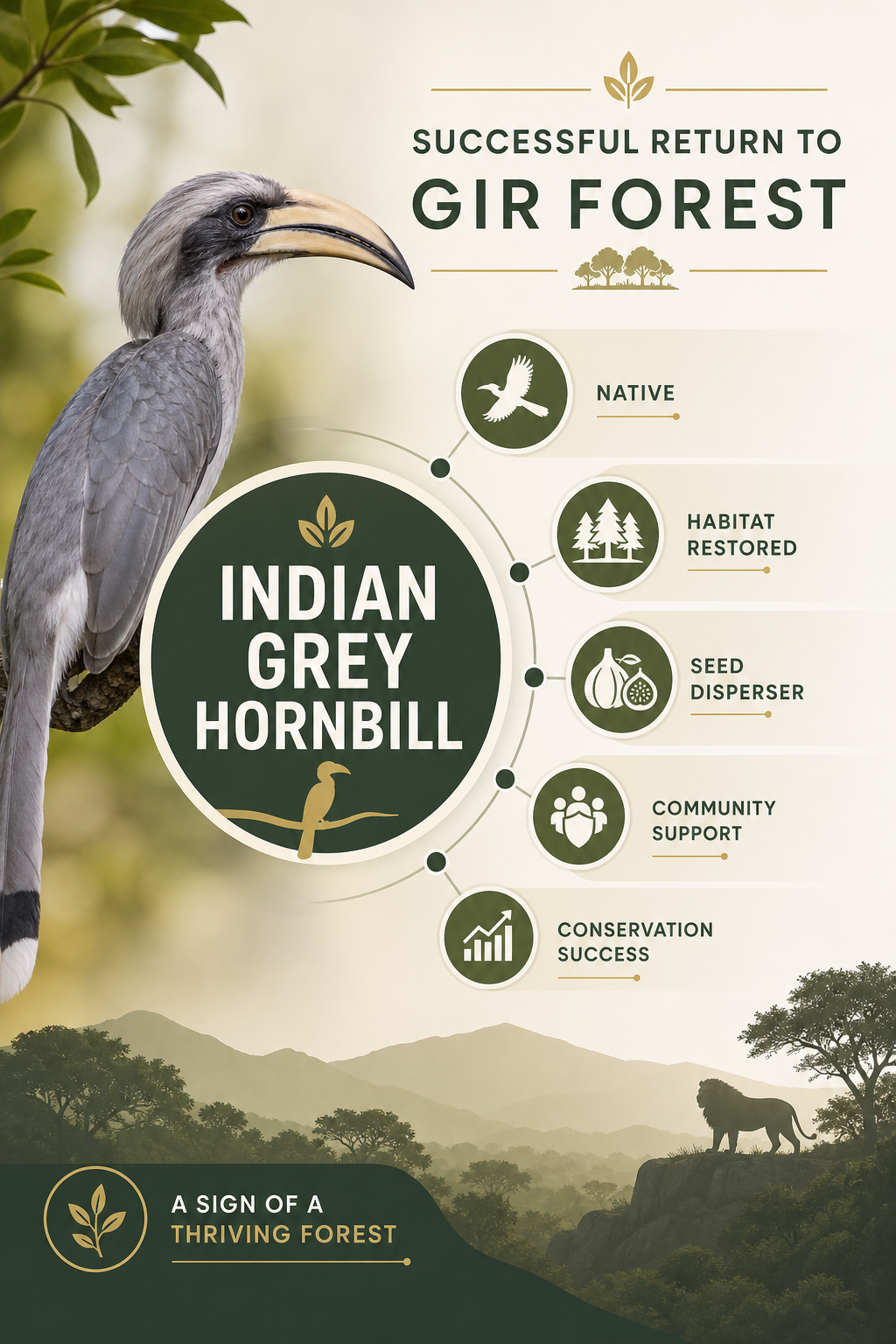
The Indian Grey Hornbill (Ocyceros birostris) is a medium-sized hornbill species native to the Indian subcontinent. It is recognised by its grey plumage and distinctive curved beak with a casque, which is more prominent in males than in females.
The species inhabits forests, wooded landscapes and urban green spaces. It primarily feeds on fruits, insects and small reptiles, making it an important seed disperser that contributes to forest regeneration. The Indian Grey Hornbill is listed as Least Concern on the IUCN Red List and is the State Bird of Chandigarh.
Why is Indian Grey Hornbill in News?
The Indian Grey Hornbill has successfully established breeding populations in Gujarat’s Gir Forest after its reintroduction in 2021. The species had disappeared from the region during the 1950s and 1960s, making this conservation programme a significant ecological success.
A recent scientific study found that the birds prefer Gir’s dry mixed deciduous and teak forests. They also nest in mature trees with large trunk girths, particularly Sterculia urens and Terminalia bellirica, emphasising the need to conserve old-growth forests.
Key Features
- Scientific name: Ocyceros birostris.
- IUCN Red List Status: Least Concern.
- State Bird of Chandigarh.
- India is home to nine hornbill species out of approximately 54 species worldwide.
- Highest hornbill diversity is found in Northeast India.
- Feeds mainly on fruits, insects and small animals.
- Acts as an important seed disperser, supporting forest regeneration.
- Prefers mature trees with large cavities for nesting.
Challenges Related to Indian Grey Hornbill
Habitat loss due to deforestation, removal of old-growth trees and urban expansion continues to threaten suitable nesting sites. Mature cavity-bearing trees are essential for successful breeding and cannot be easily replaced.
Fragmentation of forests and human disturbances may reduce breeding success and food availability.
Way Forward
Conservation efforts should prioritise protecting mature nesting trees, restoring degraded habitats and monitoring reintroduced populations through scientific surveys. Community participation and awareness can further strengthen conservation outcomes.
Expanding habitat restoration programmes and integrating biodiversity conservation into forest management plans will help secure the long-term survival of hornbill populations.
Prelims Practice Corner
-
What is the scientific name of the Indian Grey Hornbill?
Answer: Ocyceros birostris.
-
Which is the State Bird of Chandigarh?
Answer: Indian Grey Hornbill.
-
What is the IUCN status of the Indian Grey Hornbill?
Answer: Least Concern.
-
Which Indian region has the highest diversity of hornbill species?
Answer: Northeast India.
-
Which trees are preferred for nesting in Gir Forest?
Answer: Sterculia urens and Terminalia bellirica.
Mains Practice Questions
-
Q1. Discuss the ecological significance of hornbills in maintaining forest ecosystems. (10 Marks)
Outline: Introduction, Ecological Role, Threats, Conservation Measures.
-
Q2. Evaluate the importance of species reintroduction programmes in biodiversity conservation with suitable examples. (15 Marks)
Outline: Concept, Benefits, Challenges, Indian Examples, Way Forward.
FAQs on Indian Grey Hornbill
Why is the Indian Grey Hornbill important?
It is a key seed disperser that supports forest regeneration and ecosystem health.
Why is the Indian Grey Hornbill in news?
It has successfully established breeding populations in Gir Forest after being reintroduced in 2021.
What is the conservation status of the Indian Grey Hornbill?
It is classified as Least Concern by the IUCN Red List.
Related Current Affairs
Preparing for UPSC, PCS or HCS?
Talk to a mentor at Chetan Bharat Learning, Chandigarh. Free guidance on choosing the right exam and building a study plan.
Chat on WhatsAppCall 97793 53345UPSC / IAS / PCS coaching in Chandigarh · Trusted by aspirants across Punjab & Haryana
Leave a Reply
You must be logged in to post a comment.