
UPSC Syllabus Mapping
- GS Paper: GS-III
- Subject: Indian Economy
- Topic: Agriculture, Fertiliser Subsidy, Industrial Policy
- Prelims: Fertiliser policies, Nutrient-Based Subsidy (NBS), Neem-coated Urea, Soil Health Card
- Mains: Agricultural reforms, Food security, Self-reliance in fertilisers
Article
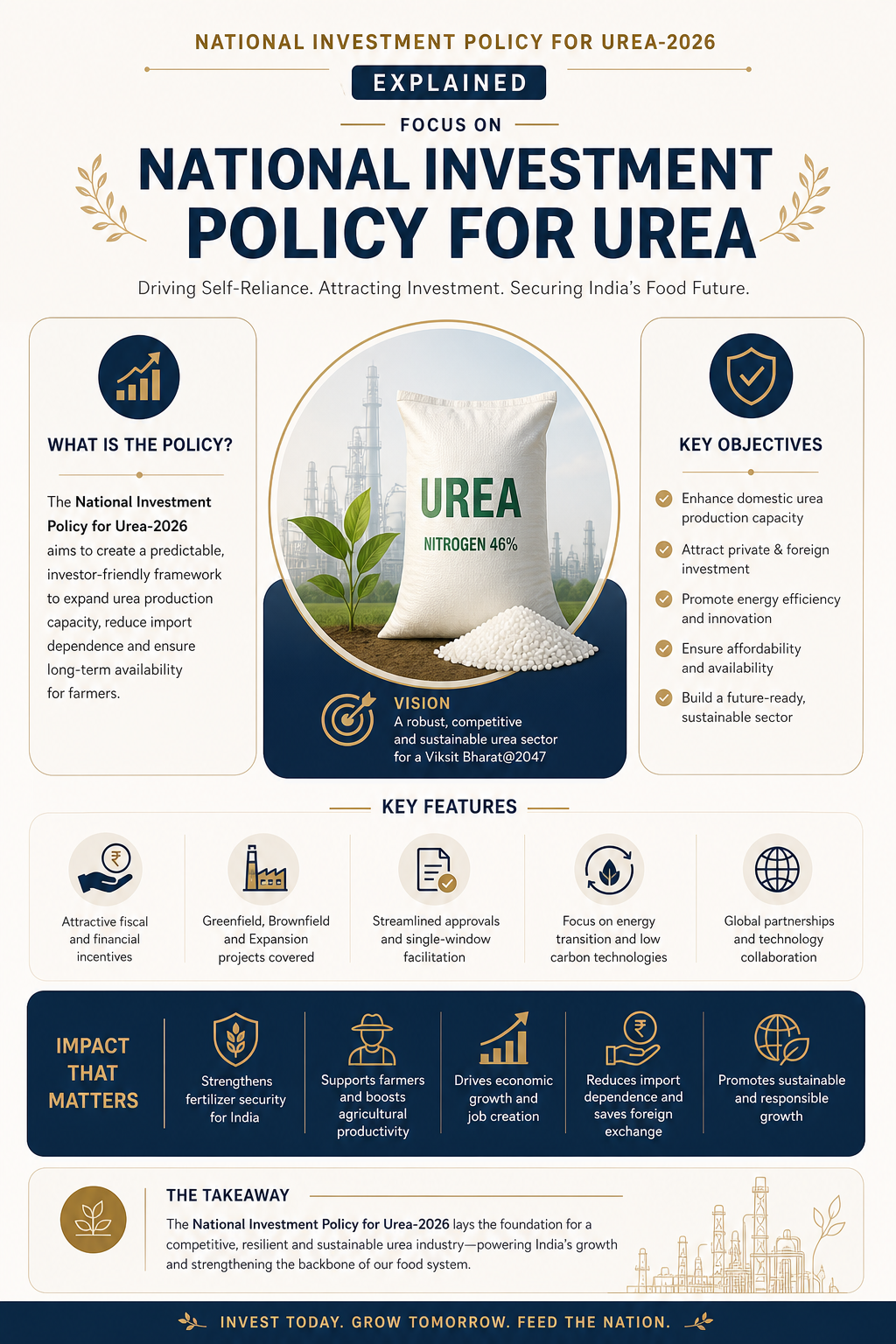
National Investment Policy for Urea is India’s latest policy initiative to encourage fresh investment in gas-based urea manufacturing plants and reduce dependence on imported urea. Approved by the Union Cabinet on 15 July 2026, the policy replaces the investment framework under the New Investment Policy (NIP)-2012 and supports the vision of Atmanirbhar Bharat by expanding domestic fertiliser production.
Why in News?
The Union Cabinet approved the National Investment Policy for Urea-2026 (NIPU-2026) to attract investments in new gas-based urea manufacturing units after the investment period under NIP-2012 ended in 2019.
Key Dimensions of National Investment Policy for Urea
What is NIPU-2026?
NIPU-2026 is a policy framework introduced by the Department of Fertilizers to encourage investment in new gas-based urea plants. The objective is to increase domestic production, improve fertilizer security, and reduce import dependence.
Why was a new policy required?
- The investment period under NIP-2012 ended in October 2019.
- Fresh investment proposals were received after 2019.
- India continues to import significant quantities of urea despite having 33 operational manufacturing units.
- The policy aligns with the Atmanirbhar Bharat initiative.
Major Features of NIPU-2026
- Applies to new gas-based urea manufacturing projects.
- Separates fixed and variable costs in the pricing framework.
- Introduces Return on Equity (RoE) ranging from 12% to 16%.
- Protects investors from foreign exchange fluctuations by converting fixed costs into Indian Rupees after four years.
- Encourages long-term private and public investment.
Quick Facts
| Operational Urea Plants | 33 |
|---|---|
| Installed Capacity | 269.42 Lakh Metric Tonnes |
| Policy Approved | 15 July 2026 |
| Implementing Department | Department of Fertilizers |
Agricultural Urea vs Industrial Urea
| Agricultural Urea | Industrial Urea |
|---|---|
| Used as nitrogen fertiliser | Used in resins, plywood, textiles, dyes, melamine and chemicals |
| Heavily subsidised | Sold at market price |
| Neem-coated and regulated under Fertiliser Control Order | Industrial specifications with no subsidy |
Policy Initiatives for Balanced Fertilisation
- Nutrient-Based Subsidy (NBS) Scheme (2010) promotes balanced use of Phosphatic and Potassic fertilisers.
- 100% Neem Coating of Urea (2015) reduces nitrogen loss and prevents diversion.
- Soil Health Card Scheme helps farmers adopt scientific nutrient management.
- Nano Fertilisers improve nutrient-use efficiency and reduce fertiliser wastage.
Significance of NIPU-2026
- Strengthens India’s fertiliser security.
- Reduces dependence on imported urea.
- Encourages investment in modern gas-based plants.
- Supports food security through uninterrupted fertiliser availability.
- Contributes to Atmanirbhar Bharat and sustainable agricultural growth.
Prelims Practice Corner (5 MCQs)
- National Investment Policy for Urea-2026 primarily promotes investment in:
- (a) Coal-based plants
- (b) Gas-based urea plants
- (c) Ammonia imports
- (d) Bio-fertiliser units
Answer: (b) The policy covers new gas-based urea manufacturing units.
- Agricultural urea is regulated under:
- (a) Essential Commodities Act
- (b) Fertiliser Control Order
- (c) Environment Protection Act
- (d) Factories Act
Answer: (b)
- Which scheme promotes balanced use of P&K fertilisers?
- (a) PM-KISAN
- (b) NBS Scheme
- (c) PMFBY
- (d) RKVY
Answer: (b)
- Neem-coated urea helps in:
- (a) Increasing imports
- (b) Reducing nitrogen loss
- (c) Increasing pesticide use
- (d) Raising MSP
Answer: (b)
- Nano fertilisers are designed to:
- (a) Replace irrigation
- (b) Improve nutrient-use efficiency
- (c) Replace seeds
- (d) Increase pesticide application
Answer: (b)
Mains Practice Questions & Answer Structure
Q1. Discuss the significance of the National Investment Policy for Urea-2026 in achieving self-reliance in India’s fertiliser sector.
Answer Framework: Introduction → Need for policy → Key provisions → Benefits → Challenges → Way Forward.
Q2. Explain the importance of balanced fertilisation in improving agricultural productivity and environmental sustainability.
Answer Framework: Introduction → Existing issues → Government initiatives → Benefits → Conclusion.
FAQs
- Q1. What is the National Investment Policy for Urea-2026? It is a government policy that encourages investment in new gas-based urea manufacturing units to increase domestic production.
- Q2. Why does India still import urea? Domestic production is insufficient to meet the country’s total fertiliser demand.
- Q3. What is the difference between agricultural and industrial urea? Agricultural urea is subsidised, neem-coated and used as fertiliser, whereas industrial urea is sold at market price for manufacturing purposes.
Related Current Affairs
Preparing for UPSC, PCS or HCS?
Talk to a mentor at Chetan Bharat Learning, Chandigarh. Free guidance on choosing the right exam and building a study plan.
Chat on WhatsAppCall 97793 53345UPSC / IAS / PCS coaching in Chandigarh · Trusted by aspirants across Punjab & Haryana
Leave a Reply
You must be logged in to post a comment.