
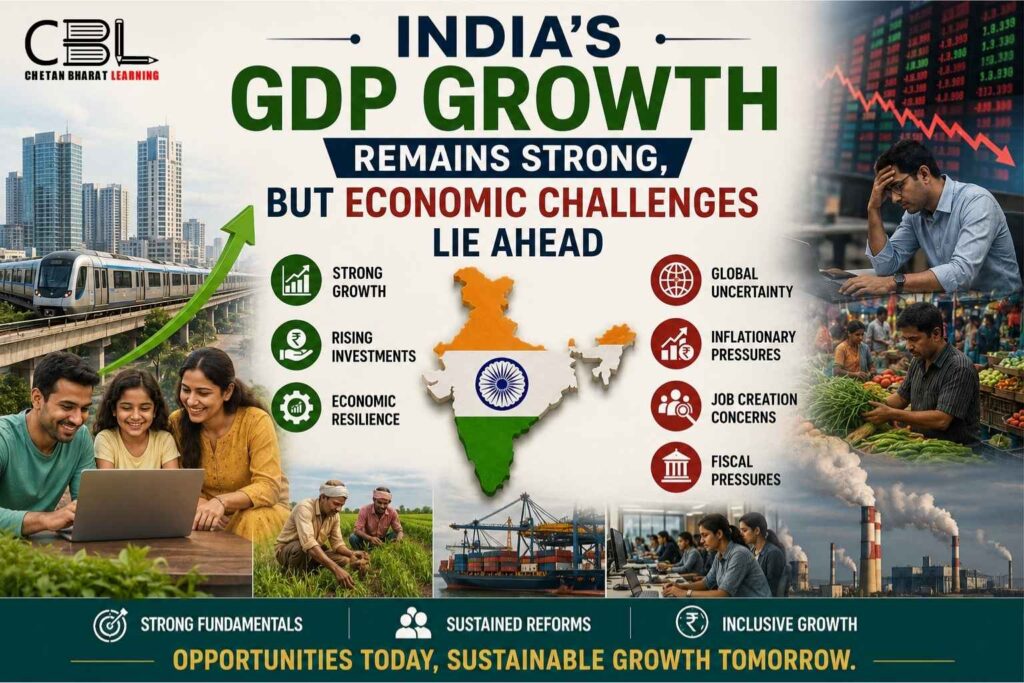
India’s economy has once again demonstrated resilience by recording strong growth despite global uncertainties and geopolitical tensions. According to recent estimates, India’s GDP grew by 7.7% in FY 2025-26, making it one of the fastest-growing major economies in the world.
However, while the headline growth numbers appear encouraging, policymakers are becoming increasingly cautious about the outlook for FY 2026-27. Rising energy prices, global trade disruptions, geopolitical conflicts, and the possibility of a weak monsoon could create fresh challenges for economic growth.
For UPSC aspirants, this topic is important from the perspective of Indian Economy, Growth, Inflation, Monetary Policy, and Global Economic Developments.
Why Is This Topic in the News?
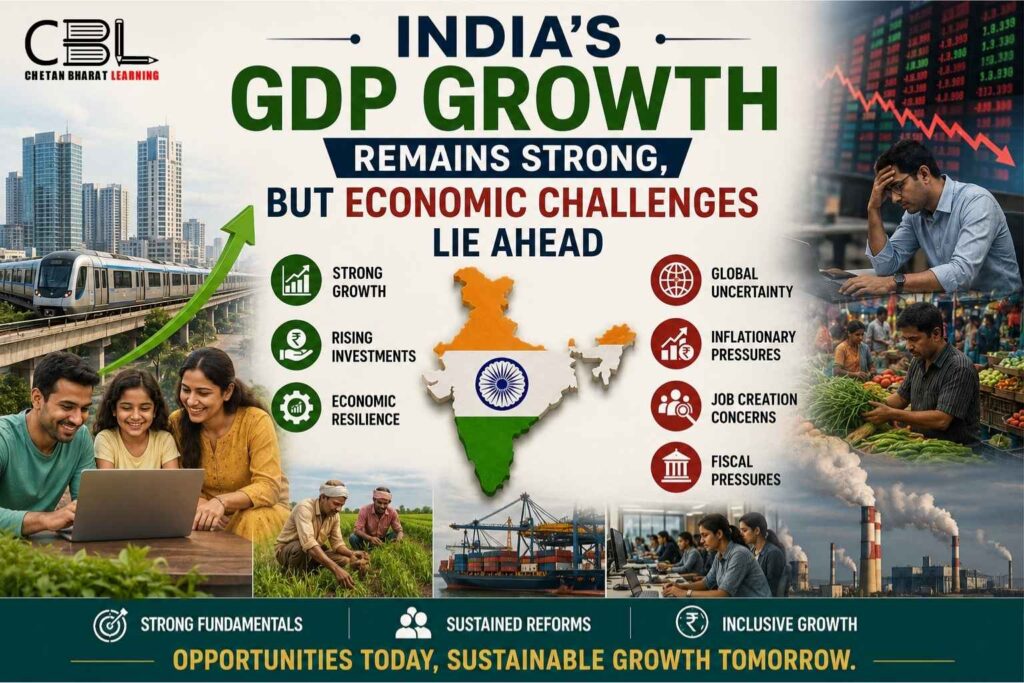
Recent GDP data released by the National Statistics Office (NSO) showed that the Indian economy grew at a healthy pace during the last financial year.
The economy registered approximately 7.8% growth in the fourth quarter (January–March) and 7.7% growth for the full financial year, supported by strong services sector performance and stable domestic demand.
Despite these positive figures, economists have warned that growth may slow in the coming year due to several domestic and global factors.
How Did India Achieve Strong GDP Growth?
India’s economic growth was supported by multiple sectors and policy measures.
The services sector remained the biggest driver of growth. Industries such as financial services, information technology, communication, trade, transportation, and hospitality recorded healthy expansion.
Agriculture also performed relatively well due to favourable weather conditions and strong crop production.
At the same time, government spending, monetary support, and stable domestic consumption helped maintain economic momentum despite global uncertainties.
The Role of the Services Sector
The services sector continues to be the backbone of India’s economy.
Several service-related industries experienced strong growth during the year, including:
- Financial Services
- Information Technology
- Real Estate
- Trade and Commerce
- Hospitality and Tourism
- Professional Services
The expansion of these sectors contributed significantly to overall GDP growth and employment generation.
India’s growing digital economy has further strengthened the role of services in supporting economic activity.
How Did Government Policies Support Growth?
Government policies played an important role in maintaining economic stability.
Measures such as:
- Infrastructure spending
- GST rationalisation
- Capital expenditure
- Support for manufacturing
- Ease of doing business reforms
helped improve investor confidence and stimulate economic activity.
The Reserve Bank of India (RBI) also supported growth through monetary policy measures aimed at maintaining liquidity and financial stability.
Why Are Economists Concerned About the Future?
Despite strong growth in FY 2025-26, the outlook for the next financial year appears less optimistic.
The RBI has projected slower growth for FY 2026-27, indicating that economic momentum may moderate.
Several risks are contributing to this cautious outlook.
Global Uncertainty and Geopolitical Tensions
One of the biggest concerns is the ongoing geopolitical instability in West Asia.
Conflicts in the region have affected:
- Global energy markets
- Shipping routes
- Supply chains
- Commodity prices
Since India imports a large portion of its energy requirements, rising oil prices can increase inflation and widen the trade deficit.
Higher energy costs also affect industries, transportation, and household expenses.
Impact of Global Trade Challenges
The global economy continues to face trade-related uncertainties.
Protectionist measures, tariff disputes, and slower global demand may impact India’s exports.
Recent trade tensions involving major economies have created uncertainty for businesses and investors worldwide.
A slowdown in global trade could affect India’s manufacturing sector and export-oriented industries.
Inflation Remains a Concern
While inflation has remained relatively manageable, several factors could push prices upward.
These include:
- Higher crude oil prices
- Rising commodity costs
- Supply chain disruptions
- Food price volatility
If inflation increases significantly, consumer spending could weaken and economic growth may slow.
Managing inflation while supporting growth will remain a key challenge for policymakers.
Weak Monsoon Could Affect Growth
Another important risk factor is the possibility of a weaker monsoon season.
Agriculture remains heavily dependent on rainfall, and below-normal monsoon conditions can impact:
- Agricultural output
- Rural incomes
- Food prices
- Consumer demand
Weather-related disruptions can have broader effects on economic activity and inflation.
Challenges Related to the Balance of Payments
India must also manage pressures on its external sector.
Rising import bills, particularly for crude oil and fertilisers, can increase pressure on the current account deficit.
Currency volatility and fluctuations in global capital flows may further affect economic stability.
Maintaining a healthy balance of payments remains crucial for long-term economic growth.
What Can Support Growth Going Forward?
India still possesses several strengths that can help sustain economic growth.
These include:
- Strong domestic demand
- Expanding digital economy
- Young workforce
- Infrastructure development
- Manufacturing initiatives
- Growing foreign investment
Continued reforms and investment in productive sectors can help offset external challenges.
The government’s focus on infrastructure, logistics, manufacturing, and technological innovation is expected to provide long-term growth opportunities.
Importance for UPSC Aspirants
This topic is highly relevant for UPSC preparation.
GS Paper III
- Indian Economy
- Economic Growth and Development
- Inflation
- Monetary Policy
- External Sector
Essay Topics
- India’s Growth Story
- Economic Challenges in a Globalised World
- Balancing Growth and Stability
- India’s Economic Future
Students preparing through UPSC Coaching in Chandigarh and IAS Coaching in Chandigarh should closely follow GDP trends, RBI policy decisions, inflation data, and global economic developments.
FAQs
What was India’s GDP growth in FY 2025-26?
India’s GDP growth was estimated at approximately 7.7%, making it one of the fastest-growing major economies.
Which sector contributed most to growth?
The services sector played the largest role in supporting economic expansion.
Why is growth expected to slow in FY 2026-27?
Global uncertainties, higher energy prices, inflation risks, and weaker monsoon expectations may affect growth.
How does inflation impact economic growth?
Higher inflation reduces purchasing power and can slow consumer spending and investment.
Why is this topic important for UPSC?
It is relevant for Indian Economy, Growth, Inflation, Monetary Policy, and Global Economic Developments.
Conclusion
India’s strong GDP growth highlights the resilience of its economy amid global challenges. Robust services sector performance, supportive government policies, and stable domestic demand have helped maintain economic momentum.
However, rising energy prices, geopolitical tensions, inflationary pressures, and weather-related uncertainties suggest that policymakers must remain cautious. Sustained reforms, investment, and macroeconomic stability will be essential to maintaining India’s growth trajectory in the years ahead.
Related Current Affairs
Preparing for UPSC, PCS or HCS?
Talk to a mentor at Chetan Bharat Learning, Chandigarh. Free guidance on choosing the right exam and building a study plan.
Chat on WhatsAppCall 97793 53345UPSC / IAS / PCS coaching in Chandigarh · Trusted by aspirants across Punjab & Haryana
Leave a Reply
You must be logged in to post a comment.