
Why Is This News Important?
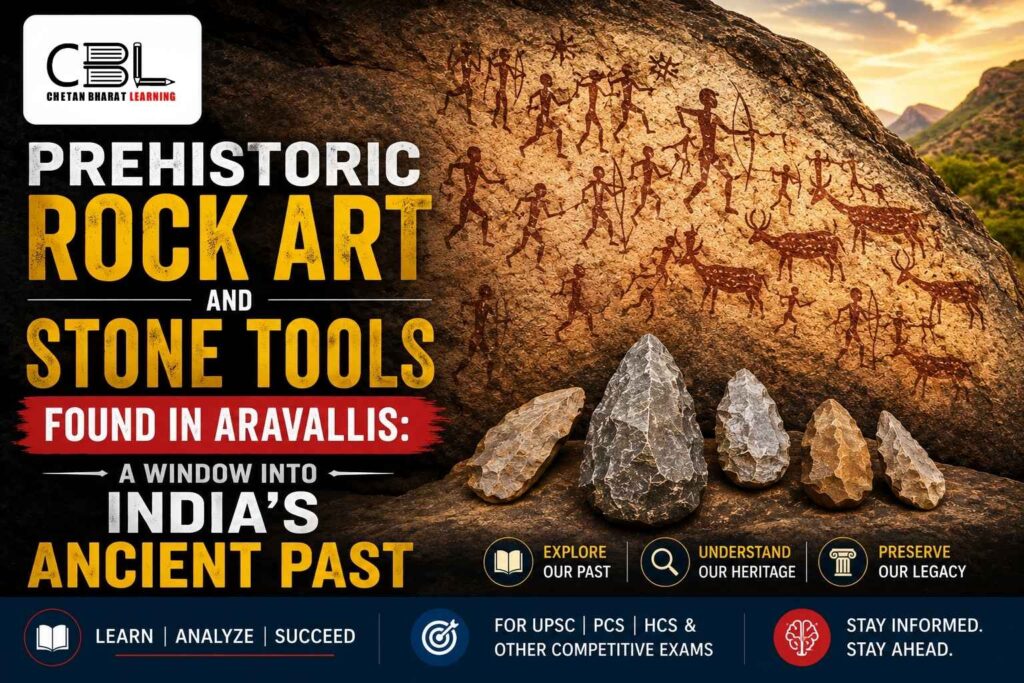
A remarkable archaeological discovery in the Aravalli region has revealed evidence of prehistoric human activity through ancient rock engravings, stone tools, geometric markings, and possible game boards carved into rock surfaces.
The findings were reported from the Bhondsi stretch of the Aravalli forests near Gurugram. Researchers and archaeologists believe the site may offer valuable insights into the cultural, social, and technological evolution of prehistoric communities.
The discovery is particularly significant because it suggests a continuity of human activity across different prehistoric phases, linking early tool-making traditions with later symbolic and ritual practices.
For UPSC aspirants, this topic is important under Art and Culture, Ancient Indian History, Archaeology, and Cultural Heritage.
What Was Discovered in the Aravallis?
Researchers identified a cluster of ancient archaeological remains scattered across rocky outcrops in the Aravalli landscape.
The discoveries include:
- Petroglyphs (rock engravings)
- Cup-shaped depressions (cupules)
- Geometric patterns
- Foot-shaped engravings
- Rock art markings
- Stone tools
- Hand axes and cleavers
- Possible stone game boards
These findings indicate that the region may have been continuously occupied or repeatedly used by prehistoric communities over thousands of years.
The variety of remains discovered at the site makes it one of the most intriguing archaeological findings in recent years.
Understanding Petroglyphs
Petroglyphs are images, symbols, or designs carved directly onto rock surfaces.
Unlike paintings, petroglyphs are created by engraving or chipping away part of the rock surface.
They are considered one of the earliest forms of human artistic expression and provide important clues about the lives, beliefs, and activities of ancient communities.
Petroglyphs often depict:
- Animals
- Human figures
- Hunting scenes
- Ritual symbols
- Geometric designs
The petroglyphs found in the Aravalli region could help researchers understand how prehistoric people interacted with their environment.
What Are Cupules?
One of the most interesting discoveries at the site is the presence of cupules.
Cupules are small cup-shaped depressions carved into rock surfaces.
Archaeologists consider them among the oldest known forms of rock art in the world.
Their exact purpose remains uncertain, but scholars have proposed several possibilities:
- Ritual activities
- Religious practices
- Symbolic communication
- Social gatherings
- Ceremonial functions
The presence of cupules in the Aravallis suggests that prehistoric communities may have engaged in activities that went beyond simple survival and included symbolic or cultural behaviour.
Evidence of Continuous Human Activity
What makes this discovery especially important is the evidence suggesting long-term continuity of human occupation.
Researchers have observed that the site contains remains from different prehistoric periods.
Stone tools indicate early human technological activity, while rock engravings and symbolic markings appear to belong to later cultural phases.
This continuity provides valuable information about how human societies evolved over time within the same geographical landscape.
It suggests that the Aravalli region remained an important habitat for prehistoric communities for thousands of years.
Stone Tools and Their Significance
Stone tools are among the most important sources of information about prehistoric societies.
The tools discovered in the Aravallis include:
- Hand axes
- Cleavers
- Cutting implements
- Tool-making remains
These tools were essential for:
- Hunting
- Food processing
- Woodworking
- Survival activities
The sophistication of stone tools often helps archaeologists determine the technological capabilities of ancient communities.
Their presence confirms that the region was occupied by early humans who possessed advanced knowledge of tool production.
Connection with Paleolithic and Mesolithic Cultures
Archaeologists believe that some of the discoveries may be linked to the Paleolithic and Mesolithic periods.
Paleolithic Period
The Paleolithic Age, often called the Old Stone Age, is characterized by the use of simple stone tools.
Key features include:
- Hunting and gathering lifestyle
- Use of hand axes and cleavers
- Nomadic existence
- Dependence on natural resources
Mesolithic Period
The Mesolithic Age represents a transitional phase between the Paleolithic and Neolithic periods.
Important characteristics include:
- Improved stone tool technology
- Semi-settled communities
- Increased symbolic behaviour
- Development of rock art traditions
The Aravalli findings may help researchers understand how human societies transitioned between these prehistoric phases.
Why Are Rock Art Discoveries Important?
Rock art serves as a direct link to the thoughts, beliefs, and lifestyles of prehistoric people.
Unlike written records, prehistoric societies left behind visual evidence of their experiences through engravings and paintings.
Rock art helps archaeologists study:
- Social organisation
- Religious beliefs
- Cultural practices
- Human-environment interaction
- Technological development
Such discoveries enrich our understanding of India’s ancient heritage and cultural evolution.
Archaeological Importance of the Aravalli Region
The Aravalli Range is one of the oldest mountain systems in the world.
Stretching across several states, it has long been recognized for its ecological and geological significance.
The latest discovery strengthens the region’s importance from an archaeological perspective as well.
The Aravallis may have served as:
- A habitat for prehistoric communities
- A source of stone raw materials
- A migration corridor
- A centre of cultural activity
Continued exploration could reveal additional evidence about human settlement patterns in northern India.
Role of Archaeological Institutions
The discoveries have attracted the attention of archaeologists and researchers from various institutions.
The Archaeological Survey of India (ASI) and regional archaeology departments are expected to conduct further studies to document and preserve the findings.
Scientific investigation may include:
- Site mapping
- Carbon dating
- Tool analysis
- Geological surveys
- Heritage conservation measures
These efforts will help establish the age and significance of the remains more accurately.
What Does This Mean for Indian Heritage?
India possesses one of the world’s richest archaeological traditions.
Discoveries such as those in the Aravallis demonstrate that many aspects of prehistoric life remain unexplored.
The findings highlight the need to:
- Protect archaeological sites
- Promote heritage conservation
- Encourage scientific research
- Raise public awareness
Preserving such sites is essential for understanding the long history of human civilisation in the Indian subcontinent.
Why Is This Important for UPSC?
This topic is highly relevant for UPSC because it connects Ancient History, Archaeology, Art and Culture, and Heritage Conservation.
Questions can be asked about:
- Rock Art
- Petroglyphs
- Paleolithic Culture
- Mesolithic Culture
- Archaeological Survey of India
- Heritage Conservation
UPSC frequently asks questions related to prehistoric cultures and archaeological discoveries.
Prelims Pointers
| Topic | Key Fact |
|---|---|
| Location | Aravalli Region, Gurugram |
| Discovery | Petroglyphs and Stone Tools |
| Institution | Archaeological Survey of India (ASI) |
| Periods | Paleolithic and Mesolithic |
| Feature | Cupules and Rock Engravings |
Mains Perspective
Possible UPSC Question
“Discuss the significance of prehistoric rock art discoveries in understanding the cultural evolution of early human societies in India.”
Key Dimensions
- Archaeological Evidence
- Human Evolution
- Cultural Development
- Heritage Conservation
- Prehistoric Art
- Ancient Technology
FAQ
What are petroglyphs?
Petroglyphs are designs or symbols engraved onto rock surfaces by ancient humans.
What are cupules?
Cupules are small cup-shaped depressions carved into rocks and are among the oldest forms of rock art.
Why is the discovery important?
It provides evidence of prehistoric human activity and cultural development in the Aravalli region.
Which prehistoric periods are associated with the findings?
The discoveries are linked to the Paleolithic and Mesolithic periods.
Conclusion
The discovery of prehistoric rock art, petroglyphs, and stone tools in the Aravalli region offers a fascinating glimpse into India’s ancient past. The findings suggest long-term human activity and provide valuable evidence about the technological, cultural, and symbolic evolution of prehistoric communities.
For UPSC aspirants, the topic is important because it connects archaeology, heritage conservation, ancient history, and art and culture. Such discoveries continue to expand our understanding of human civilisation and the rich cultural legacy of the Indian subcontinent.
Stay updated with such important Art and Culture topics through UPSC Coaching in Chandigarh and IAS Coaching in Chandigarh at Chetan Bharat Learning.
Preparing for UPSC, PCS or HCS?
Talk to a mentor at Chetan Bharat Learning, Chandigarh. Free guidance on choosing the right exam and building a study plan.
Chat on WhatsAppCall 97793 53345UPSC / IAS / PCS coaching in Chandigarh · Trusted by aspirants across Punjab & Haryana
Leave a Reply
You must be logged in to post a comment.