
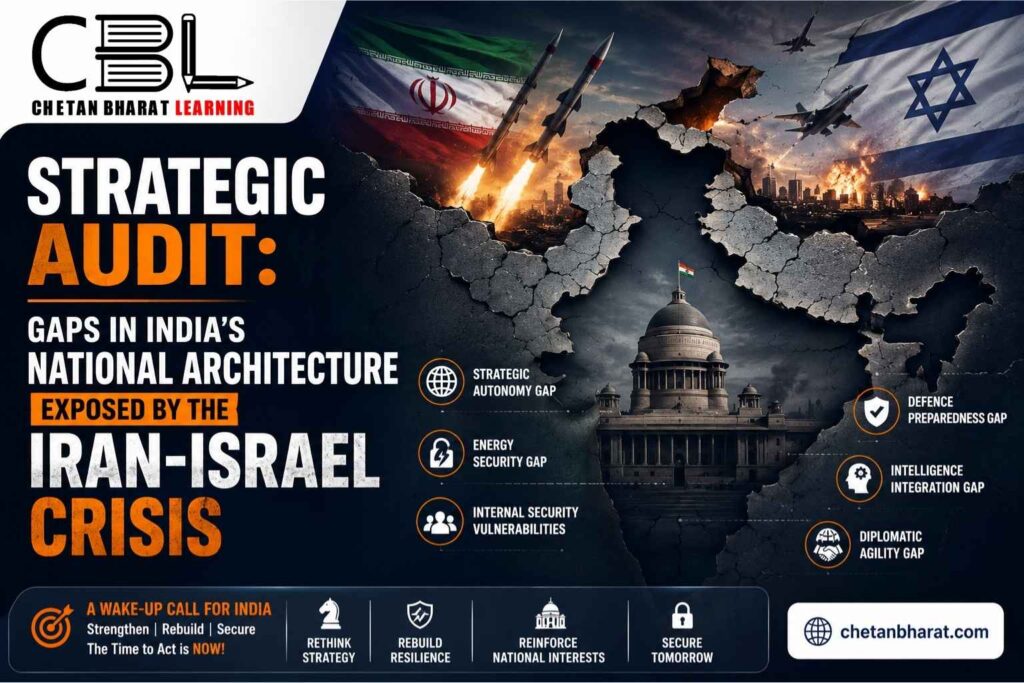
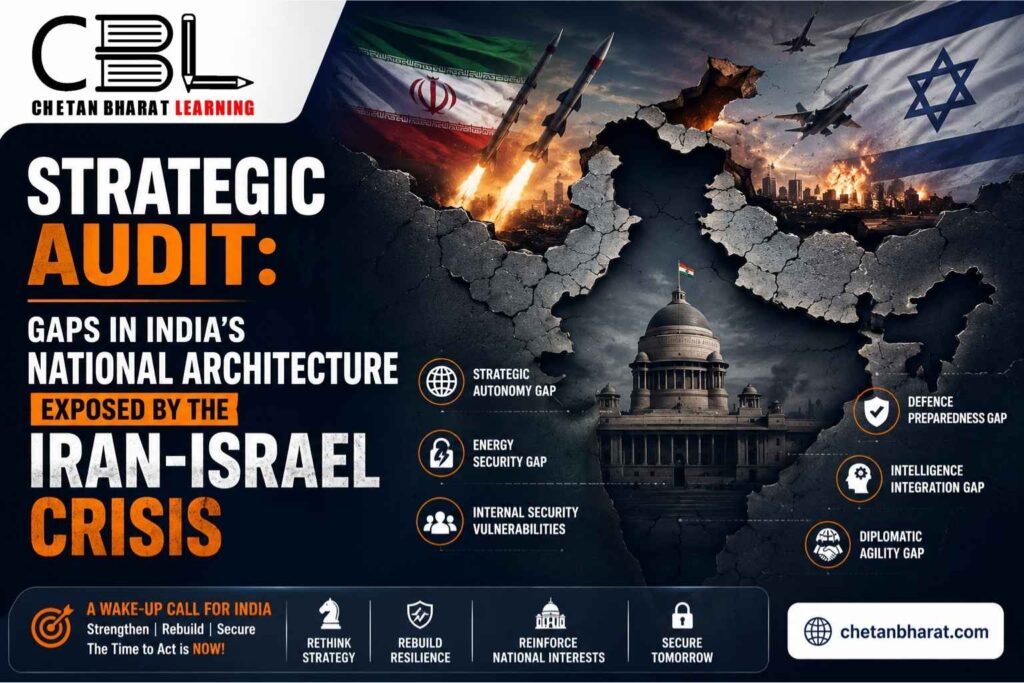
The transition from a shadow war to direct, overt military exchanges between Iran and Israel has challenged India’s long-standing regional posturing. While “strategic de-hyphenation” (engaging conflicting nations independently on bilateral merits) functioned well during low-intensity friction, the weaponization of critical maritime chokepoints and regional infrastructure has exposed several structural gaps in India’s external planning.
1. The Maritime Chokepoint & Supply Chain Gap
India’s heavy dependence on the West Asian maritime corridor leaves its domestic economy highly sensitive to localized trade disruptions.
The Hormuz Dilemma
Over 85% of India’s crude oil requirements are imported, with nearly 50% transitioning through the Strait of Hormuz (connecting the Persian Gulf and the Gulf of Oman). Overt conflict places this supply line directly under the threat of naval blockades or vessel seizures by regional actors.
The Cape Route Inflation
Disruptions in the Bab-el-Mandeb and Red Sea have forced commercial container traffic to bypass the Suez Canal and reroute around Africa’s Cape of Good Hope. This adds 10–14 days to export transit times and causes a sharp increase in maritime insurance premiums and freight costs, reducing the price competitiveness of Indian exports.
Escort Asset Density Limitations
While the Indian Navy has successfully deployed guided-missile destroyers for anti-piracy and merchant vessel escort operations in the Arabian Sea, the crisis has highlighted a gap in long-range, sustained protection capacity. India lacks the operational asset density required to independently secure its entire commercial fleet across multiple volatile blue-water zones simultaneously.
2. The Continental Connectivity & Geopolitical Gap
Regional instability has directly impacted New Delhi’s long-term infrastructure and connectivity plans designed to counter regional rivals.
IMEC FRAMEWORK
Paused due to Levant instability
Vulnerable to broken land-sea links
CHABAHAR PORT & INSTC
Complicated by secondary sanctions.
Threatens bypass route to Central Asia.
The IMEC Stagnation
The India-Middle East-Europe Economic Corridor (IMEC)—envisioned at the G20 summit as a multi-modal rail-and-shipping alternative to China’s Belt and Road Initiative (BRI)—relies on stable regional cooperation. The current security environment has paused the land-sea integration through Jordan and Israel’s Haifa Port, demonstrating that economic corridors cannot be isolated from regional security architectures.
Chabahar & INSTC Exposure
India’s long-term investment in Iran’s Chabahar Port is a strategic gateway to Central Asia and Afghanistan that bypasses Pakistan. However, overt military escalation increases the risk of broader international sanctions, complicating equipment procurement, banking clearance channels, and private-sector logistics investment.
3. The Energy Buffer & Fiscal Gap
The escalation has highlighted the limits of India’s short-term energy shock absorbers.
Strategic Petroleum Reserve (SPR) Deficit
India’s current active SPR capacity holds roughly 9.5 days of emergency crude oil consumption. When combined with the commercial stock held by domestic oil marketing companies (OMCs), the total buffer sits at around 74 days. This is well below the International Energy Agency (IEA) mandate of 90 days, leaving India fiscally vulnerable to sustained supply disruptions or sudden price spikes.
The Strategic De-hyphenation Limit
For years, India managed to maintain independent, strong ties with Israel (for defense technology and intelligence) and Iran (for energy and connectivity). The shift toward open, kinetic warfare reduces the diplomatic space for this approach, as issues like airspace access restrictions, maritime security coordination, and international votes force clear policy choices.
4. The Diaspora Security & Remittance Gap
The safety of Indian citizens abroad remains an immediate challenge during regional crises.
Logistical Evacuation Pressures
West Asia houses over 9 million non-resident Indians (NRIs), concentrated heavily in the GCC nations. Any expansion of the conflict zone into a broader regional war creates an immediate, massive requirement for humanitarian repatriation, testing the limits of civil aviation and naval sealift capacities.
Macroeconomic Remittance Risk
The Indian diaspora in West Asia accounts for more than $50 billion annually in foreign inward remittances (roughly half of India’s total inflows). Sustained regional conflict threatens local employment markets, which could directly impact India’s current account balance and domestic consumption in high-migration states like Kerala, Punjab, and Andhra Pradesh.
Mains Analytical Framework
Core Theme:
The limits of strategic de-hyphenation: How the weaponization of maritime chokepoints connects India’s domestic economic stability directly to West Asian security.
Key Concept:
Use this crisis to illustrate the Strategic Autonomy Dilemma—how India must protect its economic assets and infrastructure partnerships in Iran without complicating its deep defense, counter-terrorism, and technology co-development partnerships with Israel.
Prelims Mapping & Concepts
Geographical Chokepoints:
Strait of Hormuz:
Connects the Persian Gulf and the Gulf of Oman; crucial for global energy transit.
Bab-el-Mandeb:
Connects the Red Sea and the Gulf of Aden; guards the southern approach to the Suez Canal.
Haifa Port:
Strategic Mediterranean terminus for the planned IMEC corridor.
Policy Terms:
Look West Policy:
India’s structured diplomatic strategy aimed at significantly deepening economic, energy, and defense relationships with West Asian nations.
Blood and Water Doctrine:
A comparative strategic reference to India’s recent external posturing (such as the suspension of the Indus Waters Treaty during Operation Sindoor in May 2025), showing a growing willingness to use economic and resource levers as strategic tools during national security crises.
FAQ Bank
How does the conflict impact India’s GDP and inflation?
The Transmission:
Higher oil prices ($90–$120/barrel) and soaring maritime insurance premiums lead to imported inflation.
The Cost:
This drives up manufacturing, transport, and fertilizer costs, compressing corporate margins and leading to downward revisions of India’s annual GDP growth projections.
How are Indian oil refiners bypassing the Strait of Hormuz disruptions?
Sourcing Pivot:
Refiners are reducing dependence on the Persian Gulf by purchasing non-Hormuz-linked barrels from the Atlantic Basin (US, Brazil, West Africa).
The Russian Anchor:
Crude imports from Russia (via Baltic and Black Sea routes) remain outside the Hormuz threat zone and serve as a vital supply stabilizer.
Why does this conflict jeopardize the IMEC over the INSTC?
IMEC Stalled:
The India-Middle East-Europe Corridor requires complete geopolitical normalization between the Gulf and Israel. Kinetic warfare in the Levant has indefinitely blocked its Mediterranean link via Haifa Port.
INSTC Viability:
While the International North-South Transport Corridor via Iran’s Chabahar Port faces secondary sanctions risks, its physical route to Central Asia remains structurally open, forcing India to prioritize it over IMEC.
What is the impact on India’s diaspora and remittances?
Evacuation Pressures:
Over 9 million Indian citizens reside in the Gulf. Any expansion of the war zone places immense logistical strain on the Indian Navy and civil aviation for repatriation.
Remittance Inflows:
The region contributes roughly $50 billion annually to India’s foreign exchange reserves. Job market disruptions directly impact India’s current account balance.
Related Current Affairs
Preparing for UPSC, PCS or HCS?
Talk to a mentor at Chetan Bharat Learning, Chandigarh. Free guidance on choosing the right exam and building a study plan.
Chat on WhatsAppCall 97793 53345UPSC / IAS / PCS coaching in Chandigarh · Trusted by aspirants across Punjab & Haryana
Leave a Reply
You must be logged in to post a comment.