
For decades, international defense analytical circles viewed India through a singular, frustrating lens: the world’s perennial top arms importer. Whenever conflict flared across global chokepoints, New Delhi’s strategic options were quietly tethered to supply chains stretching back to Moscow, Paris, or Washington.
But a profound, quiet shift has taken place.
India’s defense ecosystem has crossed a historic rubicon. Driven by aggressive domestic mandates, deep structural overhauls, and an expanding private sector, India’s defense exports surged to an unprecedented ₹38,424 crore in FY 2025–26—a staggering 62.66% leap from the previous fiscal year.
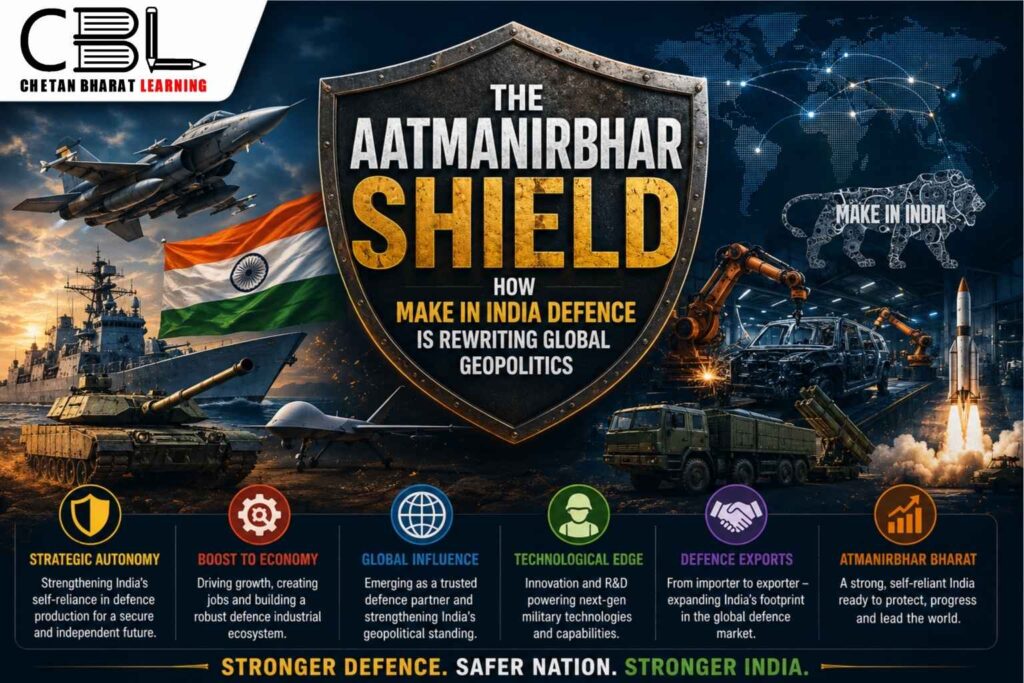
This is no longer just about economic optimization or saving foreign reserves. It is a fundamental realignment of India’s statecraft. From supply-chain vulnerability to regional security provider, “Make in India” in the defense sector is forging a brand-new architecture of hard power.
The Strategic Imperative: Breaking the Import Trap
The Historical Baggage
Post-independence, India adopted a public-sector-dominated model for defense production, relying on Ordnance Factories and Defence Public Sector Undertakings (DPSUs). While this preserved state control, it bred a culture of license manufacturing rather than original intellectual property (IP) design.
Whenever a critical technological gap emerged—whether advanced fighter radars or submarine propulsion systems—New Delhi looked abroad.
The Double Vulnerability
- The Geopolitical Leverage: Relying on foreign original equipment manufacturers (OEMs) subjects India to “end-user restrictions” and sudden spare-parts supply shocks during active conflict.
- The Capital Drain: Massive defense capital acquisitions severely strained India’s capital account, diverting precious resources away from core socio-economic infrastructure development.
Policy Architecture: The Pillars of Indigenisation
The transformation of the domestic defense landscape is driven by several complementary policy updates, rather than a single standalone measure.
1. Defence Acquisition Procedure (DAP) 2020
The DAP 2020 fundamentally altered procurement prioritization. It explicitly places the Buy (Indian-IDDM)—Indigenously Designed, Developed, and Manufactured—at the highest tier of procurement preference. If a product can be designed and built at home with at least 50% indigenous content, foreign vendors are legally barred from competing.
2. Positive Indigenisation Lists (PILs)
Moving away from general goals, the Ministry of Defence adopted a system of progressive restrictions. By issuing multiple Positive Indigenisation Lists spanning thousands of items (including complete weapon complexes, artillery pieces, light transport aircraft, and micro-components), the government placed strict import embargoes on designated timelines.
This sent an unmistakable signal to local industries: Build it, because we will no longer import it.
3. iDEX (Innovations for Defence Excellence)
Launched to bridge the gap between military requirements and technological innovation, iDEX engages startups, MSMEs, and academia. By providing development grants and technical mentorship, iDEX has accelerated innovation in quantum computing, unmanned aerial vehicles (UAVs), and secure military communications.
4. SRIJAN Portal
To tackle the micro-component import challenge, the SRIJAN portal acts as an industry-facing dashboard. DPSUs list specific parts and sub-assemblies that are currently imported, allowing domestic vendors to step in, reverse-engineer, or indigenously design alternatives.
Data Dashboard: The Defence Economy in Numbers
The policy trajectory is reflected clearly in recent performance metrics. The following data points demonstrate the shifting balance within India’s defense production ecosystem:
| Key Structural Indicator | Performance Metric (FY 2025–26 Data) | FY 2029–30 Target Horizon |
|---|---|---|
| Total Defence Budget Allocation | ₹7.86 Lakh Crore (~$83 Billion) | Continued baseline expansion |
| Annual Defence Export Volume | ₹38,424 Crore (Record High) | ₹50,000 Crore |
| Year-on-Year Export Growth | 62.66% Surge | Sustained double-digit momentum |
| Domestic Production Value | Exceeded ₹1.5 Lakh Crore | ₹3 Lakh Crore |
| Ecosystem Market Share | DPSUs: ~55% | Private Sector: ~45% | Balanced Public-Private Integration |
The Twin Structural Engines: Dual Corridors
To optimize manufacturing logistics, India established two dedicated Defence Industrial Corridors:
- Uttar Pradesh Node: Focuses on aerospace components, land systems, and specialty polymers across cities like Aligarh, Chitrakoot, and Jhansi.
- Tamil Nadu Node: Leverages pre-existing automotive and engineering strength across Chennai, Coimbatore, and Tiruchirappalli to focus on electronic warfare components and maritime systems.
Critical Analytical Review: Challenges and Structural Bottlenecks
[ STRUCTURAL WEAKNESSES ]
➣ R&D Funding Gap
Fundamental defence research ke liye funding ka percentage kaafi low hai.
India ka R&D spending global average se below hai.
Research aur innovation me investment aur badhane ki zarurat hai.
➣ IP (Intellectual Property) Ownership Issue
Core technologies ke liye foreign tech par heavy dependence hai.
Indigenous design ownership abhi weak hai.
Example:
LCA Tejas me imported engines use hote hain.
Advanced semiconductor chips bhi import karne padte hain.
➣ Ecosystem Missing Link
Tier-3 component supply network strong nahi hai.
MSMEs ko proper ecosystem support nahi milta.
Deep manufacturing chain absent hone ki wajah se production efficiency impact hoti hai.
- The Critical Technology Deficit: While India builds hulls, fuselages, and assemblies, it still relies on foreign suppliers for core high-tech components. For example, the LCA Tejas relies on American GE-F404/F414 engines, and advanced semiconductor chips must be imported.
- Sub-optimal R&D Funding: India’s overall spending on fundamental research and development hovers below global averages. Without design ownership, “Make in India” risks slipping into advanced assembly rather than true creation.
- Long Procurement Gestation: The private sector frequently faces complex, multi-year trial and evaluation cycles, which can strain capital flows for smaller MSMEs.
The Way Forward
- Focus on Joint Intellectual Property: Future defense ventures must move beyond licensed production. Technology transfer frameworks should guarantee that Indian engineers own the underlying source codes and design blueprints.
- Commercialize Testing Labs: Opening up DRDO and state testing ranges to private aerospace and defense innovators will remove testing bottlenecks.
- Harness Emerging Tech: Indigenisation efforts must anticipate future battlefields by integrating artificial intelligence, cyber-defense systems, and swarming drone technology directly into manufacturing pipelines.
Exam Focus: Masterclass Toolkit
Prelims Pointers
Buy (Indian-IDDM): Requires a minimum of 50% indigenous content if the design is domestic, or 60% if the design is non-Indian.
FDI Limits: 74% via the Automatic Route; up to 100% via the Government Route where it brings access to modern technology.
iDEX Administration: Managed by the Defence Innovation Organisation (DIO), a not-for-profit company formed by HAL and BEL.
Mains Analysis (GS Paper III)
- Core Theme: “Defense indigenisation is not merely an economic strategy; it is the cornerstone of India’s strategic autonomy.”
- Key Concept: Use the concept of Strategic Trilemma—balancing cost, timeline, and domestic content—to evaluate defense procurement trade-offs.
Essay Angle
Theme: “The strength of a nation lies not in the weapons it buys, but in the weapons it creates.”
Approach: Connect self-reliance in security to historical examples (e.g., the spare parts crunch during past regional conflicts) to explain how industrial capacity shapes sovereign foreign policy choices.
Question Bank
Q. Consider the following statements regarding the Defence Acquisition Procedure (DAP) 2020:
- ‘Buy (Indian-IDDM)’ is placed at the highest priority for capital acquisition.
- Foreign Direct Investment (FDI) in defense manufacturing is permitted up to 100% under the automatic route for all projects.
- The SRIJAN portal is designed to connect global arms suppliers with the Indian Ministry of Defence for streamlined importing.
Which of the statements given above is/are correct? A) 1 only B) 1 and 2 only C) 2 and 3 only D) 1, 2, and 3
Answer: A) 1 only Explanation: Statement 2 is incorrect because FDI up to 100% requires the Government Route; only up to 74% is automatic. Statement 3 is incorrect because the SRIJAN portal is an indigenisation portal meant to reduce imports, not facilitate them.
Q. “Evaluating the recent performance of India’s defense exports, analyze the key policy interventions that enabled this growth. What structural bottlenecks must be resolved to achieve complete self-reliance in defense manufacturing?”
FAQ Section
- What’s happening? India used to buy almost all its major military gear from other countries. Now, it is making a massive push to build it at home.
- Are we succeeding? Yes. In the fiscal year 2025–26, India exported a record ₹38,424 crore worth of defense equipment to foreign nations.
- How are we doing it? The government banned the import of thousands of defense items through “Positive Indigenisation Lists,” forcing the military to buy from Indian companies.
- Who is building it? Both government-owned factories (like HAL) and big private companies (like Tata and L&T), alongside innovative tech startups.
- What is the main problem left? India still imports the most complicated parts, like fighter jet engines and high-tech computer chips. The next step is learning to design those at home.
- What is a Positive Indigenisation List? It is a list of military hardware and components issued by the Ministry of Defence that can no longer be imported from foreign countries after a specified date.
- Which countries buy defense equipment from India? India exports to over 85 nations, supplying items like BrahMos missiles, Pinaka rockets, patrol vessels, and avionics across regions including Southeast Asia, Africa, and the Middle East.
Conclusion
True sovereignty is compromised when a nation relies on foreign supply chains for its defense requirements. By prioritizing domestic manufacturing, expanding private sector participation, and growing its export presence, India is laying the groundwork for a more self-reliant security infrastructure.
“Aatmanirbharta in defense production is no longer a matter of policy choice; it is a fundamental strategic necessity for a rising global power.”
Preparing for UPSC, PCS or HCS?
Talk to a mentor at Chetan Bharat Learning, Chandigarh. Free guidance on choosing the right exam and building a study plan.
Chat on WhatsAppCall 97793 53345UPSC / IAS / PCS coaching in Chandigarh · Trusted by aspirants across Punjab & Haryana
Leave a Reply
You must be logged in to post a comment.