
Important for:
UPSC, Haryana HCS, Punjab PCS
Prelims: Informal Sector, MSMEs, ASUSE Survey
Mains: GS Paper 3 — Indian Economy, Employment, MSMEs
Why in News?
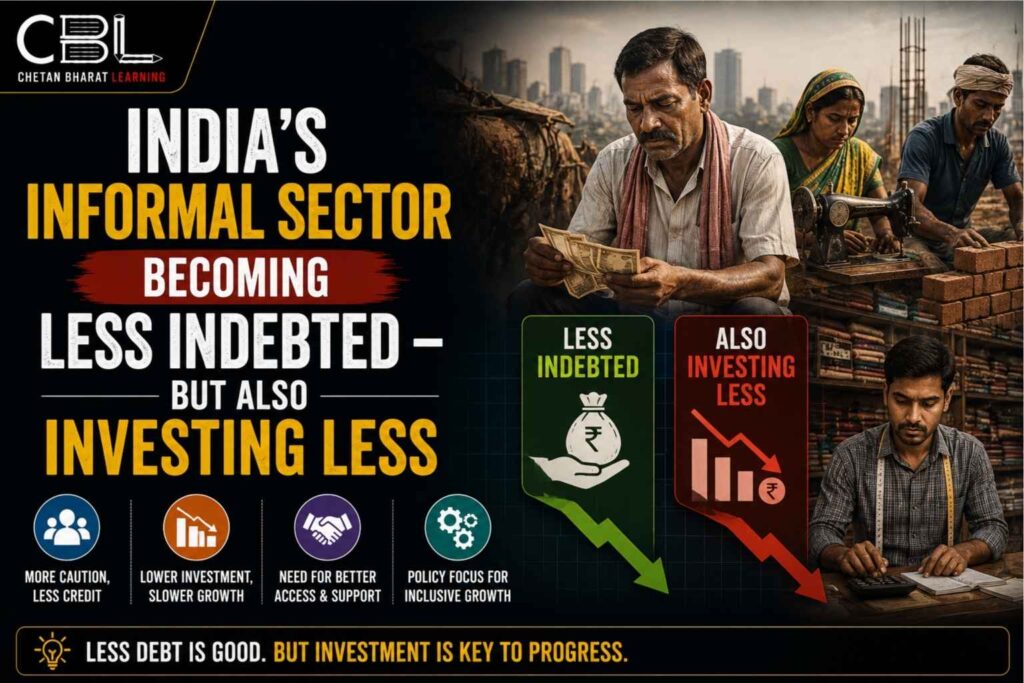
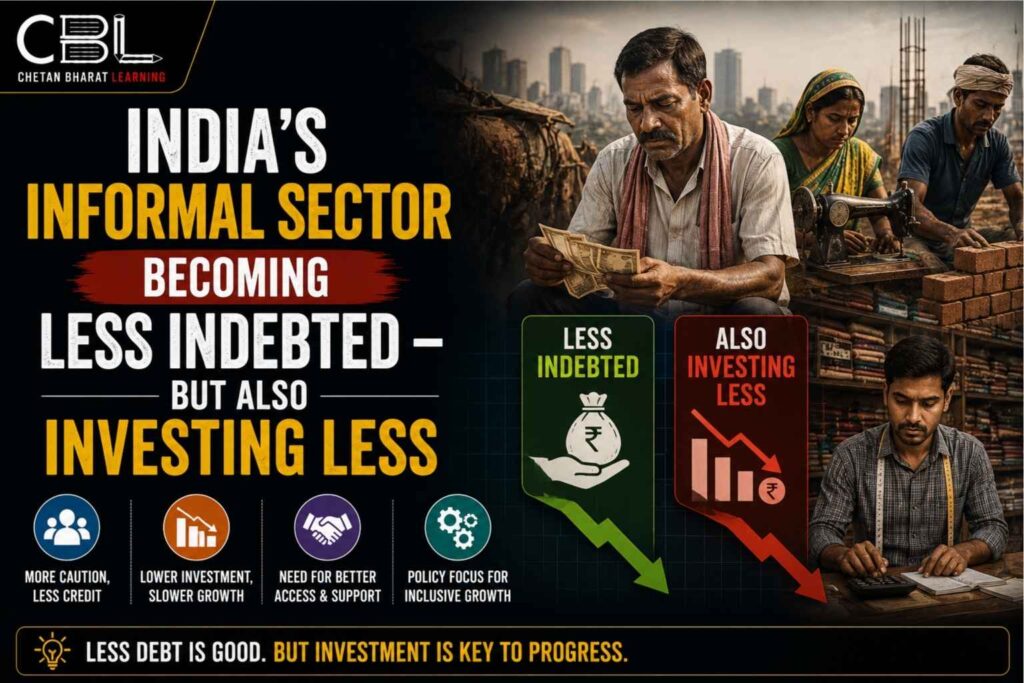
Recent survey data shows that:
India’s informal sector is becoming less indebted
but at the same time:
→ Investment activity is also slowing down.
This has raised concerns about:
✔ Economic growth
✔ MSME expansion
✔ Employment generation
What Is India’s Informal Sector?
The:
Informal sector
includes:
✔ Small businesses
✔ Street vendors
✔ Household enterprises
✔ Micro enterprises
✔ Unregistered establishments
These businesses generally:
→ Operate outside formal corporate structures.
Key Findings of the Survey
1. Debt Levels Declined
Outstanding loans reduced among many enterprises.
2. Investments Also Fell
Businesses are:
→ Spending less on assets and expansion.
3. Micro Enterprises Dominate
Micro enterprises form:
99%+ of informal establishments
in India.
4. Rural & Urban Impact
Both:
✔ Rural enterprises
and
✔ Urban informal units
showed slower investment trends.
Why Are Businesses Borrowing Less?
Possible reasons include:
✔ Economic uncertainty
✔ Weak consumer demand
✔ High operational risks
✔ Cautious business sentiment
Why Is Lower Investment a Concern?
Lower investment can affect:
❌ Employment generation
❌ Productivity growth
❌ MSME competitiveness
❌ Economic expansion
Role of MSMEs in India
MSMEs contribute significantly to:
✔ Employment
✔ Manufacturing
✔ Exports
✔ Local economic activity
They are often called:
The backbone of India’s economy
Economic Significance
A slowing informal sector may affect:
✔ Consumption demand
✔ Rural economy
✔ Urban employment
✔ Overall GDP growth
India-Specific Importance
India’s informal sector employs:
→ A very large share of the workforce.
Hence:
✔ Credit access
✔ Investment support
✔ Formalisation policies
remain crucial for economic stability.
Special Note for Aspirants
Students preparing through:
UPSC coaching Chandigarh
or
IAS coaching Chandigarh
should focus on:
✔ Informal economy
✔ MSME sector
✔ Financial inclusion
✔ Credit access
✔ Employment trends
These topics are highly important for:
→ GS3 Economy + Essay + Interview.
Key Insight for UPSC
→ Lower indebtedness is not always positive.
If borrowing declines because:
❌ Businesses stop expanding,
then:
→ Economic growth may weaken.
PRELIMS PRACTICE QUESTIONS
Q1. India’s informal sector mainly includes:
A. Large corporations
B. Small unregistered businesses
C. Foreign companies
D. Public sector units
→ Answer: B
Q2. MSME stands for:
A. Medium Sector Manufacturing Enterprise
B. Micro, Small and Medium Enterprises
C. Modern Small Manufacturing Economy
D. None
→ Answer: B
Q3. Informal sector businesses are generally:
A. Fully government-owned
B. Unregistered or loosely regulated
C. Listed on stock exchanges
D. Multinational firms
→ Answer: B
Q4. Lower investment by MSMEs may affect:
A. Employment generation
B. Judicial reforms
C. Space technology
D. Defence exports
→ Answer: A
Q5. ASUSE survey is related to:
A. Agriculture exports
B. Informal enterprises
C. Nuclear energy
D. River disputes
→ Answer: B
CBL Mains Practice Question
“India’s informal sector plays a crucial role in employment and economic activity, yet remains vulnerable to low investment and credit constraints.” Discuss.
FAQs
1. What is the informal sector?
It includes small, unregistered and non-corporate businesses.
2. Why is lower indebtedness being discussed?
Because informal businesses are borrowing less but also investing less.
3. Why are MSMEs important?
They generate employment and support economic growth.
4. What is ASUSE?
Annual Survey of Unincorporated Sector Enterprises.
5. Which GS paper covers this topic?
GS Paper 3.
Related Current Affairs
Preparing for UPSC, PCS or HCS?
Talk to a mentor at Chetan Bharat Learning, Chandigarh. Free guidance on choosing the right exam and building a study plan.
Chat on WhatsAppCall 97793 53345UPSC / IAS / PCS coaching in Chandigarh · Trusted by aspirants across Punjab & Haryana
Leave a Reply
You must be logged in to post a comment.