
Important for:
UPSC, Haryana HCS, Punjab PCS
Prelims: NGT, groundwater contamination, arsenic, fluoride
Mains: GS Paper 3 — Environment, Pollution, Public Health
Why in News?
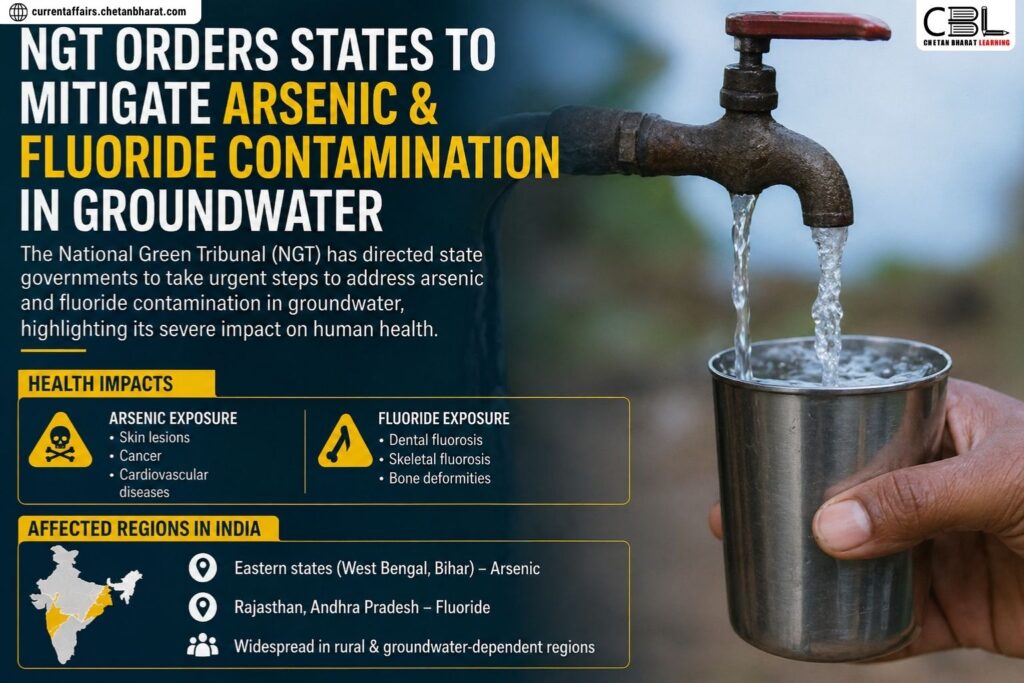
The National Green Tribunal has directed state governments to take urgent steps to address arsenic and fluoride contamination in groundwater, highlighting its severe impact on human health.
What is NGT?
- A statutory body established under:
✔️ National Green Tribunal Act, 2010
Functions:
- Handles environmental disputes
- Provides speedy justice
- Ensures enforcement of environmental laws
What is Groundwater Contamination?
It refers to the presence of harmful substances in underground water sources.
Major Contaminants:
- Arsenic
- Fluoride
✔︎ Found naturally or due to:
- Geological conditions
- Industrial pollution
- Over-extraction of groundwater
Health Impacts
☉Arsenic Exposure:
- Skin lesions
- Cancer (long-term exposure)
- Cardiovascular diseases
☉ Fluoride Exposure:
- Dental fluorosis
- Skeletal fluorosis
- Bone deformities
Affected Regions in India
- Eastern states (West Bengal, Bihar) → Arsenic
- Rajasthan, Andhra Pradesh → Fluoride
✔️ Problem is widespread in:
- Rural areas
- Groundwater-dependent regions
NGT Observations
- Monitoring systems are inadequate
- Data collection is inconsistent
- States need to:
- Identify hotspots
- Improve water testing
- Provide safe drinking water
Key Institutions Involved
- Central Ground Water Authority (CGWA)
- State Pollution Control Boards
- Public Health Departments
Government Measures
- Installation of water treatment plants
- Community water supply schemes
- Awareness campaigns
✔︎ Still challenges:
- Implementation gaps
- Infrastructure limitations
Core Issue
| Environmental Issue | Governance Challenge |
|---|---|
| Water contamination | Weak monitoring |
| Health risks | Poor rural infrastructure |
| Resource depletion | Policy enforcement gaps |
PRELIMS PRACTICE QUESTIONS
Q1. National Green Tribunal was established in:
A. 2005
B. 2008
C. 2010
D. 2012
✅ Answer: C
Q2. Which of the following are effects of arsenic exposure?
- Skin lesions
- Cancer
- Bone deformities
A. 1 and 2 only
B. 2 and 3 only
C. 1 only
D. 1, 2 and 3
✅ Answer: A
Q3. Fluoride contamination leads to:
A. Lung disease
B. Skeletal fluorosis
C. Kidney failure
D. Diabetes
✅ Answer: B
Q4. Which of the following states is highly affected by arsenic contamination?
A. Punjab
B. West Bengal
C. Gujarat
D. Kerala
✅ Answer: B
Q5. CGWA stands for:
A. Central Ground Water Authority
B. Central Green Water Agency
C. Council for Ground Water Analysis
D. Commission on Ground Water Act
✅ Answer: A
Q6. Groundwater contamination can occur due to:
- Natural geological processes
- Industrial pollution
- Rainwater harvesting
A. 1 and 2 only
B. 2 and 3 only
C. 1 only
D. 1, 2 and 3
✅ Answer: A
Q7. NGT deals with:
A. Criminal cases
B. Environmental disputes
C. Election disputes
D. Taxation issues
✅ Answer: B
✍️ CBL Mains Practice Question
“Groundwater contamination in India reflects a deeper governance and public health crisis.”
Discuss with reference to arsenic and fluoride pollution. (250 words)
FAQs
1. What is arsenic contamination?
It is the presence of toxic arsenic in groundwater, causing severe health issues.
2. What is fluorosis?
A disease caused by excessive fluoride intake affecting bones and teeth.
3. What is NGT?
A specialized environmental court for handling environmental disputes.
4. Why is groundwater contamination a concern?
Because it affects drinking water and public health on a large scale.
5. Which GS paper covers this topic?
GS Paper 3 — Environment and Public Health.
Related Current Affairs
Preparing for UPSC, PCS or HCS?
Talk to a mentor at Chetan Bharat Learning, Chandigarh. Free guidance on choosing the right exam and building a study plan.
Chat on WhatsAppCall 97793 53345UPSC / IAS / PCS coaching in Chandigarh · Trusted by aspirants across Punjab & Haryana
Leave a Reply
You must be logged in to post a comment.