
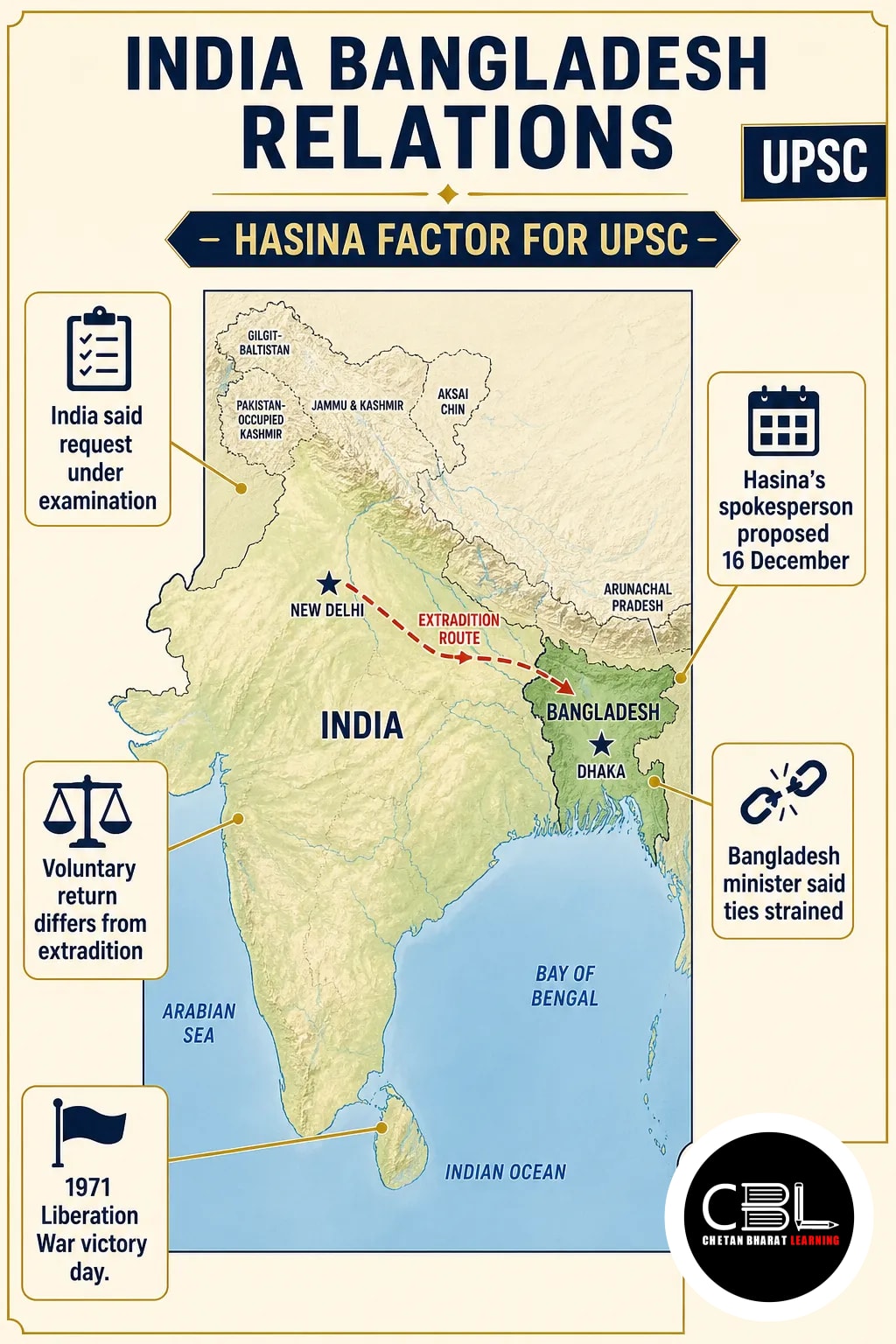
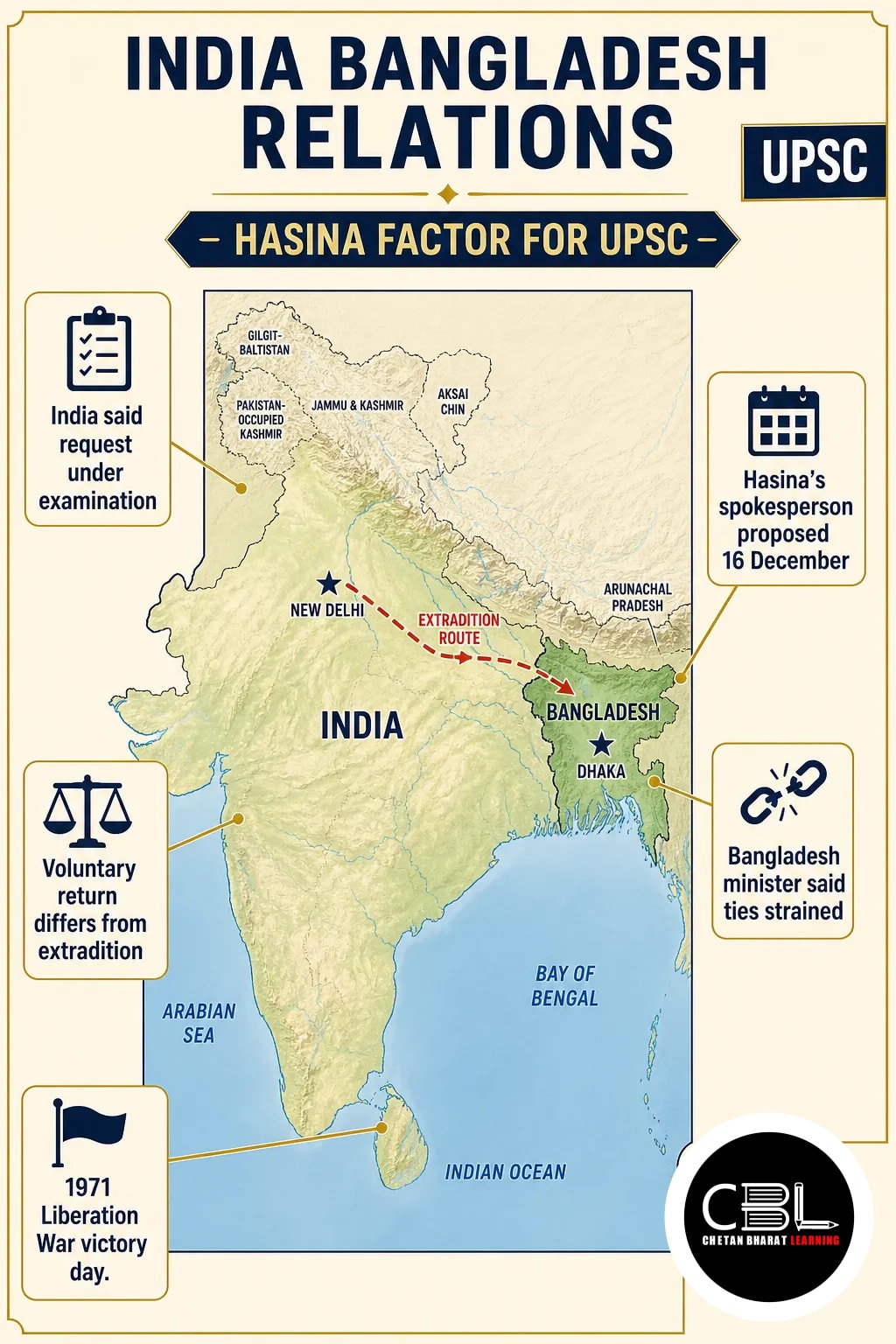
India Bangladesh relations face fresh strain after a Bangladesh minister linked Sheikh Hasina’s presence in India to bilateral tensions. This development follows CBL’s coverage of the consular dialogue; explore the wider international relations coverage.
Quick answer: India Bangladesh relations face a diplomatic test over former Bangladesh Prime Minister Sheikh Hasina’s presence in India. On 26 November 2026, Bangladesh minister Humaiun Kobir said it was straining ties. Meanwhile, India said it was examining Dhaka’s extradition request through legal processes and distinguished it from her proposed voluntary return.
What happened?
Bangladesh State Minister for Foreign Affairs Humaiun Kobir said Hasina’s presence in India had become a source of friction. On 26 November, he also claimed that New Delhi was beginning to recognise the problem.
The remarks followed statements about Hasina’s proposed return and Dhaka’s extradition request. However, India did not comment on the return plan itself and said it was examining the request through established legal processes.
Hasina left Bangladesh after her ouster, ending a 15-year period in power. For background on the bilateral relationship after her departure, see CBL’s earlier analysis of the Hasina factor.
What are the key developments?
The immediate dispute concerns two different routes: a proposed voluntary return and a requested extradition.
| Date | Development |
|---|---|
| 24 November 2026 | Hasina’s spokesperson Syed Mozammel Ali announced a plan for her return on 16 December. |
| 25 November 2026 | India’s External Affairs Ministry spokesperson Randhir Jaiswal separated voluntary return from the extradition request. |
| 26 November 2026 | Kobir said Hasina’s presence was straining ties and insisted on return through the extradition treaty. |
| 16 December 2026 | Proposed return date; Bangladesh also marks its victory in the 1971 Liberation War on this day. |
The proposed date is not confirmation that a return will occur. Moreover, the source does not report a final Indian decision on extradition.
How do voluntary return and extradition differ?
A voluntary return is a person’s return by choice, whereas extradition involves a formal handover between states through a legal process.
India’s spokesperson distinguished the two while saying New Delhi was examining Bangladesh’s request. In contrast, Kobir maintained that Hasina could return only through the bilateral extradition treaty, either in handcuffs or under strict surveillance.
These statements describe the governments’ positions, not an agreed outcome. Moreover, the source does not specify the treaty provisions or the stage of the legal examination; neither should be assumed.
Hasina faces serious legal challenges in Bangladesh. A special tribunal sentenced her to death in absentia over the deadly crackdown on protesters during the 2024 uprising. However, she has denied wrongdoing and questioned the proceedings’ legitimacy.
Why does the issue matter for India?
The case tests how India can manage a sensitive legal request alongside its broader relationship with Bangladesh.
- Diplomatic trust: Bangladesh has publicly linked Hasina’s presence to bilateral friction. Consequently, the handling of the request can affect the atmosphere for engagement.
- Legal credibility: India has identified an established process for examining the request. Therefore, a decision should be assessed through that process rather than presumed from political statements.
- Relationship beyond individuals: India maintained close relations with Hasina during her years in power. However, its current engagement must also address the government now in office.
- Channels of cooperation: A dispute over one individual need not determine every bilateral conversation. For example, diplomatic and consular channels can remain useful for discussing other shared concerns.
India had hoped that a new Bangladesh government would create an opportunity to reset ties after their deterioration following Hasina’s ouster. However, Bangladesh Prime Minister Tarique Rahman has not visited India since taking office in February, despite an invitation; he also skipped the India-hosted BRICS summit in September. BRICS is a grouping originally named for Brazil, Russia, India, China and South Africa.
What are the challenges and the way forward?
The central challenge is to address Dhaka’s request without treating diplomacy as a substitute for legal examination.
- Separate questions: India can maintain its distinction between voluntary return and extradition. This can make the scope of each discussion clearer.
- Protect due process: The request requires careful examination under applicable law and treaty provisions. Meanwhile, public claims should not be presented as a final legal determination.
- Keep dialogue open: Both governments can use diplomatic channels to clarify their positions. In addition, continued consular engagement can keep other practical matters on the agenda.
- Manage differences: Public accusations and domestic political sensitivities can complicate negotiations. Therefore, measured communication is important even when the governments disagree.
For India Bangladesh relations, the immediate test is whether the two sides can handle this contested case while sustaining wider engagement. A legal outcome remains distinct from the longer task of rebuilding diplomatic confidence.
Source: The Hindu International, 28 November 2026
- India Bangladesh Consular Dialogue: UPSC Analysis (13 Nov 2026)
- India Bangladesh Relations: Hasina Factor Explained for UPSC (10 Aug 2026)
Punjab PCS and Haryana HCS General Studies may test India’s neighbourhood diplomacy and the distinction between extradition and voluntary return. In addition, revise Bangladesh’s 1971 Liberation War as background.
Prelims Practice Corner
Mains Practice Questions
Frequently Asked Questions
Why is Sheikh Hasina’s presence in India a concern for Bangladesh?
Bangladesh seeks her extradition to face legal proceedings. Moreover, minister Humaiun Kobir has said her presence is straining bilateral ties.
Has India decided to extradite Sheikh Hasina?
No final decision is reported in the source. Instead, India said it was examining Bangladesh’s request through established legal processes.
When did Hasina’s spokesperson say she planned to return?
The proposed date was 16 December 2026. However, the announcement does not establish that the return will take place.
What is the difference between extradition and voluntary return?
Extradition is a formal legal handover between states; voluntary return is a person’s return by choice. Accordingly, India’s spokesperson treated the two as separate questions in this case.
Related Current Affairs
Preparing for UPSC, PCS or HCS?
Talk to a mentor at Chetan Bharat Learning, Chandigarh. Free guidance on choosing the right exam and building a study plan.
Chat on WhatsAppCall 97793 53345UPSC / IAS / PCS coaching in Chandigarh · Trusted by aspirants across Punjab & Haryana





Leave a Reply
You must be logged in to post a comment.